Get Full Government Meeting Transcripts, Videos, & Alerts Forever!
Get email alerts on the Northstar Kinship Assistance topic
No spam. Unsubscribe anytime.
Panel considers equalizing Northstar benefits for children under 6; House File 1276 laid over
Summary
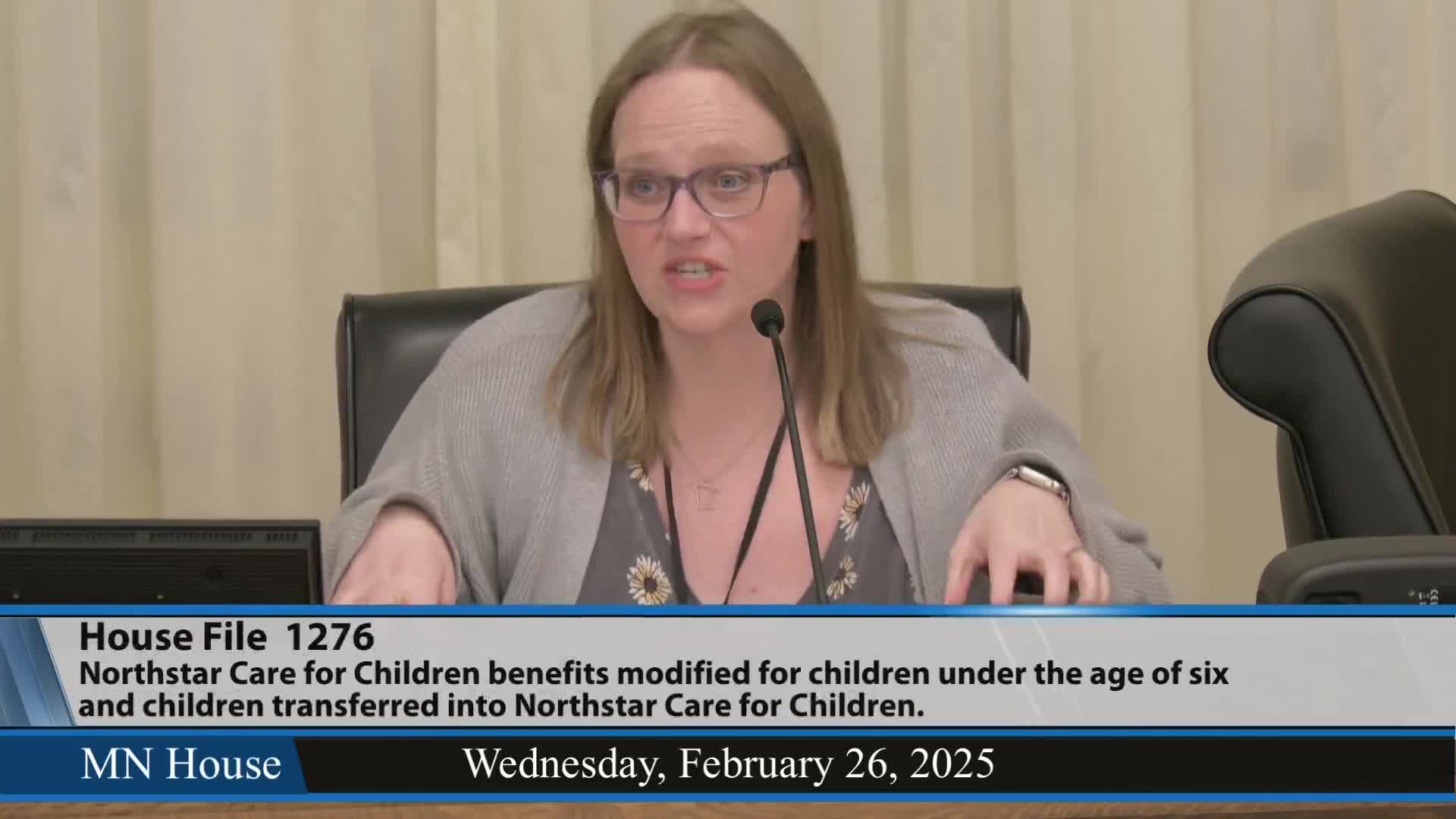
Rep. Hicks moved House File 12 76 to lay it over for possible inclusion; the bill would eliminate the Northstar preschool-entry alternate daily rate and provide equal kinship/adoption assistance to children who reach permanency before age 6.
Rep. Rep. Hicks moved House File 12 76 before the Children and Families Committee and asked members to lay it over for possible inclusion. The bill would eliminate the Northstar "preschool entry" alternate rate that currently provides lower financial assistance to relatives who finalize permanency for children younger than 6, equalizing payments regardless of the child's age at permanency.
"This bill eliminates that alternative rate for children who reach permanency with relatives ... to support family members to be able to get to yes," Rep. Hicks told the committee, describing the bill as a way to reduce financial barriers that sometimes delay permanency.
Multiple testifiers representing tribal-serving organizations, social workers and county liaisons described cases in which relatives or foster families delayed finalization until a child turned 6 so the household would receive the higher benefit. Sadie Hart, policy and advocacy director at the Enda Young Center, recounted a monitored case in which an uncle providing foster care "kept the child in foster care until she turns 6" rather than finalize permanency at a younger age because the full benefit only applied at age 6. Hart cited statistics included in materials: in 2023 there were 490 children waiting for adoption, 45% were sibling groups needing to be adopted together and 20% were children under age 6.
Witnesses cited research from the Upjohn Institute: full Northstar payments were associated with a 31% increase in average academic achievement three years after a foster-care episode began, a 29% greater chance of moving from foster care to adoption or kin guardianship and a reduction in time to permanency by about five months.
Rep. Hicks and testifying social workers described how the current payment structure can force relatives'many of whom did not plan to raise a child and who may be on fixed incomes'to choose between delaying permanency or placing children elsewhere. Representative discussion focused on fiscal trade-offs. The committee's fiscal analyst said the program base is "about $2.20 something million" for the referenced budget line and that a formal fiscal note for the bill was pending. Department staff said Northstar's preschool-entry alternate rate was adopted originally for fiscal reasons when program funds were limited.
Members discussed whether federal funding streams (for example, Title IV-E, guardianship assistance or kinship navigator grants) could offset costs. A department representative and the fiscal analyst said Title IV-E and other federal grants are relevant but the amount of federal reimbursement for any particular change must be verified in a formal fiscal analysis; one committee staffer cited a federal guardianship assistance grant (reported in testimony as approximately $36 million per year) and a kinship-navigator grant (reported as roughly $1.5 million per year).
After testimony and member discussion, Rep. Hicks renewed her motion and House File 12 76 was laid over for possible inclusion in an omnibus bill. Committee members said they expect further fiscal analysis and department follow-up on how the change would be implemented and funded.