Get Full Government Meeting Transcripts, Videos, & Alerts Forever!
Get email alerts on the Childcare Regulation Modernization topic
No spam. Unsubscribe anytime.
DHS outlines child-care regulation modernization; providers urge faster rollout of risk-based system
Summary
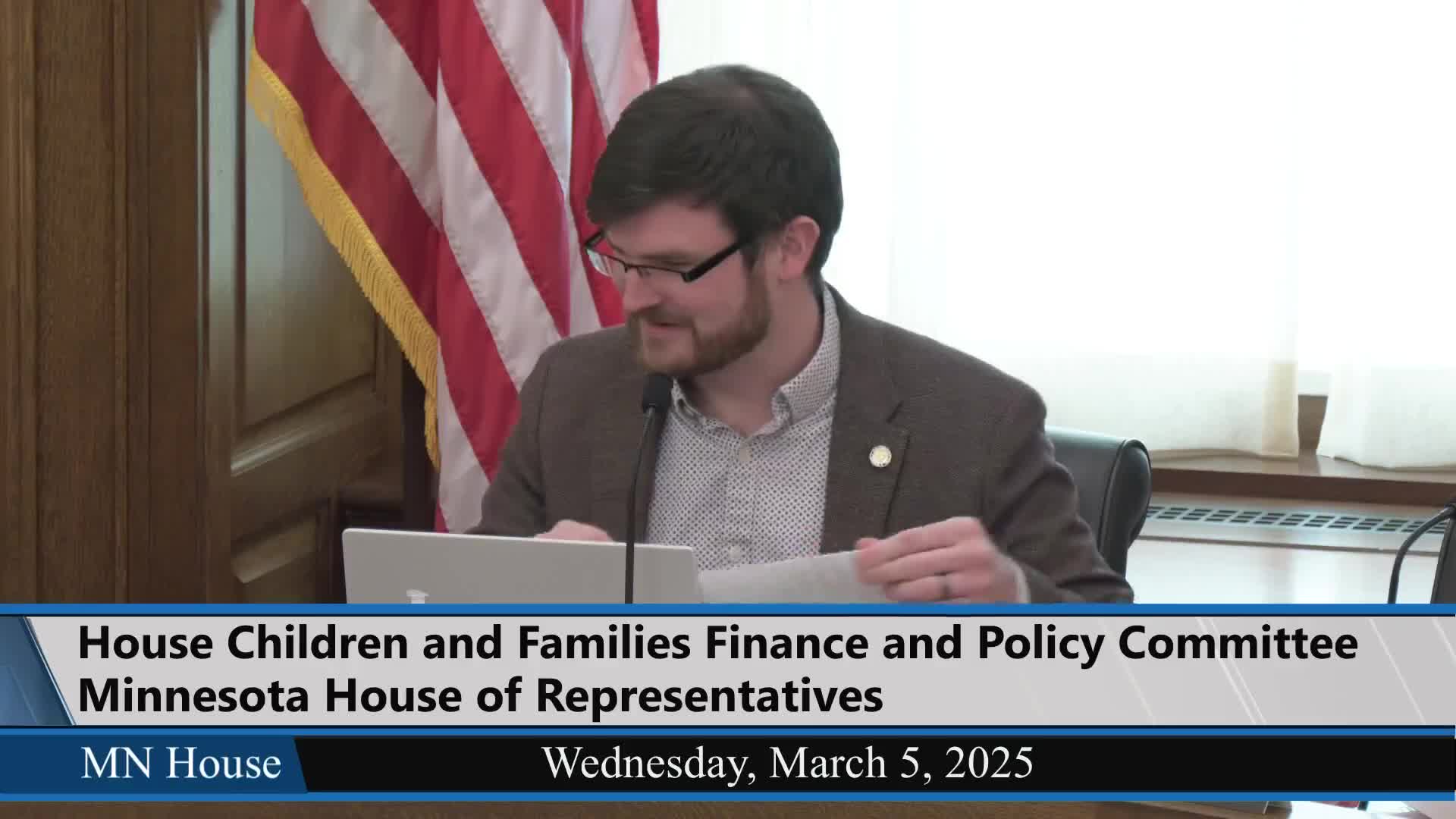
The Children and Families Finance and Policy Committee on an unspecified date heard a Department of Human Services presentation on a multi‑part childcare regulation modernization project that would add a weighted risk system, key‑indicator abbreviated inspections and revised licensing standards.
The Children and Families Finance and Policy Committee on an unspecified date heard a Department of Human Services presentation on a multi-part childcare regulation modernization project that would add a weighted risk system, a key‑indicator approach to abbreviated inspections, and revised licensing standards for family child care and child‑care centers.
The proposal comes from a 2021 legislative directive, and DHS staff told the committee the work is intended to focus licensing on the rules that most affect children’s health and safety while reducing burden for lower‑risk items. "This project came from the 2021 legislature directing the department to contract with the National Association of Regulatory Administrators," DHS manager Larry Hosch said as he introduced the initiative.
Why it matters: Committee members and provider groups said the risk‑weighting element is essential and urged DHS to implement that piece quickly. Providers say licensing records without context are already raising insurance premiums and threatening programs’ financial viability; DHS staff and advocates said revised standards and new inspection approaches could reduce unnecessary penalties and increase consistency across counties.
DHS summary of the plan DHS described three linked components: (1) a weighted risk system that scores regulations from roughly 1 (low) to 10 (high) based on potential harm to children, (2) a key‑indicator method to create abbreviated inspections for low‑risk providers, and (3) revised licensing standards drafted in two public versions so far.
DHS said it surveyed providers to develop the weighting: about 1,295 family‑childcare respondents and roughly 1,000 child‑care center respondents took part. Hosch cited examples to show the continuum for family child care: the lowest‑weighted item was a county‑of‑residence application filing (weight about 1.91); the highest was prohibiting staff alcohol or drug use while caring for children (about 9.52). For centers, the department said the average weight was about 6.72; the lowest example was posting a license conspicuously (about 2.67) and the highest was prohibiting corporal punishment and restraints (about 9.39).
Abbreviated inspections and federal constraints DHS said abbreviated annual inspections would inspect a reduced subset of standards for eligible programs (DHS cited a family‑childcare rule set of roughly 300 items that could be trimmed to under 100 for some visits), using four buckets to pick items: key indicators, all high‑risk rules, federally required rules (Child Care and Development Block Grant/CCDBG requirements), and five random items. DHS staff estimated more than half of providers could qualify for abbreviated inspections, with eligibility tied to licensing history, prior high‑risk violations, and any substantiated maltreatment findings.
Brandon Tice, a DHS project lead, noted a federal constraint: an unannounced licensing inspection is required annually under federal CCDBG rules, and DHS staff said the department is working with that requirement when designing abbreviated visits. Tice said the department plans a periodic full inspection cadence: providers would not be subject to perpetual abbreviated inspections and would face a full inspection at least every three years even if they otherwise qualify.
Revised licensing standards: examples of change DHS said the second draft of revised standards simplified or removed prescriptive items from the first draft. Examples the department highlighted: - Cleaning and documentation: the draft reduces prescriptive documentation and allows providers more discretion about cleaning products and processes. - Scents and pets: a blanket ban on scented products from draft 1 was removed in draft 2; pets language was clarified to prohibit animal waste in areas accessible to children rather than literally forbidding any animal hair. - Environmental testing: DHS removed a universal exposed‑soil lead‑testing requirement as impracticable for many rural sites, maintained water‑supply testing where appropriate, and kept a radon‑testing requirement. DHS said the draft would require an initial radon test within the first two years after a license is issued and then testing every five years thereafter. - Temperatures: draft 2 reverted family‑childcare heating standards to the current practice of a minimum of 62 degrees and no maximum temperature, rather than the draft 1 range of 68–82 degrees. - Family‑childcare license classes: draft 2 creates a new B3 license (replacing the previous class D) allowing up to 10 children — all of them under school age — where certain conditions are met; a revised C3 class would allow up to 18 children with limits on infants plus additional training and a satisfactory compliance history. - Play equipment, fall zones and fencing: draft 2 removes the strict fall‑material depths required in draft 1 and allows supervision safety plans in lieu of continuous fencing on large properties. - Documentation: DHS said it pared back documentation requirements tied to behavior guidance, children with special needs, and other health and safety recordkeeping.
Provider groups and family providers: calls for speed and clarity Minnesota Child Care Association government relations chair Claire Sanford and Think Small policy director Erica Moss both urged faster implementation of the weighted risk system and argued it would reduce disproportionate enforcement and help insurers assess providers’ true risk. "Licensing records are a key part of insurers' risk assessments and just like families, insurers don't want to go near a provider that leaves hazardous materials available to children with a 10 foot pole," Sanford told the committee.
Family‑childcare advocates said the process has been slow and that communication and translation of materials have been inconsistent. Cindy Cunningham, a long‑time Saint Paul family‑childcare provider and public‑policy chair for LeadingCare, said: "The heavy handedness of regulations, the poor communication with programs and the inconsistent implementation in the counties is what is driving many programs out of business." She and others urged more transparent engagement with providers before further drafts are finalized.
Other issues raised by committee members and DHS staff Committee members pressed DHS on several operational details: whether fines would be scaled to the weighted risk score (DHS said fines are currently limited to select safety violations and that further discussion with stakeholders would be required), how the risk scores would be published (DHS said the weights are expected to be public), and how abbreviated inspections would be triggered to convert to a full inspection (DHS said a failed abbreviated visit would flip to a full inspection and that functionality is tied to the department’s provider hub IT rollout).
On radon mitigation and cost, DHS said testing is relatively inexpensive but mitigation can be costly; staff said they expect to continue gathering stakeholder feedback and that any legislative proposal could consider resources to help providers mitigate radon if required. DHS cited collaboration with the Minnesota Department of Health on radon guidance and said the department follows that agency’s thresholds and recommendations.
What the committee decided The committee adopted the meeting minutes for March 4 by voice vote at the start of the session; Vice Chair Nelson moved approval and committee members indicated the motion prevailed.
Next steps DHS told the committee draft 2 is not a final proposal; staff said additional stakeholder engagement will continue into the summer and early fall as they revise a third draft and work toward implementation. DHS repeatedly stressed that the weighted risk system and abbreviated inspections rely on IT functionality in the provider hub and other checklist systems before the department can roll those pieces out.
The committee heard testimony from DHS, provider organizations, and family providers and encouraged DHS to provide clarifying materials and a timeline for IT and implementation updates to the committee in writing.