Get Full Government Meeting Transcripts, Videos, & Alerts Forever!
Get email alerts on the Ssis Modernization topic
No spam. Unsubscribe anytime.
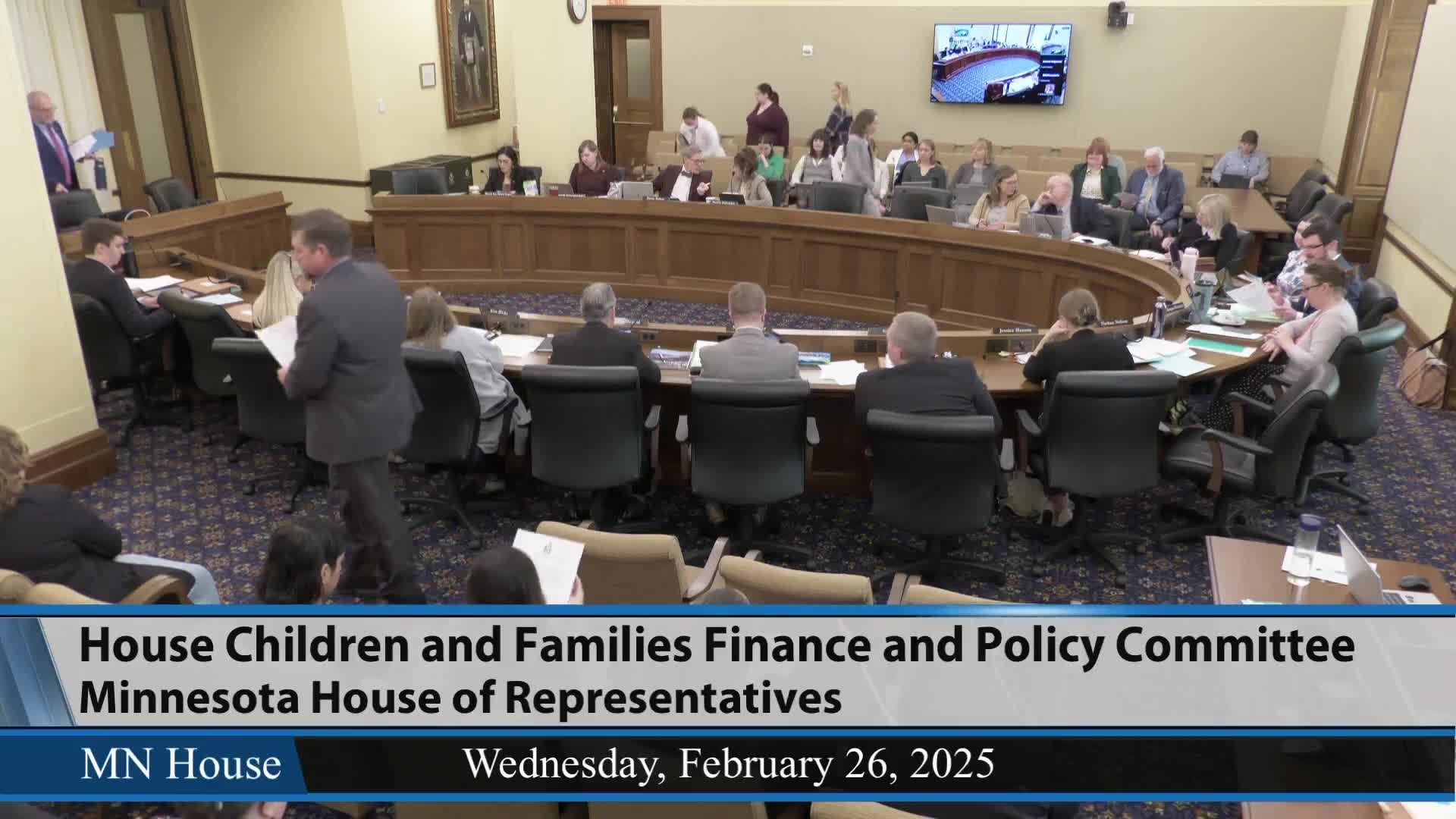
Committee hears plan to modernize SSIS; House File 1169 laid over
Summary
Vice Chair Nelson moved to lay over House File 1169, a proposal to modernize the Social Services Information System (SSIS) and reduce paperwork burdens on county caseworkers. Testimony described decades-old technology, large reporting volumes, a review with 56 recommendations and an interim web tool to halve a major document.
Vice Chair Rep. Nelson moved House File 1169 before the Children and Families Committee and asked the panel to "lay it over" for possible inclusion in an omnibus bill, outlining the measure as part of an ongoing effort to modernize the state's Social Services Information System (SSIS). The motion to lay over was approved for possible inclusion.
County and state officials told the committee that SSIS, a case-management system developed about 30 years ago, has accrued new documentation requirements over time and now imposes heavy administrative burdens on caseworkers. Anne Broscoff, director of human services for Brown County, testified on behalf of the Minnesota Association of Social Service Administrators (MACSSA): "Pieces of paper and clicks in SSIS don't keep kids safe," she said, arguing that time spent on documentation reduces direct work with families.
Cynthia Schapolski, CCWIS modernization supervisor at the Department of Children, Youth and Families' SSIS section, gave a technical update. She said SSIS supports statewide child welfare work that includes roughly 76,000 reports of alleged abuse or neglect annually, about 32,000 child-protection assessments and child-protection case management for roughly 4,500 families; the system also supports approximately 4,400 children who experience out-of-home placement each year. A 2024 review produced 56 recommendations to reduce paperwork; staff have completed nine, five are actively in progress, and 16 were judged feasible to pursue before a broader modernization.
Schapolski described usability and performance problems: slow interfaces, lack of autosave, confusing document workflows and difficulty exchanging data with courts and education systems. As an interim fix, she said the department will release a secure web-based tool to streamline the out-of-home placement plan, a document long criticized by counties; the interim tool will halve the plan's length and produce a one-page printable summary.
Members and testifiers emphasized the need for funding and a collaborative governance model with counties. Vice Chair Nelson said part of the project could qualify for federal matching dollars and that final costs are pending vendor proposals. Representatives, county officials and department staff discussed dependencies with other state systems (for example, MAXIS and MMIS) and the need for secure, bidirectional data exchanges with courts and education systems.
After the public testimony and member discussion, Rep. Nelson renewed his motion to lay House File 11 69 over for possible inclusion in an omnibus bill; the committee approved the motion. The committee scheduled additional modernization discussions and indicated further hearings that will focus on funding pathways and implementation timelines.