Get Full Government Meeting Transcripts, Videos, & Alerts Forever!
Get email alerts on the Inspector General Consolidation topic
No spam. Unsubscribe anytime.
Committee advances bill to create legislative Office of Inspector General after hours of questions on scope and federal funding
Summary
Representative Patty Anderson introduced House File 1, a proposal to create an independent Office of Inspector General (OIG) within the legislative branch and to consolidate several agency OIG functions under that office.
Representative Patty Anderson introduced House File 1, a proposal to create an independent Office of Inspector General (OIG) within the legislative branch and to consolidate multiple existing agency OIG functions under that office.
Anderson said the office would be overseen by the Legislative Audit Commission and charged with investigating fraud and “misuse” of public funds, running a fraud-reporting hotline, conducting unannounced monitoring and referring suspected crimes to law enforcement. “House file 1 is a bill that establishes, an office, an independent office of inspector general, within the legislative branch,” Anderson told the committee.
Supporters and agency officials said the bill aims to centralize investigatory knowledge and avoid siloing across agencies. Elise Bailey, budget director at the Department of Human Services, told committee members the DHS Office of Inspector General employs roughly 487 people overall and that the department’s program-integrity oversight unit is about 99 employees. “Our whole office of Inspector General has about 487 employees. However, if we're just talking about our program integrity oversight unit, it's 99 employees,” Bailey said.
Union representatives and some members raised concerns about worker rights and legal limits. Devin Bruce, director of legislative and political affairs for the Minnesota Association of Professional Employees (MAPE), said moving executive-branch OIG staff into the legislative branch could strip those employees of collective-bargaining protections under Minnesota Statutes chapter 179A. “We believe that all workers deserve to have the right to collectively bargain and negotiate fair terms and conditions of their employment,” Bruce testified.
Members pressed on operational details: whether the consolidated OIG would have prosecutorial authority (Anderson said it would not; referrals would go to counties, the Bureau of Criminal Apprehension or the attorney general), how the office would avoid duplicating investigators who must remain in agencies to meet federal requirements, and how long transfers would take. Anderson said some agency functions would remain inside agencies where federal rules require them and that transfers would not occur until the inspector general certifies readiness to assume duties.
Lawmakers also asked about the bill’s effect on federal funding and the timeline for staffing and data transfers. Nonpartisan staff pointed to language in the draft that exempts certain DHS positions from transfer and noted that transfers would not occur until the new inspector general certifies in writing that the office is ready to assume responsibilities. Members repeatedly requested documentation that the bill would not jeopardize federal matching dollars.
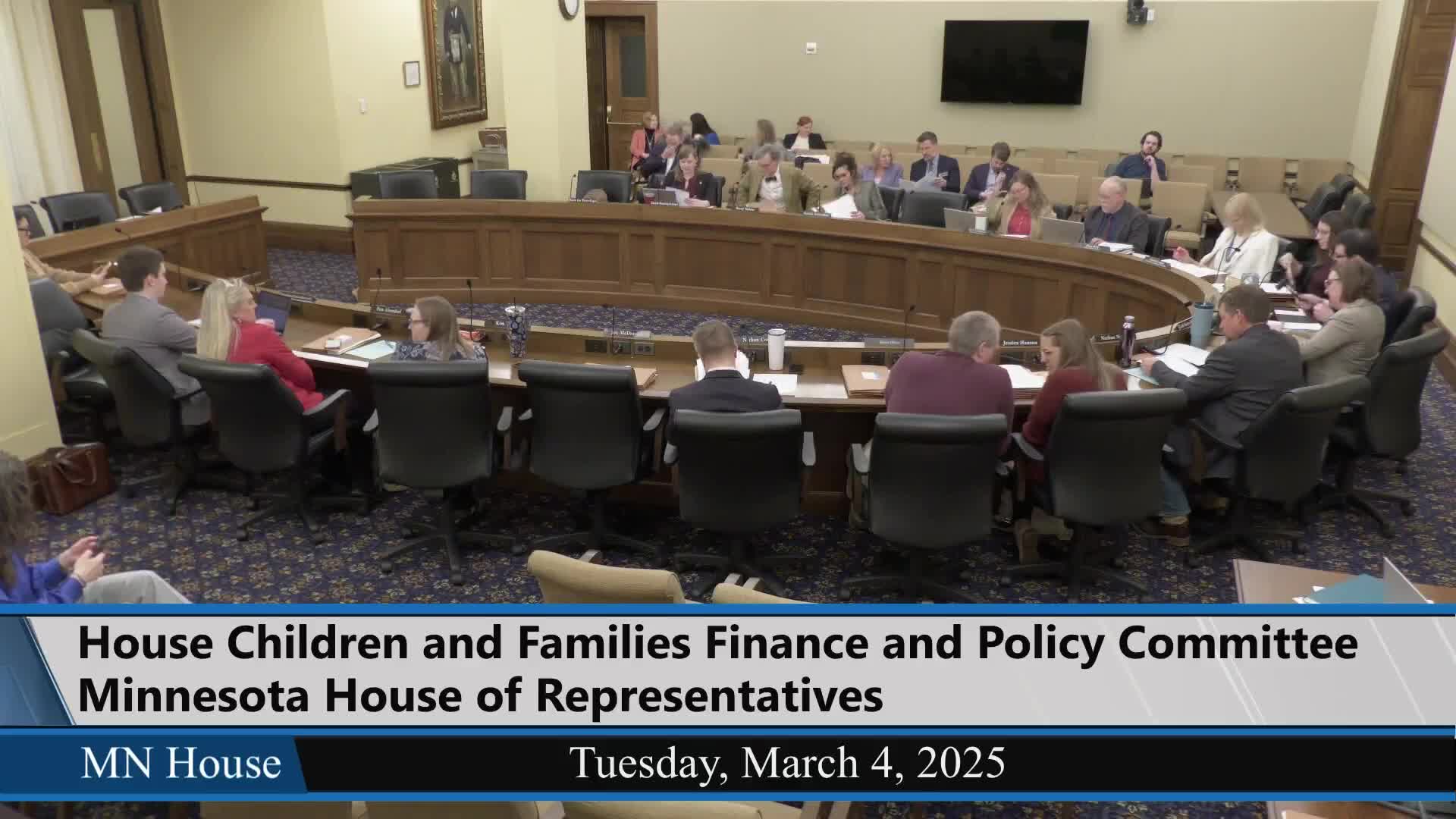
After more than an hour of questions and public testimony, the committee voted to re-refer House File 1 to the Committee on State Government Finance. Representative West renewed the motion to refer; the motion prevailed and the bill was sent on for further consideration.
The committee discussion left several items for follow-up: nonpartisan staff and the sponsor were asked to provide explicit documentation on which DHS and other agency positions would remain in the executive branch to preserve federal compliance, and to supply estimates of staffing, IT and transition costs before final consideration in later committees.