Get Full Government Meeting Transcripts, Videos, & Alerts Forever!
Get email alerts on the Childcare Licensing And Enforcement topic
No spam. Unsubscribe anytime.
DHS outlines licensing rules, enforcement tools and modernization plan after parent’s abuse testimony
Summary
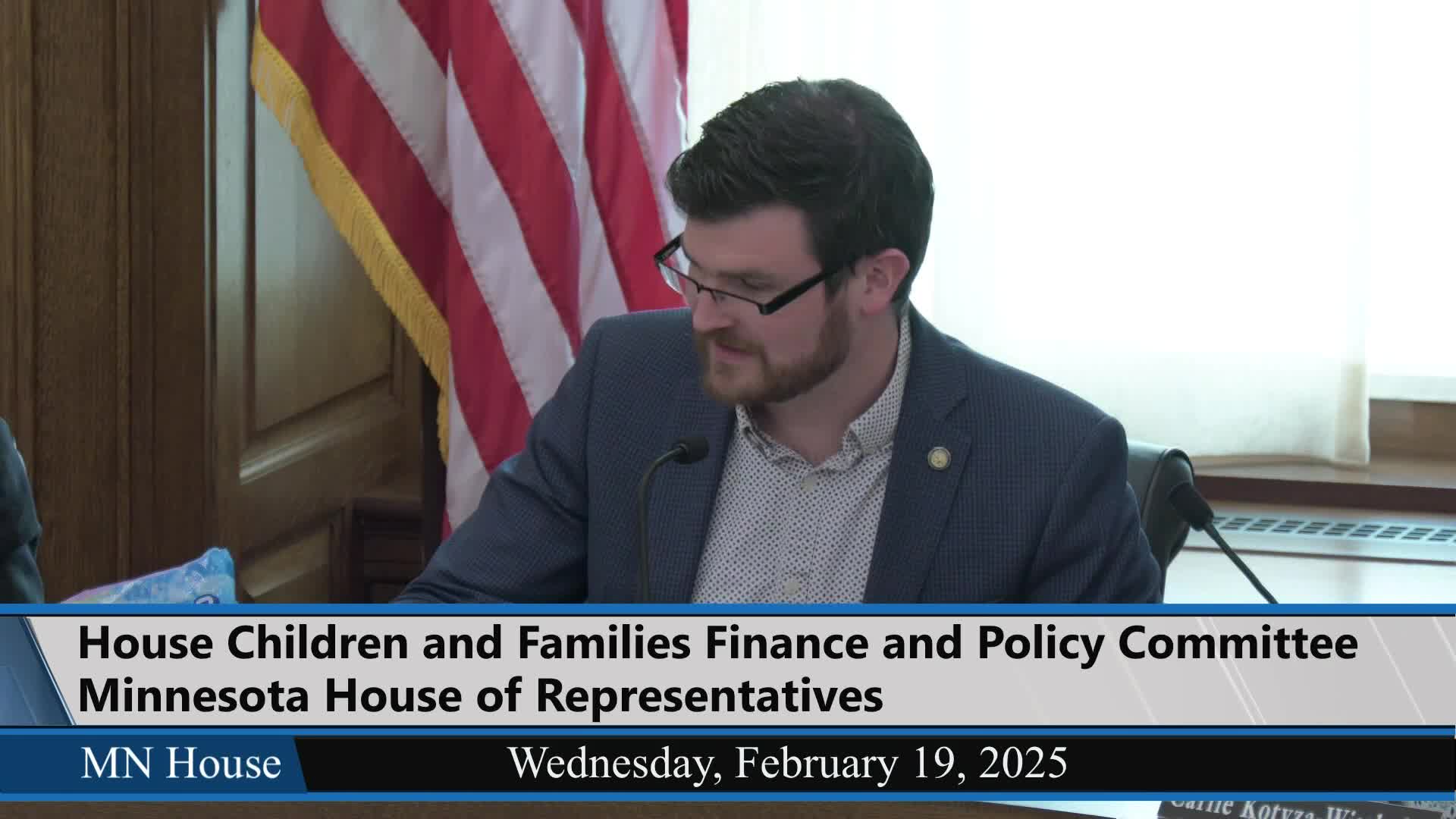
Department of Human Services staff briefed the Children and Families Finance and Policy Committee on Minnesota’s child care licensing structure, enforcement options, background checks and a multi-part modernization project, after a parent described alleged abuse at a private center.
DHS told the Children and Families Finance and Policy Committee on Tuesday that state and county licensors use a tiered mix of inspections, correction orders, fines and, in the most serious cases, license suspensions or revocations to protect children in licensed care. The briefing came after parent Joshua Truax described video he said showed his 3‑year‑old being physically and emotionally mistreated at Little Explorer's Plymouth Academy.
The presentation and public testimony framed the committee’s review of licensing standards, enforcement mechanisms and a multi-component modernization project that DHS said is intended to focus inspection resources on higher‑risk standards while reducing administrative burden for consistently compliant providers. "In general, the baseline of what we do in licensing is to ensure that programs can meet a minimum level of health and safety standards to ensure the well‑being of children and vulnerable adults in care," said Alyssa Dodson, Deputy Inspector General for the Licensing Division at the Department of Human Services (DHS). Dodson described how DHS and counties share licensing responsibilities and how sanctions range from 48‑hour “fix‑it” compliance items to fines, conditional licenses, immediate suspensions and revocations.
Why it matters: the committee is weighing policy and oversight changes amid provider shortages and high public concern after the parent’s account. Joshua Truax told the committee his son "was innocently drumming in the corner" when, he said, a teacher "picked him up, slammed him into a chair, aggressively pushed him into a table" and removed his drumsticks; Truax said the video went viral and urged stricter oversight and consequences. His testimony prefaced detailed DHS explanations of inspection frequency, complaint intake, and the planned revisions to licensing standards for family child care and center‑based programs.
DHS gave specifics on current practice and numbers. Dodson said Minnesota had 1,791 licensed centers and 5,756 licensed family child care providers as of February 2025. Federal Child Care and Development Fund (CCDF/CCDBG) rules require annual unannounced visits; DHS licensors vary visit times by season and program schedule and said they also operate an "early and often" unit that conducts four visits in a new center’s first year (one announced technical assistance visit followed by three unannounced visits). Dodson said the department evaluates violations by "nature, severity and chronicity" to decide corrective steps and that fines for maltreatment can be $1,000 or $5,000 depending on statutory criteria, with family child care fines statutorily set at $1,000.
DHS also described a multi‑part modernization plan that includes: (1) a weighted‑risk system to classify standards by risk to child safety and direct enforcement accordingly; (2) abbreviated inspections for providers that meet key compliance indicators to reduce time licensors spend onsite; and (3) a revision of family child care licensing standards developed with the National Association for Regulatory Administrators (NARA). Dodson said a second draft of revised standards was released on Feb. 13 and that further drafts and stakeholder engagement would continue through the summer; she said licensing functions for children currently at DHS will move to the Department of Children, Youth, and Families (DCYF) in June, though county‑delegated licensors will remain with counties.
On background checks, Dawn Davis, Deputy Inspector General for the Background Studies Division, described the statewide NETStudy 2 process: applicants consent electronically, are fingerprinted via the vendor IDEMIA, and DHS reviews criminal and maltreatment records (including interstate checks) before issuing determinations. Davis said DHS performed roughly 538,000 background study applications in calendar year 2024 across many program types and that 73,556 (about 14%) were for child care providers. She said disqualifying offenses are defined in Minnesota statute (chapter 245C) and include maltreatment, physical assault, murder, criminal sexual conduct and theft; many disqualifications are time‑limited while some are permanent.
Members pressed DHS on how licensing and program‑integrity investigations intersect with CCAP (Child Care Assistance Program) payments. Dodson said licensing violations alone do not automatically trigger a stop to CCAP payments; payments are stopped when program‑integrity investigations find evidence that meets the program’s threshold for fraud or other reportable grounds. DHS’s CCAP investigations team — Dodson said it has four investigators currently — has recovered about $2.4 million since 2020 and referred an average of five cases per year to law enforcement since 2021; she said roughly 20% of program‑integrity investigations lead to criminal referrals, with the remainder typically administrative matters or billing errors that can still require repayment.
Committee action: Vice Chair Hanson moved to approve the committee minutes from Feb. 18; the motion was adopted without recorded opposition. No legislative action or new rules were adopted during the hearing; DHS said its revised licensing standard drafts and engagement plans will proceed and that additional oversight and technical assistance options are under consideration.
The committee asked DHS for follow‑up materials — including more detail on how program‑integrity investigators verify attendance and when CCAP payments are withheld — and DHS agreed to provide written answers. Dodson said DHS is studying trends in provider exits and evaluating alternate licensing models (including "special family child care" or umbrella arrangements) to support smaller or group settings and potentially reduce cost and administrative burden.
A parent’s testimony about alleged abuse at Little Explorer's Plymouth Academy set the tone for the hearing and underscored the committee's stated objective to balance provider viability with child safety as DHS pursues revised rules and inspection priorities.