Get Full Government Meeting Transcripts, Videos, & Alerts Forever!
Get email alerts on the Family Childcare Capacity topic
No spam. Unsubscribe anytime.
Committee advances bill to raise family‑childcare capacity from 10 to 12 and allow two caregiver‑children exemptions; bill laid over
Summary
The committee amended and laid over House File 655, a bill to raise family‑childcare capacity from 10 to 12 and to exempt up to two of a provider’s own children from licensed capacity counts.
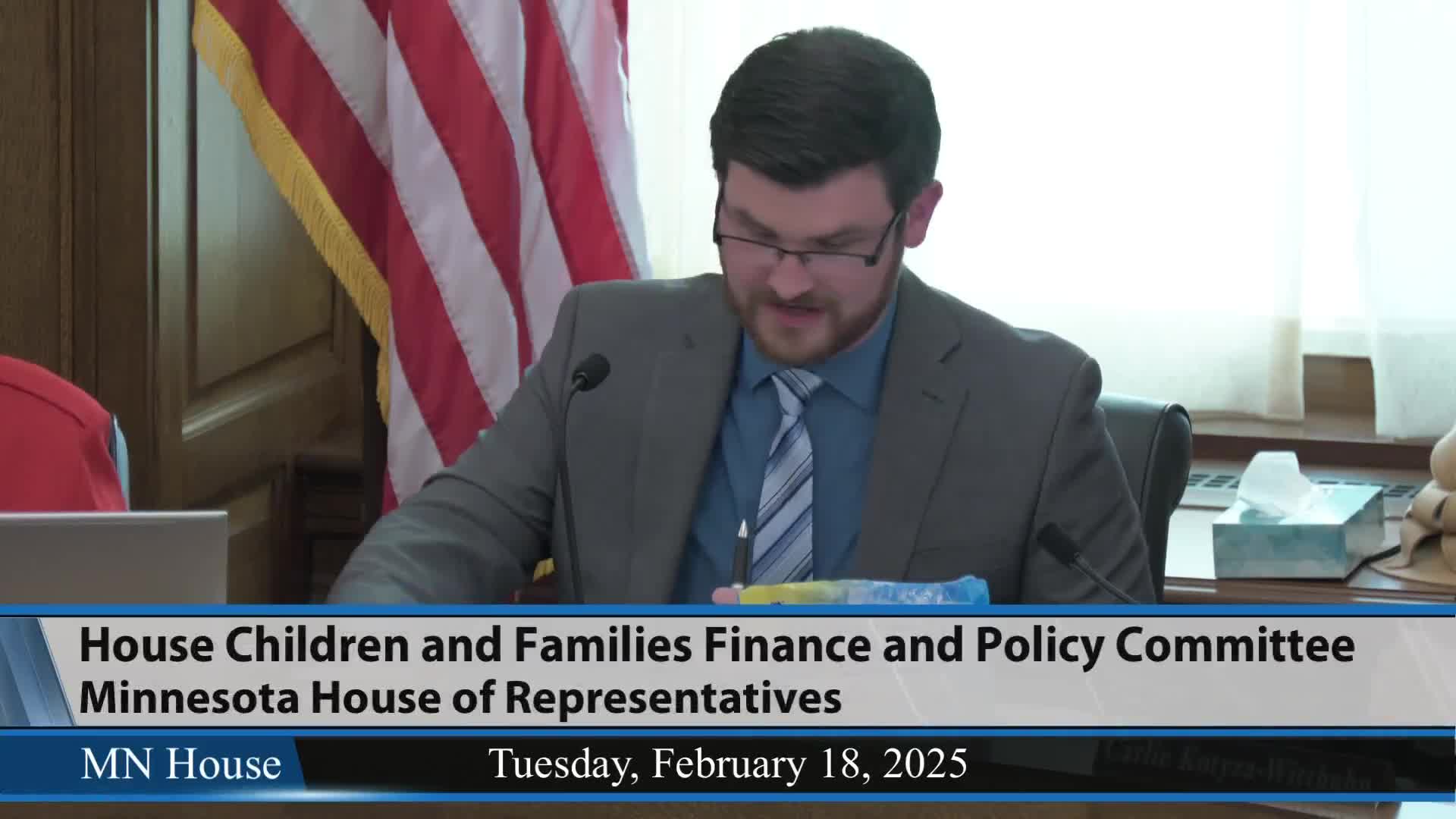
The House Committee on Children, Youth and Families on Tuesday amended and laid over House File 655, a bill from Representative Zalesnikar that would raise the maximum licensed capacity for family childcare providers from 10 to 12 children and exempt up to two of a caregiver’s own children from the licensed capacity count.
Representative Zalesnikar said the change would preserve flexibility for providers who operate outside center schedules — nights, weekends, summers and school breaks — and would help fill gaps when centers in a community are full. "Many of the facilities that run 24 hours a day…use family child care models," she said, describing situations where family providers are the only option for certain shift‑work schedules.
Leading Care Public Policy chair Cindy Cunningham testified in support, speaking from 27 years as a family childcare provider. Cunningham described how a provider’s own children are counted in licensing ratios until age 11 and said that counting those children reduces the provider’s income potential. "Financial success of the business means optimizing income and limiting expenses...We're looking at easily $1,200 a month just for two children of income that we can't realize," she told the committee.
The committee adopted an amendment (A1, as orally amended) that refines the bill language to clarify that the exemption applies to up to two of the caregiver’s own children and to emphasize availability for before‑and‑after‑school care. Members asked for further detail from DHS on how the licensing process would treat the exemption in practice, and whether site visits, reporting requirements or other safeguards would be used to prevent fraud and to ensure safety.
Members raised safety and historical fraud concerns. Representative Hemmingson Yeager cited earlier CCAP fraud cases and asked whether loosening ratio rules could create opportunities for billing abuse; sponsors and supporters said licensing, reporting and on‑site inspections remain in place and that existing accountability mechanisms should address misuse.
Representative Zalesnikar said she will continue to work with DHS and committee members to refine language and implementation details, and the committee laid the bill over for possible inclusion in a later omnibus bill.