Get Full Government Meeting Transcripts, Videos, & Alerts Forever!
Get email alerts on the Childcare Staffing topic
No spam. Unsubscribe anytime.
Committee advances bill to make temporary childcare aide supervision flexibility permanent
Summary
The Committee of Children and Families Finance and Policy adopted a DE1 amendment and voted to refer House File 1247 to the General Register. The bill would remove a July 2025 sunset and allow classroom aides to supervise children independently for up to 25% of the day under existing guardrails.
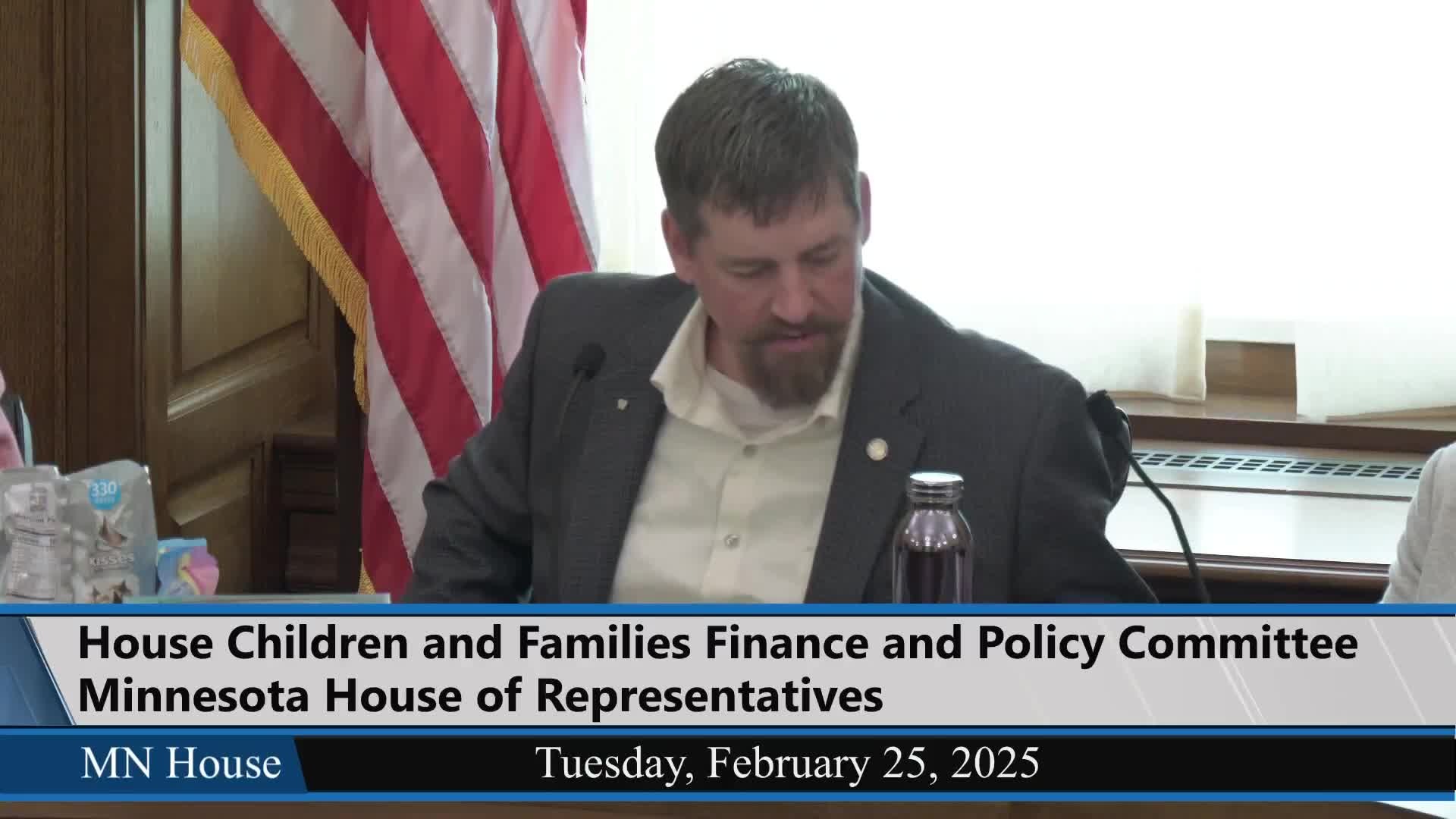
House File 1247, carried by Representative Nadeau, was amended and advanced out of the Committee of Children and Families Finance and Policy Wednesday, sending the bill to the General Register.
The bill would make permanent a temporary change enacted in 2023 that allows classroom aides to supervise children independently for up to 25 percent of the day. Representative Nadeau said the language ‘‘removes that sunset’’ that otherwise would have ended the flexibility in July 2025 and that the Department of Human Services ‘‘was asked if this flexibility had created any data related to negative health or safety impacts in the 18 months that it’s been in effect, and the answer was no.’’
The DE1 amendment was moved into the bill at the committee hearing and adopted on a voice vote. Darielle Danan, contract lobbyist for the Minnesota Childcare Association, described the measure as continuing existing law with guardrails and stressed training and tenure requirements already included when the change first passed in 2023. Danan said aides serving in solo supervisory capacity must be at least 18 years old, must have worked for the program a minimum of 30 days, and that aides employed for less than 90 days must complete required licensing training within their first 90 days.
Owner-operators who testified said preserving the flexibility helps manage staffing shortages without harming safety. ‘‘Without it, we will face increased staff burnout, higher turnover rates, and operational challenges that directly affect the quality of our childcare programs,’’ said Jen Orth, owner of High Point Child Care, who described using the flexibility to schedule fully qualified teachers during core learning hours while aides cover transitional times.
Representative Dose moved that House File 1247, as amended, be referred to the General Register; the motion carried on a voice vote. The committee recorded the outcome as approved by voice vote; individual roll-call tallies were not specified in the transcript.
The bill’s sponsors and supporters said there is no fiscal impact to the state and that the change provides programmatic flexibility that helped centers manage staffing since the 2023 pilot. Opponents did not register concerns during the committee hearing recorded in this transcript.
If enacted, the change would preserve the current guardrails and allow centers to continue scheduling aides and teachers under the same temporary framework without a July 2025 sunset.
Votes at a glance: House File 1247 (DE1 adopted; referred to General Register by voice vote).