Get Full Government Meeting Transcripts, Videos, & Alerts Forever!
Get email alerts on the Snap Outreach topic
No spam. Unsubscribe anytime.
Committee adopts A1 to reduce SNAP outreach appropriation; HF 45 laid over for omnibus consideration
Summary
The committee adopted an A1 amendment that reduces the proposed appropriation for the state SNAP outreach grant program from $1,000,000 to $500,000 per fiscal year and laid House File 45 over for possible inclusion in an omnibus bill while proponents urged restoring outreach funding to prevent a funding cliff.
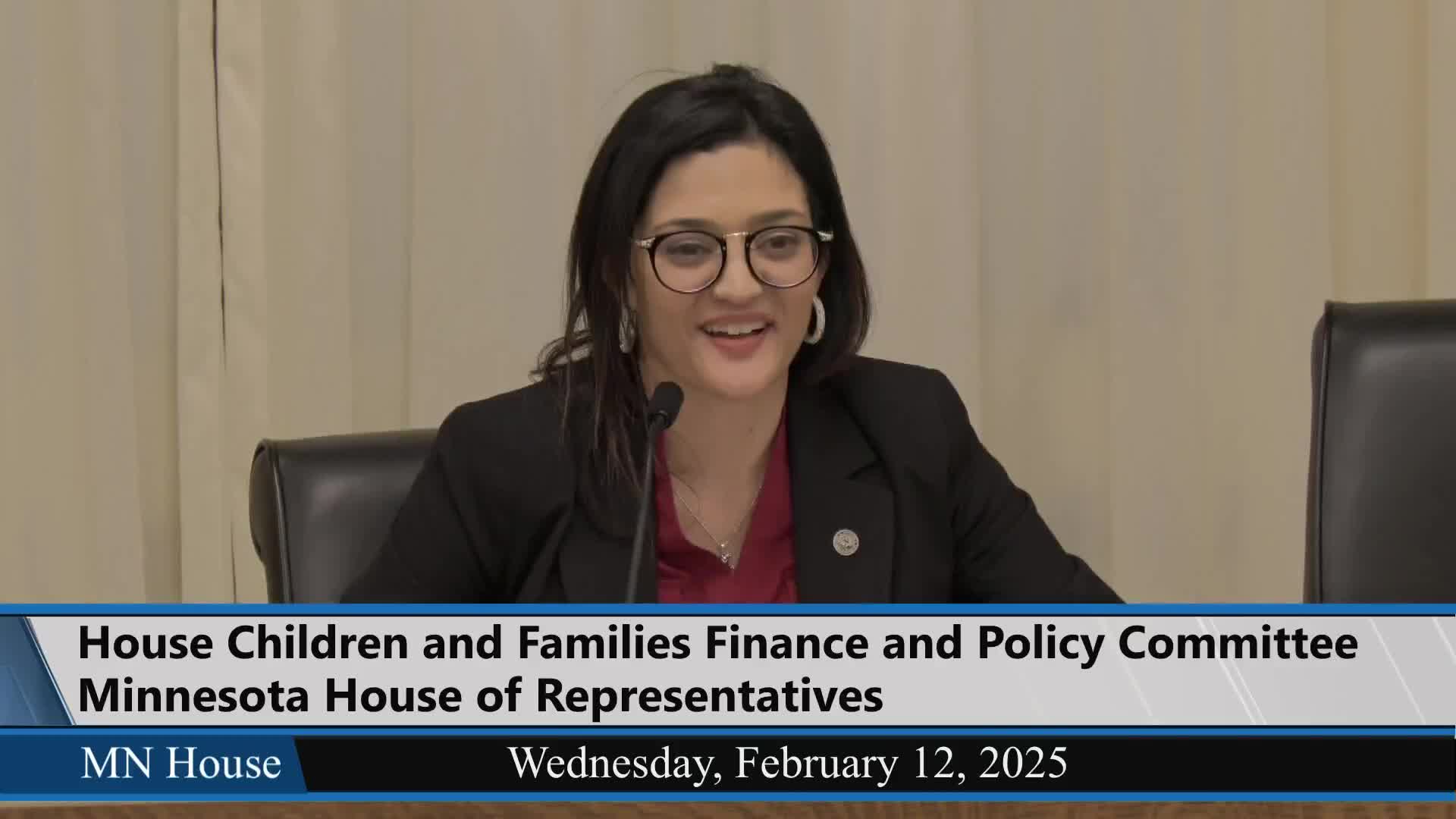
The Committee on Children and Families on Feb. 11 considered House File 45, a bill to restore funding for Minnesota’s Supplemental Nutrition Assistance Program (SNAP) outreach grants. Representative Pérez Vega offered an A1 amendment that reduced the appropriation from $1,000,000 to $500,000 per fiscal year; the committee adopted the A1 amendment and laid the bill over for possible inclusion in an omnibus bill.
Why it matters: SNAP outreach organizations told the committee that outreach increases program participation and brings federal dollars into local grocery stores and markets. Witnesses said Minnesota’s SNAP participation lags peer states and that ending outreach funding would create a cliff for grantees that help residents complete complex applications and follow‑up documentation.
Representative Pérez Vega moved HF 45 with an A1 that "modifies the bill’s appropriation from $1,000,000 to $500,000 per fiscal year." Mesa Sebert, Neighbor Services Outreach Manager at Second Harvest Heartland, testified the program supports 29 outreach grantees covering all 87 counties and that in 2024 her team handled more than 200 outreach events and assisted "8,500 plus Minnesotans with SNAP." Sebert said Minnesota ranks lower than many states in SNAP participation and called outreach the most efficient anti‑hunger investment: "For every 1 meal our food bank provides, SNAP can provide 9."
Janet Grama, president and CEO of Neighborhood House, told the committee her organization has a dedicated SNAP navigator and said Neighborhood House distributed 47% more food in the current program year than the previous year, describing a rising need in her community. Yvette Risa Martinez of Greater Twin Cities United Way cited a 57% increase over three years in 211 referrals related to food and said 2,000 of 2024 referrals came from outside the Twin Cities metro area.
Representative McDonald asked why the author reduced the appropriation; Representative Pérez Vega described the change as a budget‑conscious compromise to preserve outreach while acknowledging statewide fiscal constraints and noted a federal match possibility was available. Representative Ngo and others questioned whether outreach funding was the highest priority versus direct food support; witnesses said outreach generates access to ongoing federal benefits that have longer‑term impact and are spent locally.
The committee adopted the A1 amendment by voice vote and the chair laid the bill over for possible inclusion in an omnibus bill. No final appropriation was enacted by the committee; members said they plan to consider the measure further in the budget and omnibus process.