Get Full Government Meeting Transcripts, Videos, & Alerts Forever!
Get email alerts on the Department Creation Program Transfers topic
No spam. Unsubscribe anytime.
New Department of Children, Youth and Families outlines transfers, budget and plans to strengthen program integrity
Summary
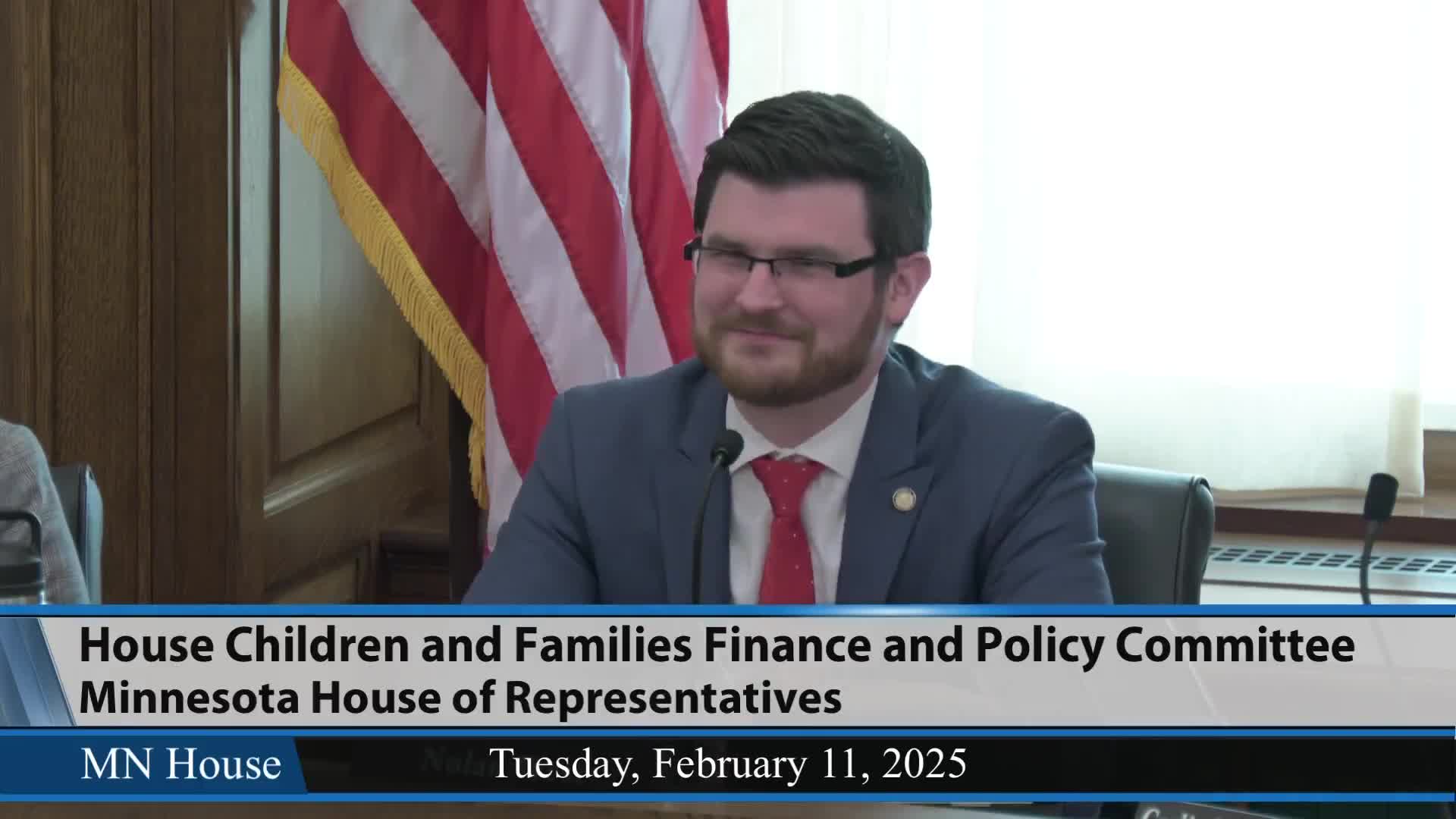
Commissioner Tiki Brown, commissioner of the Department of Children, Youth and Families, told the House Children and Families Committee that the new agency launched July 1 to centralize child- and family‑focused programs and improve access to services across Minnesota.
Commissioner Tiki Brown, commissioner of the Department of Children, Youth and Families, told the House Children and Families Committee that the new agency launched July 1 to centralize child- and family‑focused programs and improve access to services across Minnesota.
"We launched a new agency to create a sustainable public face for children's issues in state government with aligned outcomes and policy, improving the front door for services, easing access and navigation for families," Commissioner Brown said.
The presentation outlined why the department was formed and what it now houses: early learning services moved from the Department of Education in July; core child welfare functions and related Office of Inspector General (OIG) responsibilities moved from the Department of Human Services (DHS) in phases; Help Me Connect moved from the Department of Health in January; and a larger set of functions — including the remainder of the DHS OIG, youth-justice functions from the Department of Public Safety, and remaining DHS central operating staff — are scheduled to transfer in June.
"When fully implemented the agency will include programs from four different agencies," Brown said, describing four internal administrations for children and family services, early childhood, economic opportunity and youth services, and family well‑being.
Why it matters: DCYF will be one of Minnesota's largest state agencies by budget and will administer major federal and state safety‑net programs. Committee members pressed for details about program-integrity controls, childcare oversight after recent media reporting on provider violations, the aging SSIS case-management system, and the risk posed by potential federal funding pauses.
Budget and scale
Ashley Reisenhower, chief financial officer for DCYF, told the committee that the agency's projected expenditures are about $3,700,000,000 per year and that federal funding accounts for roughly two‑thirds of that total.
"DCYF's total expenditures are projected to be about $3,700,000,000 per year," Reisenhower said. She said the state general fund represents about $1,000,000,000 of that total and other funds about $290,000,000. DCYF also oversees roughly $1,000,000,000 in technical and fiduciary funds, including about $640,000,000 related to child‑support payments.
Reisenhower said grants account for about $2,400,000,000 of annual spending and that DCYF will administer several forecast programs — including cash assistance, adoption and kinship assistance, and childcare supports — that together account for roughly $1,100,000,000 in spending. She said, when fully staffed, DCYF will have about 900 to 1,000 full‑time equivalent positions and that about 99.7% of the agency's budget and staff transferred from originating agencies under the implementation legislation.
Program transfers and timeline
Commissioner Brown and staff provided a timeline of staged transfers: early learning and core children and family services in July; additional central operating functions in October; Help Me Connect in January; and the largest remaining transfers in June (including the DHS Office of Inspector General functions related to licensing and program integrity).
Brown said one statutory condition governs the after‑school community grant program: that program will transfer only if additional funding is appropriated; otherwise it remains at the Department of Education with grant funding through 2027.
Program integrity and the Office of Inspector General
Brown said licensing and program integrity work currently at DHS — including investigations of childcare provider fraud and audits of childcare grants — will move to DCYF in June. She described the OIG's usual investigative path: tips and data analysis lead to audits or investigations, administrative remedies (warnings, recoupment, suspensions) and referrals of suspected criminal conduct to law enforcement partners such as the Bureau of Criminal Apprehension.
"If an audit reveals that a provider did not qualify for the grant, OIG will recoup that funding. If an audit reveals that there has been suspected fraud, the case is then referred to law enforcement," Commissioner Brown said.
Brown said DCYF's inspector general position starts the day after the committee hearing and will work with DHS on knowledge transfer ahead of the June move.
Several lawmakers sought details about ongoing investigations and high‑profile reporting. State Representative Joe McDonald asked whether recent investigative finds — including one provider reported to have numerous violations and millions in questioned payments — were missed because of the transfer process. Brown said the investigations remained DHS work at present and that the transition had not interrupted current investigative functions.
Childcare programs, payments and provider supports
Assistant Commissioner Diane Halsey (Early Childhood) described statewide efforts to stabilize and grow the child‑care workforce and supply. She highlighted the Great Start Compensation and Payment Program and a "Grow Your Own" workforce pipeline as existing tools intended to boost provider compensation and recruitment.
"The purpose of the money is to help to increase the compensation of child care providers, which we know are often woefully underpaid," Halsey said of the Great Start program.
Reisenhower said Great Start and other programs are significant line items: the Great Start compensation program was shown in the agency's materials as roughly $176,000,000 in fiscal 2026 and noted it supports roughly 6,000 child‑care providers; early learning scholarships serve more than 10,000 children; and the SSIS child‑welfare modernization planning had multiyear appropriations.
Committee members repeatedly raised closures of family‑childcare homes and center shutdowns in Greater Minnesota and suburbs, asking for new or accelerated policy responses and for more data on how grant payments are being distributed. Committee members also asked for transparency on payments to individual providers; DCYF staff said they have provided available data but plan to propose policy changes to increase transparency while working with providers concerned about public release of payment data.
Information systems and SSIS modernization
Brown and staff described the Social Services Information System (SSIS) — built on 1980s and 1990s technology — as a critical weakness that causes downtime and consumes worker time. Committee members emphasized the operational impact on county social‑service staff and asked about federal matching for modernization work. Reisenhower said SSIS planning includes an expected federal match (historically about 50%), and Brown said the department has received appropriations and planning investments and is pursuing incremental modernization while planning a longer‑term replacement.
Federal funding risk
Representative Nathan Coulter asked how a potential federal funding pause might affect DCYF programs. Brown said DCYF had not experienced a pause and was monitoring federal developments and staying in contact with federal partners. She stressed that many DCYF programs — including SNAP, foster care and adoption assistance, and some childcare funding — rely heavily on federal dollars and that any federal action would risk services for large numbers of Minnesotans.
Requests, follow‑up and next steps
Committee members asked for additional data and follow up: counts and outcomes of fraud referrals and investigations; itemized reporting on Great Start compensation recipients; and more detail on staffing changes caused by the agency realignment. Staff said the new inspector general would coordinate handoffs with DHS and that DCYF would provide additional information requested by the committee.
The committee spent most of its time questioning agency leadership after a compact presentation; no formal votes or motions were recorded during this session. The committee adjourned after asking DCYF to return with requested data on program integrity audits, payments and SSIS modernization plans.
Ending
Commissioner Brown told members that DCYF's priority is to avoid breaks in service during transfers and to improve outcomes for children and families statewide. The inspector general position was expected to begin work immediately and the department said it would continue coordination with DHS, the Department of Education and the Department of Public Safety as remaining functions transfer in June.