Get Full Government Meeting Transcripts, Videos, & Alerts Forever!
Get email alerts on the Parental Rights topic
No spam. Unsubscribe anytime.
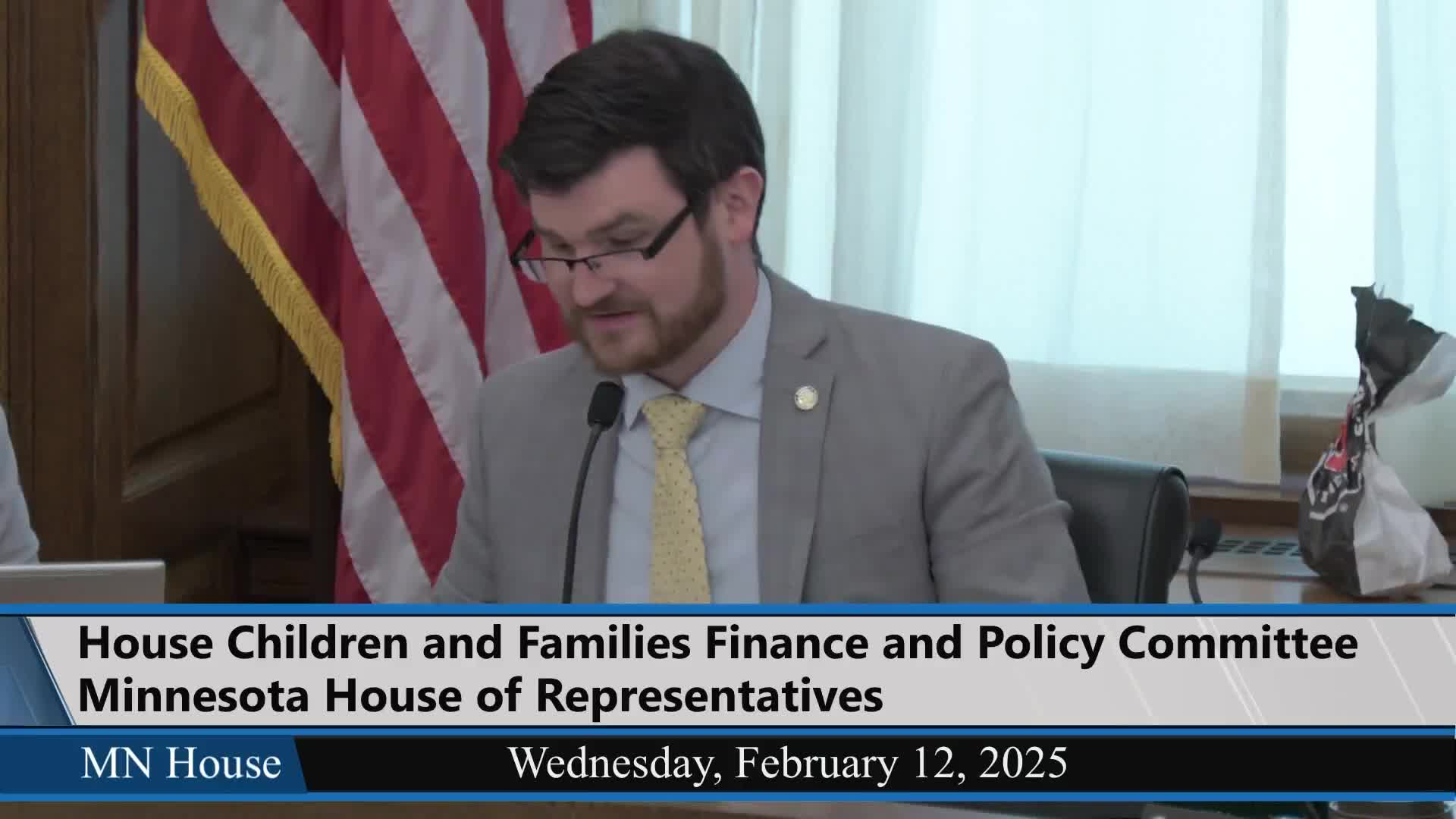
Committee hears hours of testimony on parental‑rights bill; A1 amendment adopted and House File 22 referred to Education Policy
Summary
The House Committee on Children and Families heard hours of testimony for and against House File 22, adopted an A1 author’s amendment that adds a strict standard of review for alleged infringements on parental rights, and voted to refer the bill to the Education Policy Committee for further consideration.
The House Committee on Children and Families on Feb. 11 took testimony on House File 22, a measure that would codify broad parental rights over the education, upbringing, religious instruction, health and privacy of minor children, adopted an author’s A1 amendment, and voted to re‑refer the bill to the Education Policy Committee.
Why it matters: Supporters said the bill clarifies and protects parental authority; opponents and some committee members said the measure, particularly as amended, raises conflicts with child‑protection law, school practice and health‑care delivery and could make it harder for schools and courts to act in a child’s best interests.
Representative Dawn Gilman, the bill’s author, opened the hearing and described the bill’s intent: "House Bill 22 establishes a broad parental rights to direct the education, upbringing, religious instruction, health and privacy of a child without government interference." Gilman said the bill "does not create new rights, but rather recognizes the rights parents already have." The committee adopted Gilman’s A1 amendment, which adds language requiring government actions that infringe parental rights to meet the "most stringent legal standards," described in the hearing as the strict‑scrutiny standard used by courts in fundamental‑rights cases.
Dozens of Minnesota parents and advocacy groups testified in favor. Alicia Leviska, co‑director of Minnesotans for Health and Parental Rights, said her group submitted written testimony with more than 15 family accounts and argued the bill would provide "clear, consistent protection for parents and families across Minnesota." Christine Bridal, founder of Minnesota Parents Alliance, told the committee she was concerned about what she called the "blurring of lines between education and healthcare" in school‑based clinics and wraparound services.
Education and child‑welfare advocates opposed or urged caution. Meg Lugar Nikolai, an attorney with Education Minnesota, said the bill "appears geared toward making [educators'] efforts harder" and warned that the measure could risk routine services such as vision and hearing screenings. Rebecca Delahunt, director of public policy at Minnesota Family Council, supported the bill’s goals but opponents warned about effects in dependency and neglect proceedings. William Wagner, vice president of the Parental Rights Foundation (testifying via videoconference), urged adoption of the amendment, telling the committee that under U.S. and Minnesota precedent parental rights are fundamental and courts apply strict scrutiny when those rights are limited: "The court applies what's called strict scrutiny when reviewing government actions that interfere with a citizen's fundamental rights."
Committee members probed technical and placement questions. Vice Chair Hansen (Representative Hansen) pressed the author about why the bill is drafted in chapter 260C of Minnesota law, the chapter that governs juvenile protection and court proceedings; nonpartisan staff explained courts ultimately determine whether a government action meets a compelling‑interest test, but members said the choice of placement could create confusion about where the provision would apply. Hansen and several members also asked about: how the bill would work in split‑custody cases; whether it could give cover to abusive parents; how schools would enforce the law; and how the statute would treat older minors (the bill defines a minor as under 18).
The committee adopted the A1 amendment by voice vote after Representative Gilman offered it and then, on a recorded voice vote, re‑referred House File 22 to the Education Policy Committee. Chair West moved the re‑referral; the committee "All those in favor say aye" and the motion prevailed.
What the committee did not do: The hearing produced no final substantive changes beyond adopting the A1 amendment and referring the bill; committee members repeatedly asked the author to consult stakeholders, nonpartisan staff and child‑welfare and health experts as the bill moves forward.
Looking ahead: Committee members said they expect more drafting and stakeholder meetings before the bill reaches subsequent committees, with particular attention to statutory placement, definitions of "parent," how the law would operate in child‑protective proceedings, and the effect on school‑based health services.
Votes at a glance: The committee adopted the A1 author amendment (voice vote) and voted to re‑refer House File 22 to the Education Policy Committee (voice vote). Specific roll‑call tallies were not provided on the record.