Get Full Government Meeting Transcripts, Videos, & Alerts Forever!
Get email alerts on the Childcare Property Tax topic
No spam. Unsubscribe anytime.
Committee approves amendment to convert in‑home childcare proposal into 50% property‑tax exclusion; bill referred to Taxes
Summary
The House Committee on Children, Youth and Families adopted an amendment converting Representative Nadeau’s tax credit proposal into a 50% market‑value property tax exclusion for in‑home family childcare providers and re‑referred the bill to the Committee on Taxes for revenue review.
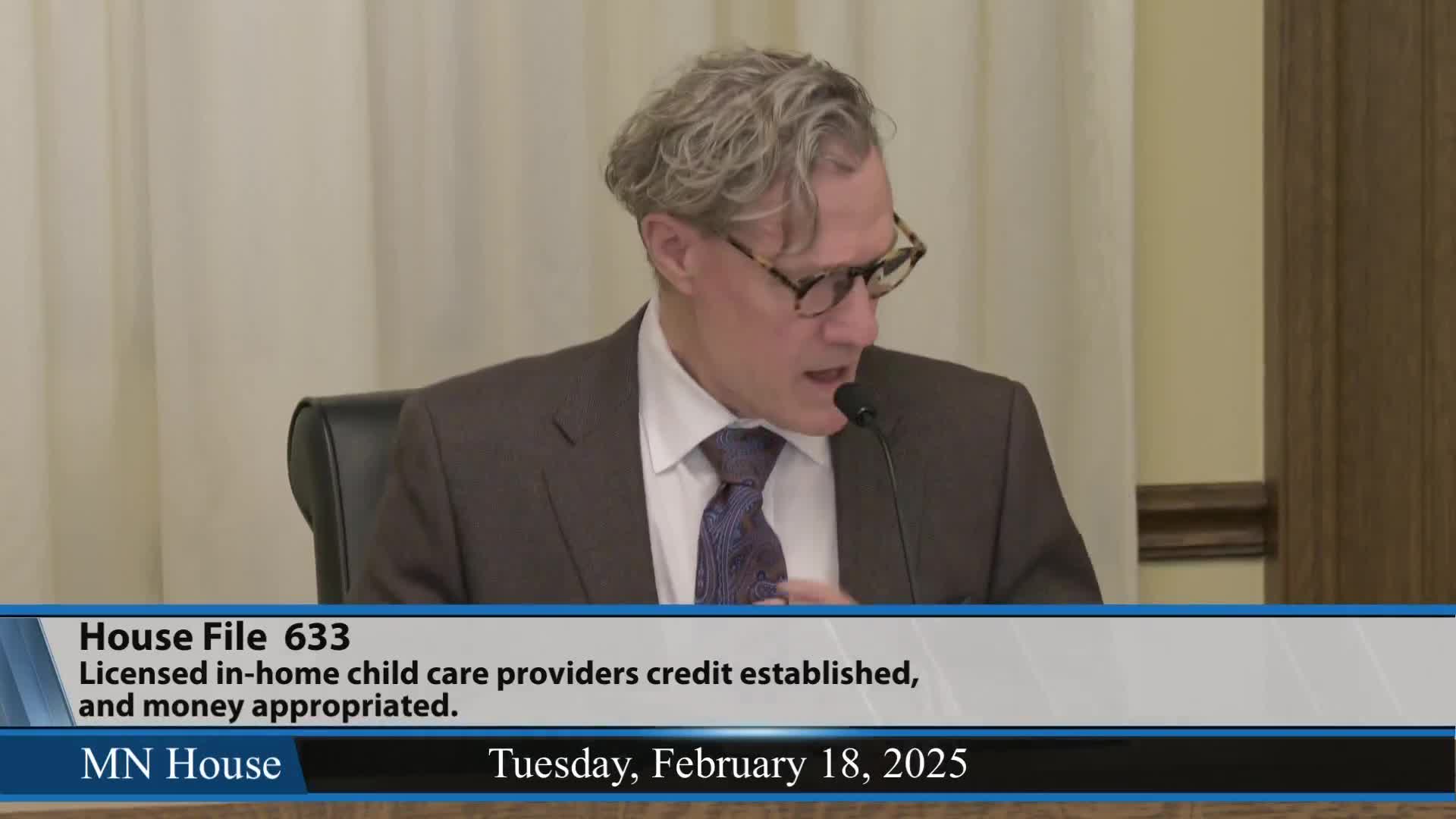
The House Committee on Children, Youth and Families on Tuesday adopted an amendment that converts Representative Nadeau’s proposal from a state paid tax credit into a 50% market‑value exclusion on property taxes for in‑home family childcare providers, then voted to re‑refer the amended bill, House File 633, to the Committee on Taxes for a revenue estimate and further work.
Supporters said the change is designed to lower the operating costs of small, home‑based childcare businesses and to stabilize shrinking family childcare capacity across Minnesota. "The effect of this bill is a 50% exclusion on property taxes that are attributed to the net capacity levies. And this is only for in home family care providers," Representative Nadeau said when introducing the measure and the amendment.
The nut graf: committee members framed the bill as one way to blunt steep declines in family childcare supply and to reduce parents' wait lists, but members differed on whether a state appropriation (a credit) or a market‑value exclusion is the better policy tool. Representative Nadeau said the exclusion is a practical path to immediate relief; other members said a direct state credit would better target limited public dollars.
Representative Nadeau described the scale of the problem in testimony to the committee, citing state market figures and licensing counts: he said Minnesota had about 12,000 licensed childcare providers in 2011, roughly 7,150 ten years later, and 5,782 active in‑home family‑care licenses as of January 1 of this year. "As the number of providers for family care goes down, the costs and the wait lists go up," he said. He also noted national cost rankings for center care in 2021: "the market rate for infant care at a center was $16,164…we were seventh highest in toddler care at over $14,000." (Representative Nadeau provided those figures during committee remarks.)
Two public testifiers supported the measure. Grant Johnson, who said his wife operates a licensed in‑home daycare in Edina, described rising business costs for providers and declining numbers of new providers entering the field. Cindy Cunningham, identified as chair of Leading Care Public Policy and a longtime family childcare provider, said family providers operate in and for their communities and receive limited direct funding; she told the committee the proposal would help "stabilize" small home businesses that currently shoulder property tax and other expenses.
Opponents and cautious members raised distributional and fiscal concerns. Representative Kolter questioned converting the proposal to an exclusion because exclusions shift revenue burdens onto other local property taxpayers and tend to benefit higher‑value houses more than lower‑value ones; he said he preferred a refundable credit paid by the state. Jared Swanson of House Research told the committee that, because the bill is structured as an exclusion rather than a credit, a substantial portion of the value is shifted locally and that the state impact would likely appear as a small increase in homeowner property tax refunds.
Representative Nadeau defended the exclusion, saying it would provide a substantial—up to 50%—property‑tax reduction for qualifying providers and that he saw it as a fast, pragmatic step to preserve in‑home capacity. "This is a simple, common‑sense bill that I hope helps stabilize in‑home family childcare providers," he said.
The committee adopted the DE1 amendment that changes the fiscal structure from a state credit to a 50% market‑value exclusion and then approved a referral of the amended bill to the Committee on Taxes. The bill will receive a revenue estimate and further review in that committee; no appropriation was attached in committee today.
The committee record shows continuing interest in finding additional or alternative mechanisms—targeted credits, enrollment‑based subsidies or geographic prioritization—to ensure relief reaches lower‑income providers and communities, and authors said they will continue working with colleagues and fiscal staff as the bill moves forward.