Get Full Government Meeting Transcripts, Videos, & Alerts Forever!
Get email alerts on the Criminal Justice Public Safety topic
No spam. Unsubscribe anytime.
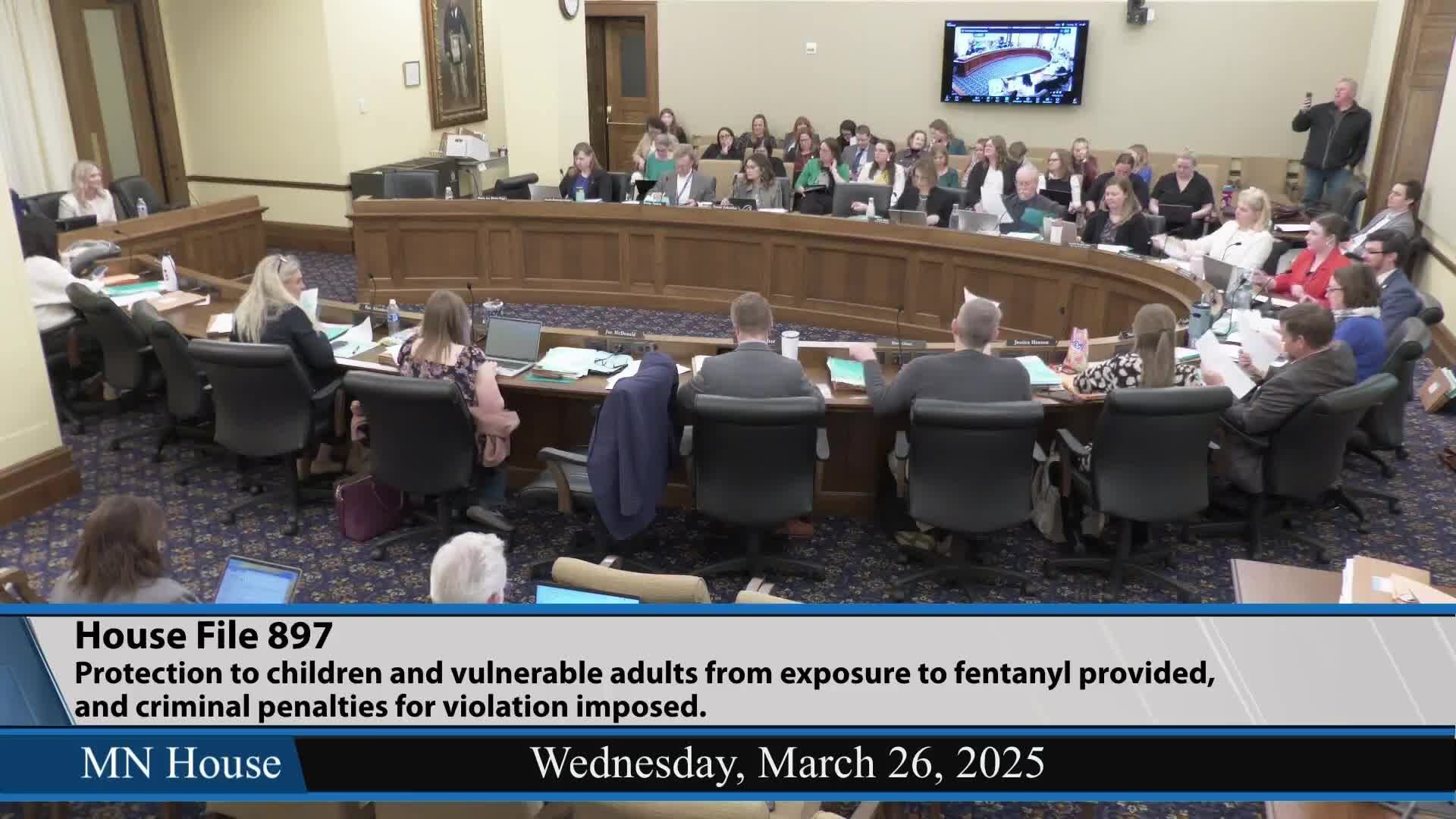
Committee sends House File 897 to Public Safety to add fentanyl to criminal exposure statute for children and vulnerable adults
Summary
House File 897 would add fentanyl to the statute that criminalizes exposing children and vulnerable adults to methamphetamine; representatives and prosecutors said fentanyl's potency creates a substantially higher risk to infants and small children. Committee voted to re‑refer the bill to Public Safety for further work.
Representative Knudson presented House File 897, a bill to align the criminal penalty for exposing children and vulnerable adults to fentanyl with existing statute covering exposure to methamphetamine. The author said the measure responds to a rising number of tragic incidents involving fentanyl exposure.
Several outside speakers supported the bill. A representative of Fentanyl Free Communities described fentanyl as far more lethal than methamphetamine and urged felony‑level penalties for caretakers who expose children. Sebastian Mesa, an assistant Anoka County attorney, told the committee fentanyl is present in almost every fatal overdose and is easily mixed with other drugs; he called the bill a commonsense step to close an obvious statutory gap. Remote testifiers described community harms, including transit exposure and harms to people with mobility limitations.
Members asked about how the statute would operate in communal public settings such as transit and whether the definition of "expose" could be overly broad. Prosecutors and the testifiers said prosecutorial discretion and existing statutory definitions would limit overbroad application: the bill would insert fentanyl into the same statutory framework that currently applies to methamphetamine exposure, which already contains definitions and limitations on where children are "likely to be found." Members also asked about impacts on vulnerable adult settings and whether human services reviewers should weigh in on language; presenters pointed to the existing statutory definition of "vulnerable adult" in criminal law as the controlling definition.
Representative Knudson renewed a motion to re‑refer House File 897 to the Committee on Public Safety; the motion carried and the bill was advanced to Public Safety for additional work.
Ending: The bill moves to Public Safety for further drafting of statutory definitions and fiscal implications; committee members asked for continued review of the language to ensure it targets caregivers who knowingly expose children and vulnerable adults without sweeping into unintended communal settings.