Get Full Government Meeting Transcripts, Videos, & Alerts Forever!
Get email alerts on the Childcare Cameras topic
No spam. Unsubscribe anytime.
Parents and providers clash over proposed camera mandate for child-care centers
Summary
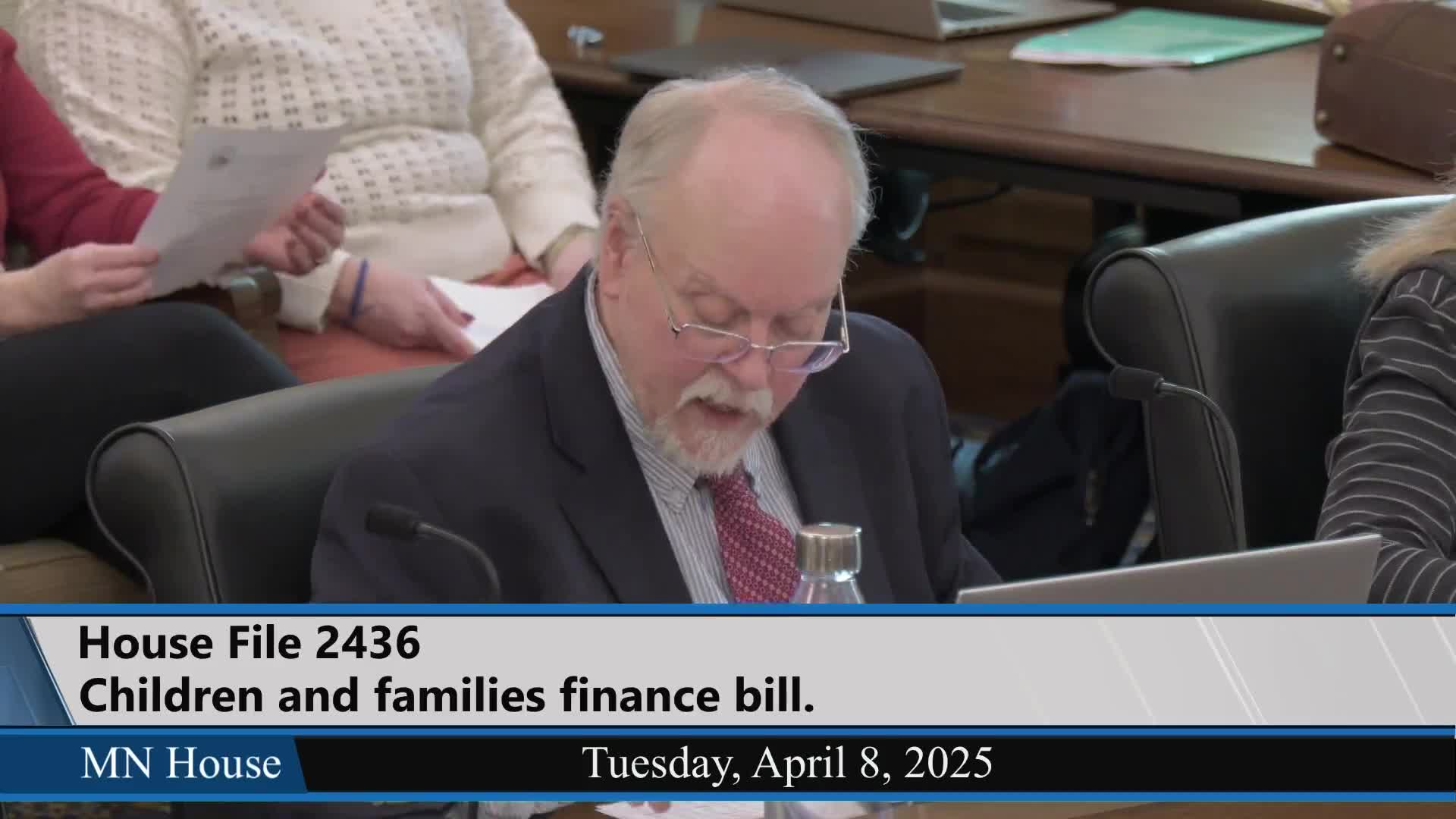
Members of the Children and Families Finance and Policy Committee heard emotional testimony for and against a proposed requirement that licensed child-care centers install video cameras and retain recordings.
Members of the Children and Families Finance and Policy Committee heard emotional testimony for and against a proposed provision related to video cameras in licensed child-care centers as part of the DE1 discussion.
Supporters — many parents who said their infants were injured in care settings — urged lawmakers to include a camera requirement or retention standard, saying video often provides the only objective way to identify abuse in nonverbal or immobile infants. "So today we are asking the committee to support this bill as we feel it truly would keep children safe by having cameras present," testifier Christina Peck said, recounting a July 19 incident in which her infant was found to have a fractured tibia.
Medical, child-welfare and child-safety advocates also testified in favor. Dr. Lisa Hollensteiner, a retired emergency-room physician and chair of Safe Passage for Children of Minnesota, said cameras can both document abuse and protect staff when injuries are not abuse. "Without cameras we have no way of verifying injuries on a non mobile infant or a non verbal toddler," she testified.
Providers, industry groups and many center owners testified in opposition or urged caution. Testimony from small rural providers emphasized costs of installation, storage and ongoing maintenance that could fall on parents or reduce pay to an already underpaid workforce. "For me to upgrade at the level to which this bill would require would mean that I would have a significant one-time as well as an ongoing expense for three small child-care centers," testified Karen DeVos, owner of Little Learners Early Childhood Centers in rural Norman County.
Other providers argued cameras do not prevent abuse and could create privacy and operational problems. "I still don't believe that cameras are going to achieve the goals or our practical solution to create a safer and higher quality child-care environment," said Joe Pickett, a former Primrose Schools owner who urged investment in supervision and staffing supports instead.
Nut graf: testimony split along two lines — families seeking evidence and accountability, and providers warning of cost, privacy and the risk of reduced access to infant care. Multiple witnesses asked the committee to consider incentive-based approaches, targeted requirements for programs with poor safety records, or stronger policies on provider video policies and family notice rather than a universal mandate.
Details and recurring points
- Evidence and accountability: Several parents described injuries discovered only through medical exams and said retention beyond seven days would have produced clearer evidence and more convictions.
- Privacy and access concerns: Providers raised privacy risks to children and staff, the difficulty of controlling parental access to footage, and potential violations of non-enrolled children’s privacy when classroom video is shared.
- Costs: Multiple providers and industry groups estimated initial compliance costs ranging from several thousand to tens of thousands of dollars per center, plus ongoing storage and staffing costs; many said the DE1 appropriation would be insufficient to cover statewide compliance.
- Alternatives proposed: Broad support among provider witnesses for voluntary camera policies, written disclosure of camera policies to families, stronger licensing visit protocols, and investments in staffing, higher pay, and improved supervision.
What comes next
Chair West signaled the DE1 does not yet reflect the signed agreement between the chairs on cameras and that an amendment to resolve differences would be introduced in the markup. The committee deferred final decisions to the scheduled markup the following day.
Ending: The committee heard more than 20 testifiers on camera policy and other DE1 items and adjourned with markup scheduled for the next day.