Get Full Government Meeting Transcripts, Videos, & Alerts Forever!
Get email alerts on the Economic Development topic
No spam. Unsubscribe anytime.
DEED seeks $2.7M for Greater Minnesota infrastructure grants, $1.8M for transportation economic development
Summary
The Department of Employment and Economic Development sought $2.7 million for the Greater Minnesota Business Development Public Infrastructure grant program and $1.8 million for the Transportation Economic Development Infrastructure program to support public infrastructure that enables private business expansion.
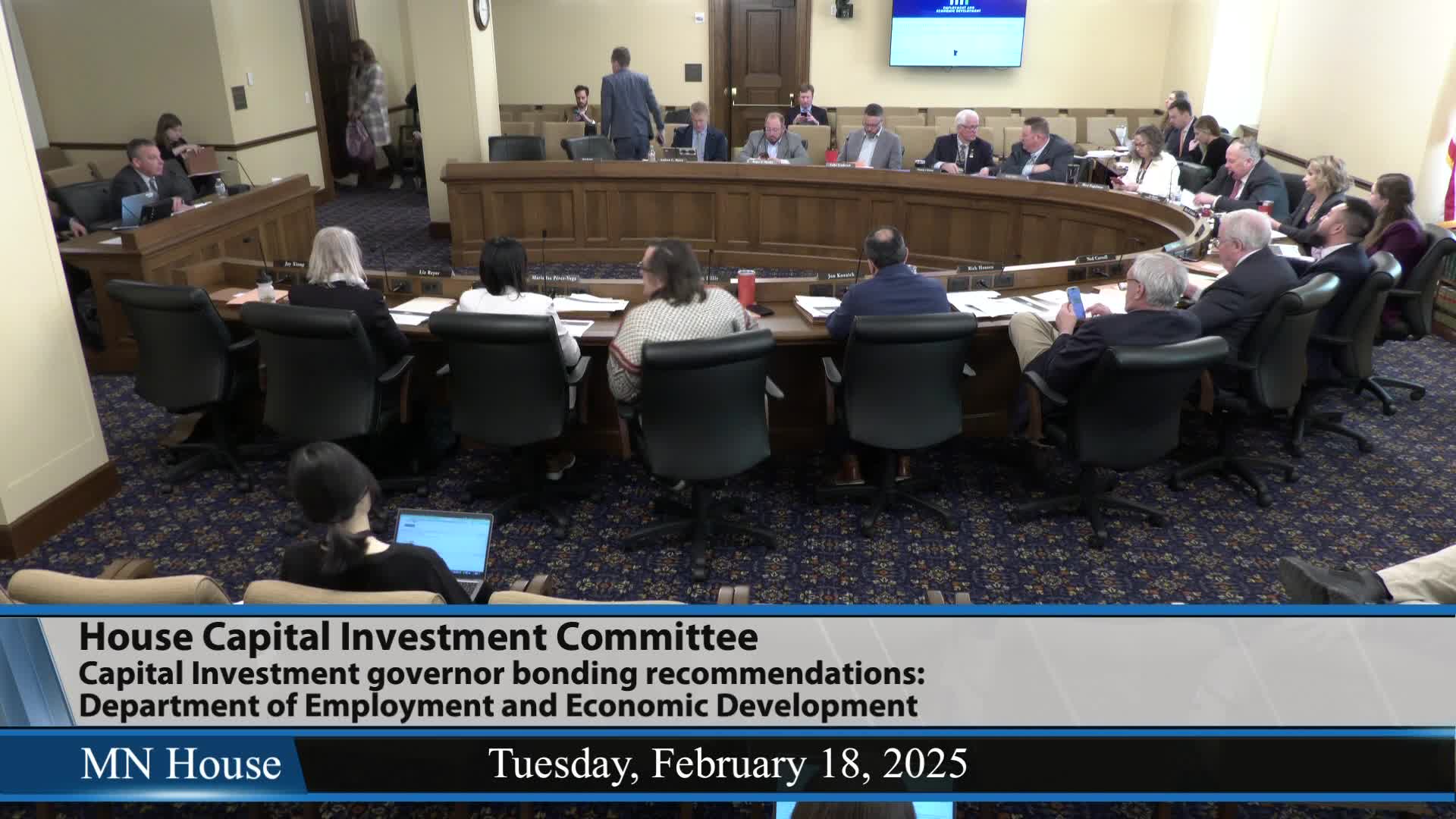
Kevin McKinnon, deputy commissioner for economic development and research at the Department of Employment and Economic Development (DEED), briefed the Capital Investment Committee on two grant programs the agency wants funded in the governor’s 2025 capital recommendations.
DEED asked for $2,700,000 for the Greater Minnesota Business Development Public Infrastructure (BDPI) grant program, which provides grants to local governments outside the seven‑county metro to cover up to 50% of eligible public infrastructure costs that support industrial or distribution development. Cities can receive up to $2,000,000 from BDPI over two years, McKinnon said; the program began in 2002 and DEED has completed roughly 200 grants since inception. He described a recent example in Cold Spring, where BDPI funds supported new publicly owned water wells tied to private brewery expansion.
DEED also requested $1,800,000 for the Transportation Economic Development Infrastructure (TEDI) program, a joint DEED‑MnDOT initiative that supports transportation improvements for business parks and industrial sites. McKinnon said TEDI runs on a competitive RFP process once a year; DEED typically reimburses grantees after projects are executed and requires matching funds.
McKinnon noted BDPI’s available balance is about $5,000,000 and that DEED has a pipeline of projects; TEDI’s balance is small (roughly $60,000) but DEED listed about $4,500,000 in projects in the pipeline. He also said an innovation‑focused BDPI variant (IBDPI) was not funded in this governor request because DEED recently awarded the remaining balance (about $1.3 million) and currently has no balance left in that account.
Why it matters: Both programs are designed to lower the cost of industrial and transportation infrastructure for local governments and private developers, supporting job creation and private investment in Greater Minnesota.
Next steps: The committee received the presentation; agencies noted they will continue to process pipeline applications and seek contract approvals as funds permit.