Get Full Government Meeting Transcripts, Videos, & Alerts Forever!
Get email alerts on the Water Infrastructure topic
No spam. Unsubscribe anytime.
Public Facilities Authority seeks $39M state match to unlock federal water funds and proposes new emerging-contaminant grants
Summary
The Minnesota Public Facilities Authority told lawmakers it needs roughly $39 million in state match to unlock $215 million in federal capitalization grants and outlined proposed changes to grant caps and an emerging-contaminant program to address PFAS, manganese and other risks.
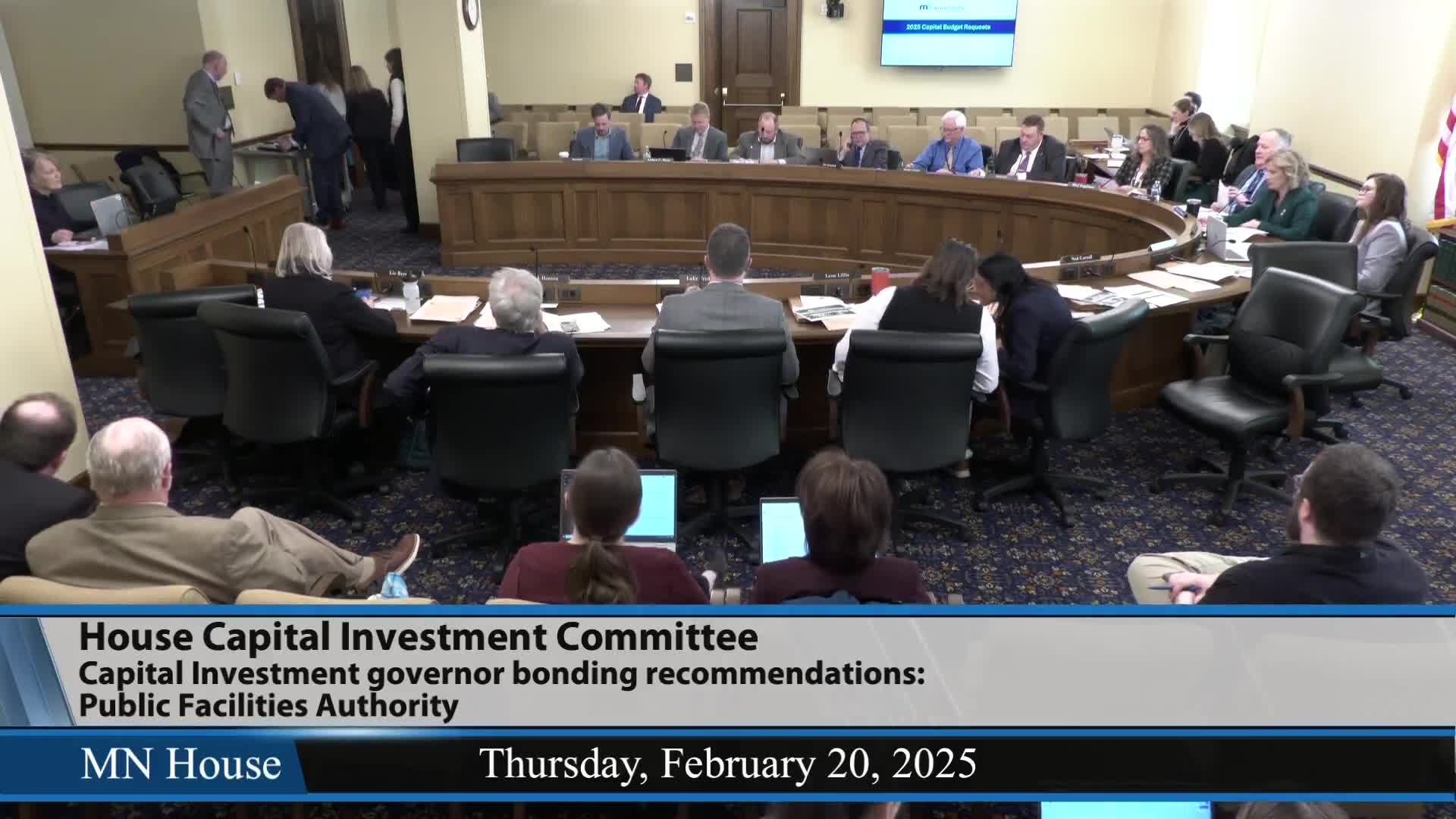
Karen Burkholtz, deputy director of the Minnesota Public Facilities Authority, told the Capital Investment Committee the agency’s 2025 capital request would support drinking-water and clean-water revolving funds, targeted grants for affordability and a proposed emerging-contaminant grant program.
Burkholtz said the governor’s capital budget request for the PFA totals "a little over $99,000,000," including a $39,000,000 state match that would unlock about $215,000,000 in federal funds. She described the PFA’s role in packaging low-interest loans and grants and said the authority prioritizes projects listed on the Minnesota Pollution Control Agency and Minnesota Department of Health project-priority lists and then builds annual intended-use plans.
The PFA asked the committee to consider statutory changes and additional capital to expand the Water Infrastructure Fund (WIF) and the Point Source Implementation Grant (PSIG) program. Burkholtz said the administration proposes raising the WIF grant cap from $5,000,000 to $10,000,000 and increasing the PSIG cap from $7,000,000 to $12,000,000 to reflect rising project costs and complexity.
On emerging contaminants, Burkholtz said the administration proposes a state program to pair with federal Infrastructure Investment and Jobs Act (IIJA) dollars. "Minnesota expects to receive about $120,000,000 over the five-year period" from federal emerging-contaminant funds, she said, and the state proposal would “provide 80% grants up to $12,000,000 to local governments for projects to address emerging contaminants.” The PFA estimated statewide emerging-contaminant project costs of about $450,000,000.
Representative Hansen raised affordability concerns, noting Minnesota Statute 446A.072 (as quoted in the hearing) sets an average-system-cost affordability test that can exclude some metropolitan-area communities from grant eligibility. Burkholtz said the PFA already applies a disadvantaged-community affordability test for lead-service-line replacement and that the agency intends to return with proposals for future appropriations, including lead-service-line replacement funding in 2026. She said the agency seeks to honor legislative intent to avoid imposing replacement costs on residents where possible.
Burkholtz described a short federal pause after a White House executive order that temporarily delayed some disbursements; she told the committee federal funding resumed after a U.S. district court restraining order and that the EPA notified states after Feb. 3 that the pause was lifted. "We had a pause for, like, 10 days... and then we got the confirmation from EPA that it indeed was and we were proceeding business as usual," she said.
Committee members asked about timing and carryover of previously certified projects. Burkholtz said carryover projects certified by MPCA and MDH are included in the fundable range by rule; she also said the PFA has authority to transfer between clean-water and drinking-water funds when necessary. The PFA noted remaining unfunded needs: Burkholtz cited an estimated $124,000,000 unfunded PSIG need across 26 projects and identified WIF unfunded need estimates tied to IIJA principal-forgiveness funds.
Burkholtz closed by noting the PFA’s long record of municipal financing since 1989 and said the authority has awarded more than $6.09 billion in state financing, producing more than $1 billion in interest-rate savings for local governments.
No committee vote on PFA requests took place at the hearing; members asked for follow-up materials on spending timelines, fund transfers and emerging-contaminant coordination.