Get Full Government Meeting Transcripts, Videos, & Alerts Forever!
Get email alerts on the Federal Grants Debt topic
No spam. Unsubscribe anytime.
Committee presses agencies on security of recent federal grants and strain on state matching and debt capacity
Summary
MnDOT and budget officials told the Capital Investment Committee that many January federal grant announcements do not yet have signed grant agreements and that the state could face a shortfall in matching funds; MMB officials said prior trunk‑highway authorizations constrain state debt capacity under guideline 3.
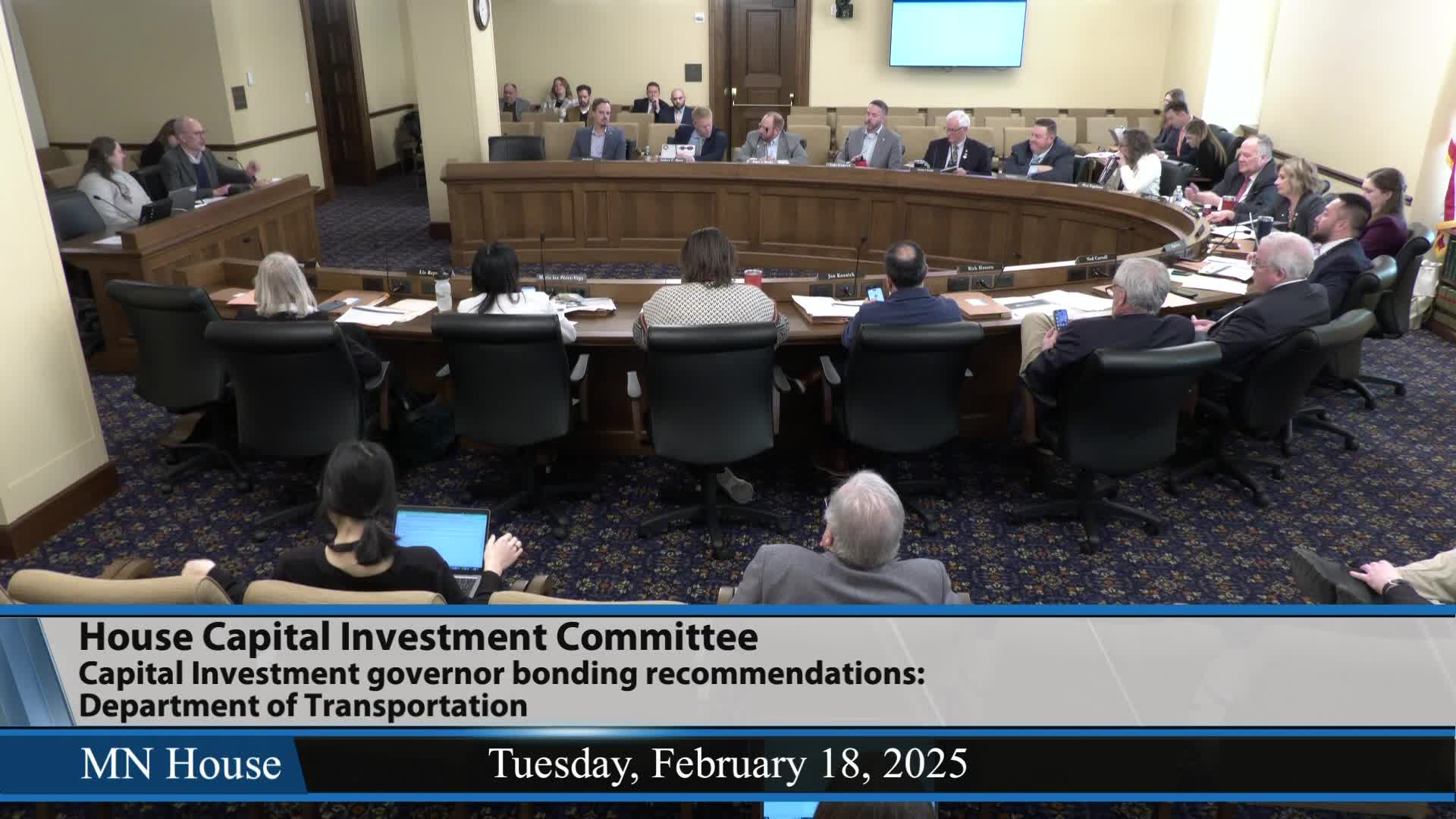
Committee members used MnDOT’s appearance to press for clarity about whether recent federal grant announcements remain secure and what the state might owe if grants are paused or require payback.
Eric Rudine of MnDOT said program guidance on a few federal programs has changed, but as of Feb. 18 “the NEVI formula funds have continued to flow,” and he warned that it is projects for which funds have not been obligated that are most at risk. Rudine said roughly $4,000,000 in NEVI funds the state expected are now not expected to be received.
Rudin and other witnesses repeatedly distinguished an announcement from a fully executed grant agreement. Rudine explained that a press announcement of a grant award must be followed by a signed grant agreement and then an obligation in the federal accounting system (FEMIS or similar) before funds are effectively guaranteed. “So far, we feel that if you have a signed grant agreement in place, you’re pretty likely to get those funds,” he said; he added that many projects announced on Jan. 20 do not yet have signed agreements.
Representative Perez Vega asked whether specific projects — including a $25,000,000 federal announcement for the Robert Street Viaduct — are at risk; Rudine said the viaduct project’s federal grant is not obligated and the department is monitoring the grant‑agreement process and annual inspections to ensure safety in the interim.
Budget officials explained the state’s matching and debt constraints. Mary Ann Conboy, capital budget coordinator at Minnesota Management and Budget, summarized guideline 3: “40% of general obligation bonds shall be due within 5 years and 70% are due within 10 years,” a limit used to measure how quickly the state pays down debt. Andrew Lee of House fiscal staff provided a list of outstanding trunk‑highway bond authorizations that MMB must assume will be sold: 2018 $237.2 million, 2020 $62 million, 2021 $348 million, 2023 $565 million and 2024 $19 million. Those outstanding authorizations, officials said, constrain how much new GO‑bonding the state can issue without breaching internal guidelines.
On matching funds, officials told the committee the Legislature appropriated about $200,000,000 in general funds to match federal grants in 2023 and that roughly $20,000,000 remains available; they estimated the January announcements could require roughly $40,000,000 in state matches if all grants are finalized, leaving a potential shortfall.
Why it matters: Many high‑profile federal announcements require later administrative steps to obligate funds. Projects without signed agreements or obligations remain at risk if federal guidance changes; the state also faces practical limits on selling additional bonded debt because of prior authorizations and guideline 3 requirements.
Next steps: MnDOT and budget staff said they will continue to monitor federal agency guidance, pursue signed grant agreements where possible and advise the Legislature on matching needs as grant agreements are finalized.