Get Full Government Meeting Transcripts, Videos, & Alerts Forever!
Get email alerts on the Wetland Replacement And Conservation Easements topic
No spam. Unsubscribe anytime.
BWSR urges steady bonding for wetland replacement banks, expands CREP coverage and emphasizes long lead times for credits
Summary
John Jasky, executive director of the Minnesota Board of Water and Soil Resources, and Andrea Fish, assistant director, presented statewide capital items relating to wetland replacement banks and conservation easements.
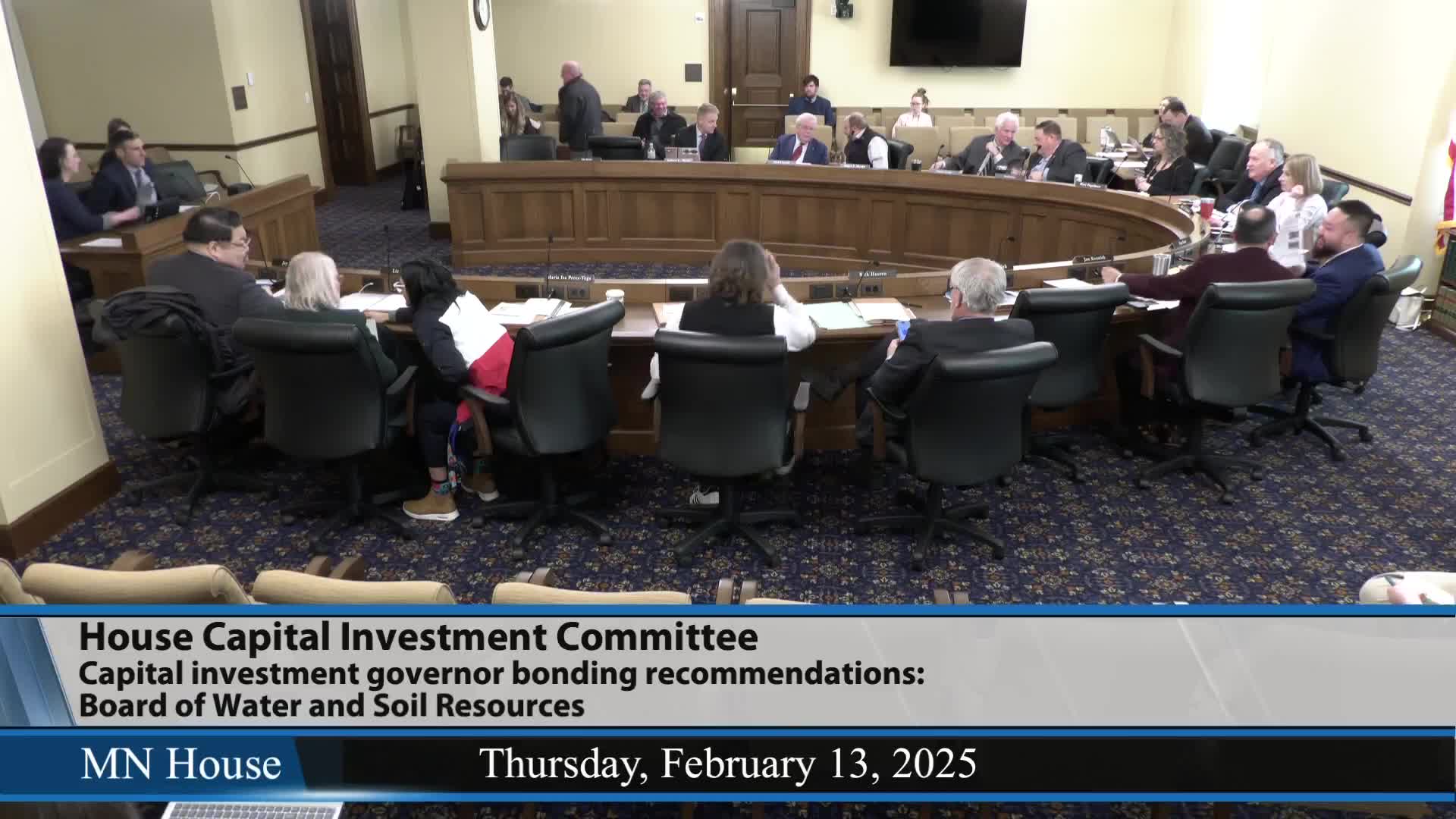
John Jasky, executive director of the Minnesota Board of Water and Soil Resources, and Andrea Fish, assistant director, presented two statewide capital items to the Capital Investment Committee on Feb. 13: the local government roads wetland replacement program and land conservation easement work managed under Reinvest in Minnesota (RIM).
"In cases where local government road projects would interfere, impede or necessarily go over a wetland, an existing wetland, they are required to replace those wetland acres within the state," Andrea Fish said, explaining why a centralized bank approach is more efficient for permitting and cost effectiveness than piecemeal local mitigation.
The nut graf: BWSR told lawmakers the operational challenge is not program design but reliable, multi‑year funding. The agency said wetland replacement credits can take eight to ten years to identify, design, construct and monitor, so local road projects need assurance that credits will be available when permitting timelines require them.
Key details: Fish described bank service areas that ideally replace wetlands within the same region; some bank service areas currently hold less than one year's anticipated credits and must buy credits from other areas at higher cost. Jasky said a recent amendment and extension of the USDA agreement expands CREP (Conservation Reserve Enhancement Program) coverage to additional counties (those with more than 30% agriculture) and increases allowable enrollment acres. Under the federal-state leveraging noted in the presentation, approximately $3 of state investment has historically unlocked about $7 of federal funding on eligible projects (reported as a 7-to-3 ratio in the presentation).
Jasky provided historical funding numbers showing roughly $175,000,000 in state contributions has leveraged about $350,000,000 in federal funding in recent years under related programs. The work group convened late last year concluded that state bonding remains the most practical funding mechanism for the statutory program provided funding is stable and predictable.
Ending: BWSR asked the committee to consider steady capital investment for the wetland replacement program to avoid project delays for local road authorities and to maintain 8–10 years of available credits within each bank service area. BWSR said it would provide the committee with the work group findings and additional documentation on program options.