Get Full Government Meeting Transcripts, Videos, & Alerts Forever!
Get email alerts on the Met Council Requests topic
No spam. Unsubscribe anytime.
Metropolitan Council seeks state match for H Line, inflow-and-infiltration grants and regional parks funding
Summary
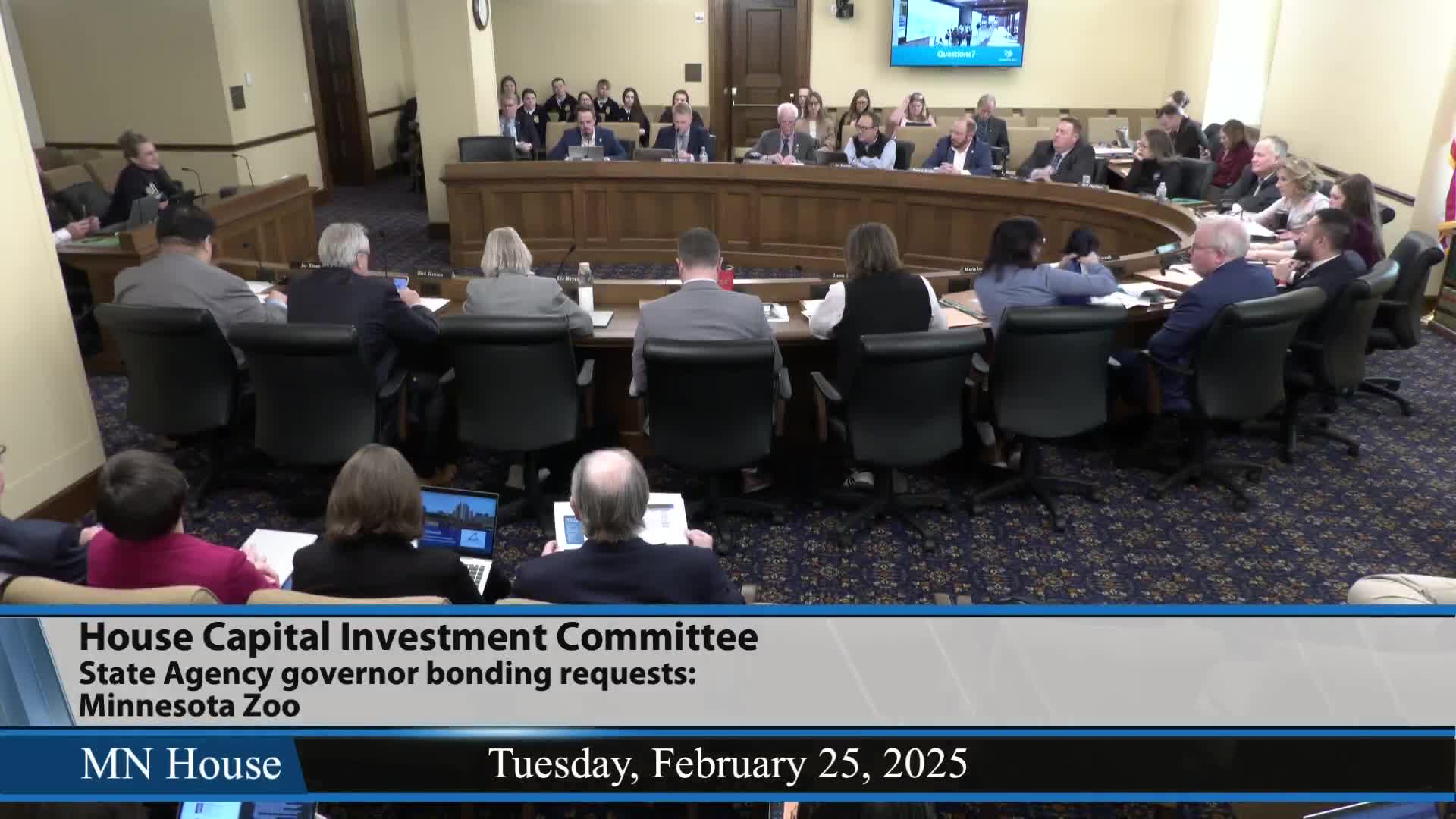
Metropolitan Council Chair Charlie Zelle told the Capital Investment Committee the governor recommends $15 million as local match for the H Line arterial bus rapid transit, $4.6 million for inflow-and-infiltration grants and $2.3 million for regional parks and trails.
Charlie Zelle, chair of the Metropolitan Council, told the Capital Investment Committee on Feb. 25 that the governor's recommendation for the Met Council's capital requests includes $15 million for busway capital (to support the H Line), about $4.6 million for inflow-and-infiltration (I&I) grants that help municipalities repair leaky sanitary systems, and $2.3 million for regional parks and trails.
Zelle said the H Line is an east–west arterial bus rapid transit project planned along Como Avenue and Maryland Avenue, connecting Minneapolis to a hub east of St. Paul and intersecting a dozen other transitways. He described $15 million as the local funding needed to position the H Line for federal Small Starts funding; he said the project has roughly $60 million already secured and that total project cost is expected in the $120 million–$150 million range.
On inflow and infiltration, the council described a long-running grant program that reimburses local work (typically on a 50% match basis) to reduce stormwater and groundwater entering sanitary systems. Kyle Colvin, manager of wastewater planning and community programs at the Met Council, told the committee past solicitations have been fully encumbered, that recent state grants produced a leverage of roughly 6-to-1 in local construction work, and that the total public‑sector need has been characterized previously at about $150 million (in 2008 dollars) for the public-collection system; Colvin cautioned that the figure is a moving target because infrastructure continues to age.
Zelle and other council staff also outlined the regional parks and trails bonding program; the governor recommended $2.3 million for that program, which leverages council funds and local matches to maintain a 55,000-acre regional park system and roughly 500 miles of trails. Lisa Barajas, Executive Director of Community Development at the Met Council, said the regional parks system is independent of the Minnesota Department of Natural Resources (DNR) though the agencies coordinate on connecting trails and programming.
Committee members queried the council on the scale of need for I&I, the capacity of contractors and municipalities to deliver projects, how proposed transit investments would coordinate with MnDOT corridor projects, and how potential operational changes such as curtailing Northstar commuter rail would affect council finances. Met Council staff said recent grant rounds were fully subscribed, that municipal administrative capacity can be a constraint in some cases, and that operations-savings questions (for example around Northstar) would affect long-term operating capacity rather than this H Line capital match directly.
No committee vote on the Met Council requests occurred during the hearing.