Get Full Government Meeting Transcripts, Videos, & Alerts Forever!
Get email alerts on the Corrections topic
No spam. Unsubscribe anytime.
Minnesota DOC urges $65.5M in asset-preservation bonding and additional funding to expand Rush City programming space
Summary
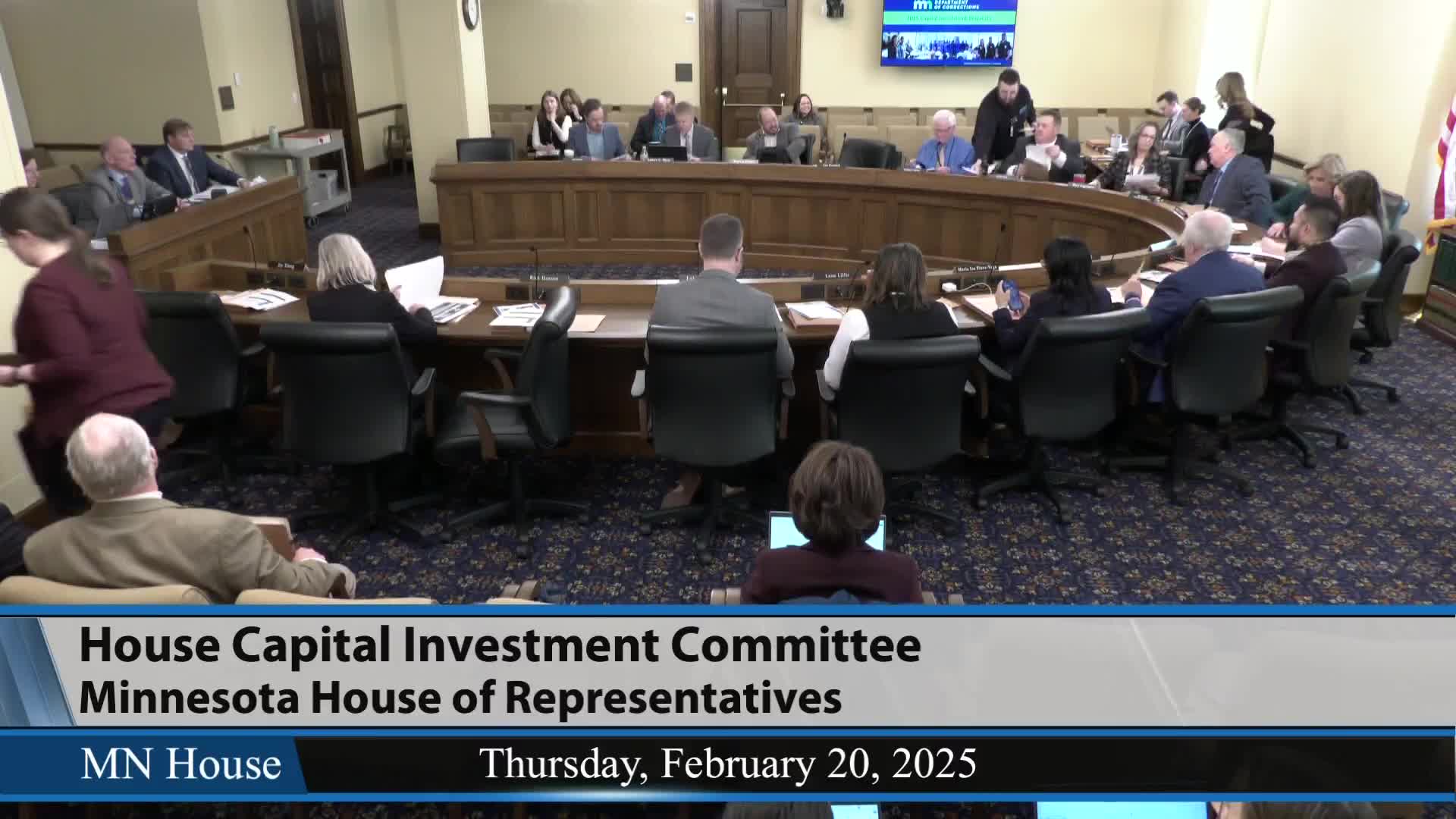
Commissioner Paul Schnell told the Capital Investment Committee on Feb. 20 that the Minnesota Department of Corrections needs sustained capital investment to address a $732 million deferred-maintenance backlog and to expand rehabilitative space at the Rush City prison.
Commissioner Paul Schnell testified to the Capital Investment Committee on Feb. 20 that the Minnesota Department of Corrections needs continued legislative capital investment to maintain safe, secure facilities and expand rehabilitative programming.
Schnell said the department manages 11 prisons and “about 8,300 people in our prisons” with roughly 4,300 employees, and that asset preservation remains the agency’s top priority. "Of the deferred maintenance of all assets managed by state agencies, 33%, a full 1 third, is within the Department of Corrections," Schnell told the committee, and he gave the current estimate to bring DOC buildings to fair condition as $732,000,000.
The nut of the department’s request is twofold: $65,500,000 in governor-recommended asset-preservation bonding to fund about 40 critical projects and a separate capital request to expand rehabilitative space at the Rush City prison. Carl Hunt, the DOC’s Capital Resource Administrator, said the requested $65.5 million would deliver upgrades to water and treatment systems, roofs, life-safety systems, security infrastructure and emergency generators. He cautioned the committee that a large deferred-maintenance backlog requires the agency to divert resources repeatedly to emergency repairs, delaying other projects: "We currently have over a 175 projects on hold waiting for resources necessary for them to be completed," Hunt said.
Schnell and Hunt framed asset preservation as integral to public safety and rehabilitation. Schnell said 95 percent of people incarcerated in Minnesota will return to communities in the state and that rehabilitative programming reduces recidivism. "Individuals who participate in rehabilitative programming while they are incarcerated are 43 percent less likely to return to prison," he said.
On the Rush City project, Schnell told the committee the prison was built 24 years ago and was doubled-bunked before it opened, producing a persistent shortage of programming space. He said about 1,000 men are incarcerated at Rush City and that roughly one-quarter of them are "entirely idle" because programming space is unavailable. Hunt told the committee the 2024 capital request for Rush City was about $46,000,000 and that the figure has increased by roughly $11,000,000 because of escalation and a longer design and construction schedule. Committee members and Schnell discussed options for addressing double-bunking over time; Schnell said single-bunking at Rush City is not likely in the near future and that the agency is exploring honors units and population-management options.
Members pressed for specifics on program capacity and timing. Schnell said the offender-specific treatment space planned for Rush City would serve about 30–35 people at any one time and that maximum treatment length can be about 17 months, depending on risk levels. He also told the committee the facility had very limited dedicated mental-health space and a temporary trailer in use for some counseling services, which contributes to retention challenges for therapy staff.
Members raised staff-safety concerns. Representative Lillie said staff safety is top of mind after tours of older facilities; Schnell agreed, describing staffing and design challenges at century-old facilities and saying the state will need to evaluate what it takes to bring older prisons to modern safety standards.
Votes at a glance: At the start of the meeting the committee approved the minutes for Feb. 18 by voice vote; the chair announced "no opposed" and said a quorum was present. The transcript records a motion by Representative Fredericks and a voice vote; numerical tallies were not specified in the record.
The DOC requested continued asset-preservation funding and the Rush City expansion; committee members indicated interest in moving bonding this year and next.
The department left the committee with follow-up items, including requested details on testing frequency for water issues raised by the Public Facilities Authority presentation to follow.