Get Full Government Meeting Transcripts, Videos, & Alerts Forever!
Get email alerts on the Transportation Infrastructure topic
No spam. Unsubscribe anytime.
MnDOT seeks small‑bonding allotments for aging railroad gates and public ports
Summary
MnDOT told the Capital Investment Committee it is requesting $1.8 million in GO bonds for railroad‑crossing warning devices and $2.8 million for the Port Development Assistance Program in the governor’s 2025 capital recommendations; officials said these are ongoing life‑cycle needs, not full system replacements.
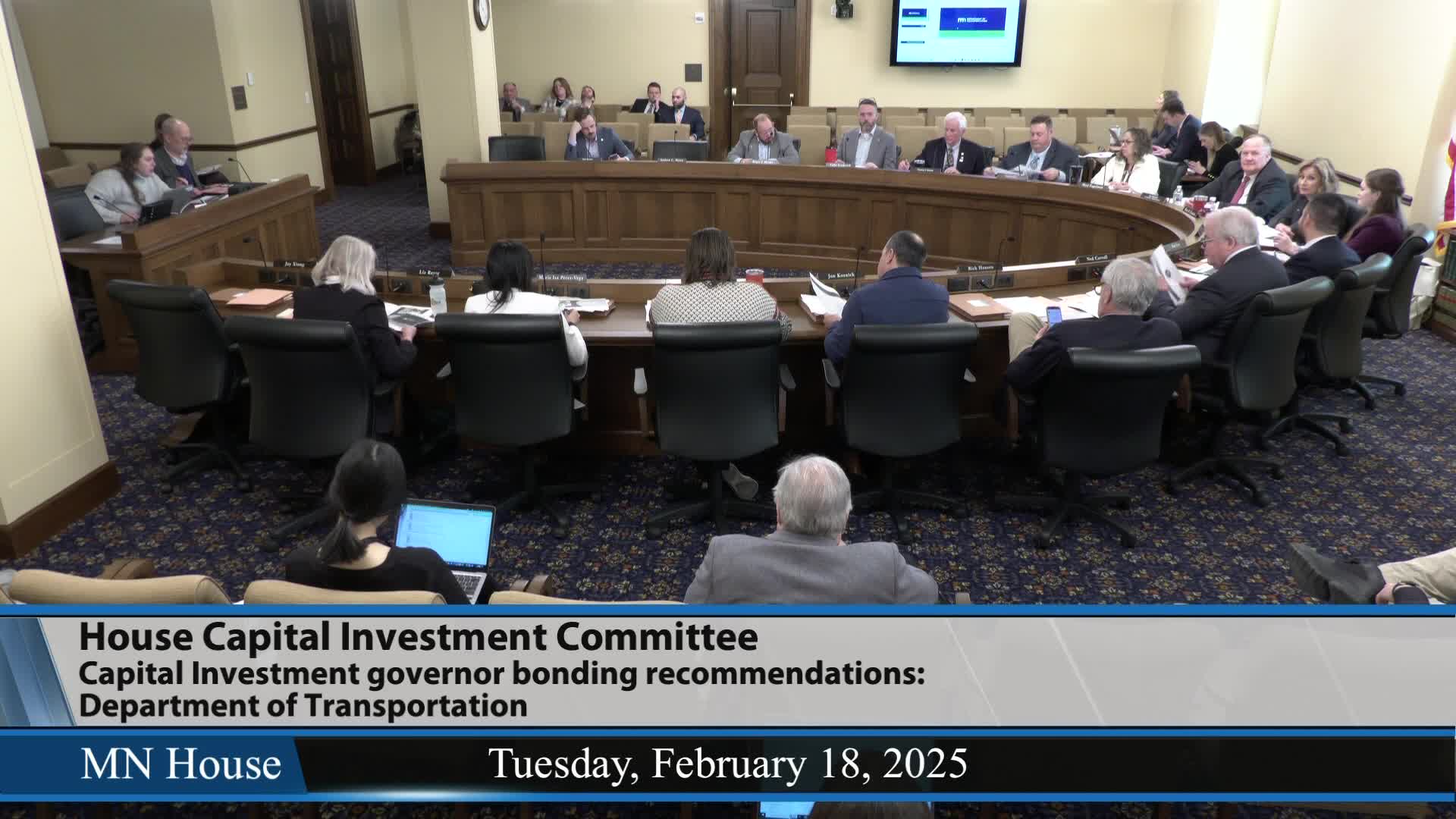
Taylor Besser Frederick, assistant budget director with the Minnesota Department of Transportation, and Eric Rudine, MnDOT government affairs, told the Capital Investment Committee the governor’s 2025 capital recommendations include $1,800,000 in general obligation bonds to maintain railroad crossing warning devices and $2,800,000 in GO bonds for the Port Development Assistance Program.
Frederick said Minnesota maintains the nation’s fourth‑largest roadway system with more than 143,000 centerline miles and oversees 1,800 level‑crossing systems; about 750 signal systems are past their useful life. “The reliability of these gates is critical for public safety,” she said, and the department described the request as ongoing life‑cycle replacement rather than an attempt to replace every device at once — MnDOT estimates total replacement cost of those systems at more than $300,000,000.
Rudine explained how responsibility is shared at crossings: “Typically, the road authority is responsible for the installation ... and then the railroad is the entity that actually operates them,” he said, describing cost participation and ongoing maintenance responsibilities.
On ports, Rudine listed five public ports eligible for the state program — St. Paul, Duluth, Red Wing, Wabasha and Winona — and said the Port Development Assistance Program supports public port infrastructure such as dredging and other public components of port facilities. Representative Kosnick pressed a numerical discrepancy and MnDOT clarified that the 2023 GO bond appropriation for ports was $18.1 million, not $1.8 million as misspoken earlier.
Committee members also asked about noncapital bridge safety measures after temporary fencing was erected on Washington Avenue in Minneapolis for suicide prevention. Rudine said Hennepin County and the University of Minnesota have been involved in temporary solutions and that MnDOT has provided technical assistance; he cautioned that permanent fencing can add weight and may require structural work during retrofit.
Why it matters: The requests are framed as targeted, recurring capital needs to preserve safety systems and support public port infrastructure; MnDOT said the packaging aims to keep systems in their life cycle rather than fund a full, immediate replacement of every failing device.
Next steps: MnDOT will continue to ask the committee to consider these items during the session’s bonding deliberations.