Get Full Government Meeting Transcripts, Videos, & Alerts Forever!
Get email alerts on the Water And Wastewater Infrastructure topic
No spam. Unsubscribe anytime.
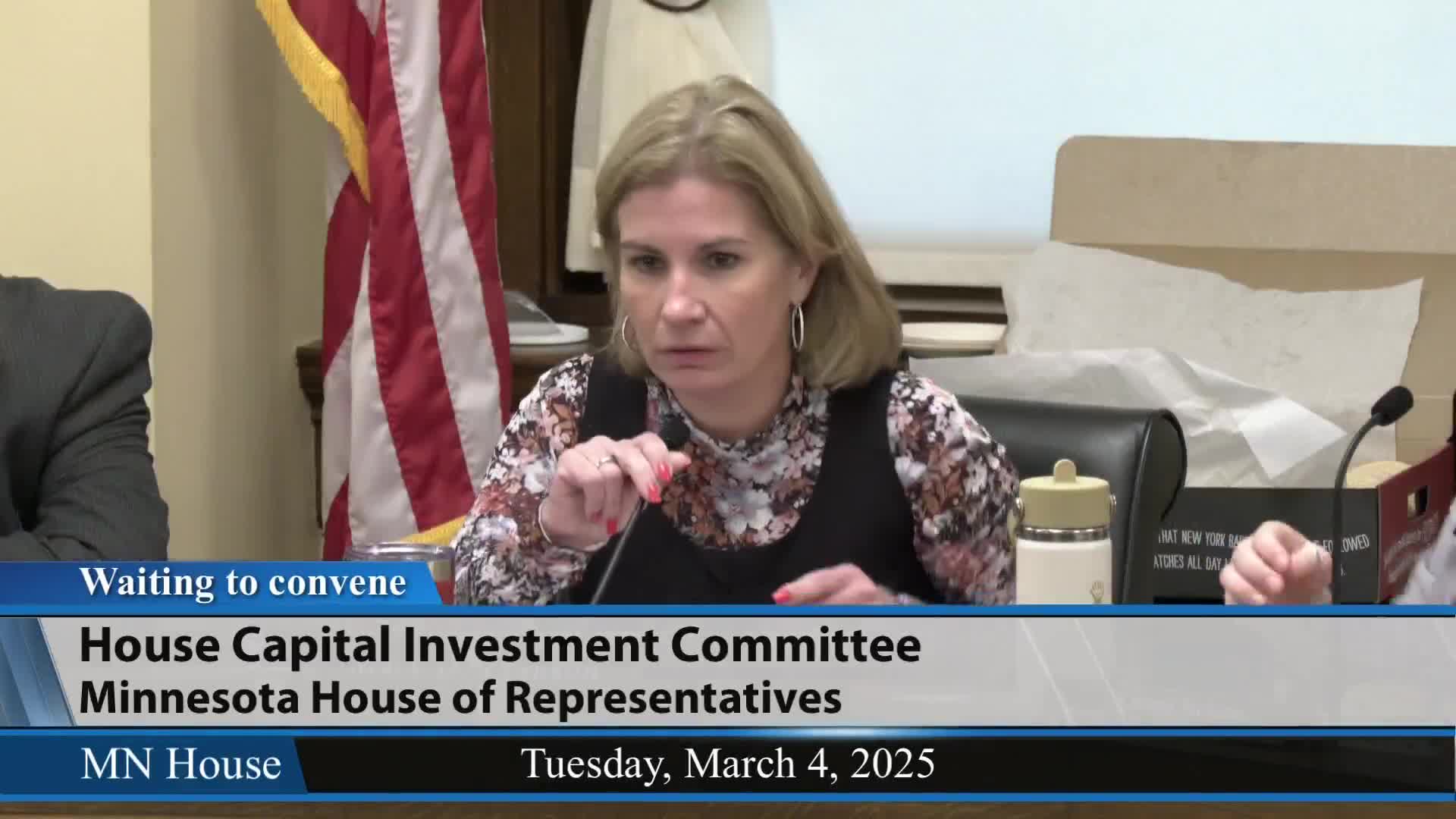
Capital Investment Committee hears 17 water and sewer bonding requests from Minnesota cities
Summary
The Minnesota House Capital Investment Committee on March 4 held informational hearings on 17 capital requests from cities and townships for water and sewer projects, including treatment plants, sewer main extensions, and water towers. No committee action was taken; the items were informational only.
The Minnesota House Capital Investment Committee on March 4 heard presentations on 17 informational bonding requests from municipalities across the state seeking help for drinking-water and wastewater projects, infrastructure replacement and upgrades, and sewer main expansions. Committee members did not take formal action; presenters were limited to five minutes each.
Why it matters: Committee members heard projects that proponents say affect public health, local development and affordability — from treatment to remove manganese, radium and PFAS in drinking water to sewer fixes aimed at reducing inflow and infiltration that can overload systems and send sewage toward local waters. Several cities said rising construction costs and limited local tax capacity require state assistance to keep utility bills from sharply increasing for residents.
Most of the requests presented were for water treatment plants, sewer main extensions, or major rehabilitation. Representative Bernie Perryman presented St. Joseph’s request for $6.2 million to expand a trunk sewer to open roughly 2,100 acres for industrial, commercial and residential development; City Administrator David Murphy said the city will match bonding and that costs have risen from last year’s $5.7 million estimate. Randy Sabar, St. Joseph city engineer, told the committee the project can be phased on design but the trunk sewer construction offers limited phasing options.
Laketown Township Chair Pete Paris testified that aging community wastewater systems installed in the 1980s now exceed their life expectancy and do not meet current code. He said engineering estimated the total project at about $25.4 million but that phase 1 could proceed with a reduced DE amendment of $6.4 million to enable phasing; Paris said some households on the existing system face assessments of $30,000–$35,000 and that without state funding the project cannot proceed.
Burnsville requested $8.55 million for upgrades at its combined surface- and groundwater treatment plant to address contaminants including radium, replace water lines and electrical infrastructure, and add ion-exchange and membrane filtration capacity; Mayor Elizabeth Kautz and Representative Kayla Berg said the city will meet local-match requirements. Representative Bralyn said committee members had toured the plant and observed the need.
Smaller and mid‑sized cities described a mix of compliance-driven and long‑deferred needs. Mound (House File 406) asked for continued assistance to treat manganese, which the city said the Minnesota Department of Health classifies as an emerging contaminant; Mayor Jason Holt told the panel the city faces an estimated $30 million remaining cost for a full treatment plant after prior appropriations and that a PFA grant this year might cover roughly $3 million. Minnetrista (House File 408) requested $26.755 million for a new treatment plant to remove manganese and iron; Council Member Kathleen Refkin said two new wells are drilled and the site is ready and that without bonding each entry-level home could see about $1,200 a year in added costs for 20 years.
Blue Earth (House File 730) sought $7 million (about 35% of the estimated project cost) to complete a reverse-osmosis system required by the Minnesota Pollution Control Agency; General Manager Tim Stoner said the city has raised rates over the past decade and that without the state funding monthly water and sewer bills could increase further. Lewisville (House File 731) asked for up to $10 million to replace citywide sewer, water systems and roads after earlier construction problems left the town with limited reserves; Mayor Barb Pfeil said average combined monthly utility bills are already about $120 and would rise to $190 without assistance.
Dayton presented two related bills: a wellhead treatment plant request to treat elevated manganese and other contaminants (House File 314) and a separate water tower for the historic village area (House File 315) to improve pressure and fire flows. Mayor Dennis Fisher and City Administrator Zack Dowd described rapid growth in much of Dayton but noted the historic village area is not expected to grow and needs targeted fixes.
Waseca (House Files 425 and 426) made two requests: sanitary sewer repairs to reduce inflow and infiltration (I&I) into the system and replacement of an aging water tower. City Manager Carl Sonnenberg said heavy rain events overflow the system and that costs and high utility rates have pressured the city for years; he said the water tower project is planned to be phased and estimated at $7.5 million over time.
Brooklyn Park requested $4.5 million (House File 1017) for a water‑main crossing to serve a 250‑acre biotech innovation district at the Highway 610/169 interchange; Mayor Hollis Winston and City Engineer Mark Culver said crossing under major MnDOT facilities requires upsized mains and steel casings that raise costs but would unlock development the city says would create jobs and housing.
Newport presented two I&I requests (House Files 652 and 761). Mayor Lori Elliott and staff described severe inflow during rain events — one 3.1‑inch storm produced nearly 3 million gallons treated as sewage — and warned that special assessments could approach $10,000 per property in some neighborhoods without state help. Newport officials said the city is designated by Metro Waste as a high I&I priority and that costs fall heavily on lower‑income households.
South St. Paul (House File 1079) sought $3 million for pressure‑control valves and related distribution improvements that staff said were deferred while the city built a radium treatment plant at Well No. 3; City Administrator Ryan Garcia said recent projects funded through the Drinking Water Revolving Fund increased median residential bills by roughly 23% in the first year and 10% in the second year. Garcia also noted a potential $6.5–$7 million estimate for future PFAS treatment at another well.
Saint Francis (House File 1056) asked for $3 million toward an $8 million water and sewer trunk‑line project timed to avoid re‑digging when MnDOT reconstructs Highway 47 through the city. City Council Member Kevin Robinson and City Administrator Kate Lundstrom said aligning the timing with the highway project reduces total costs and inefficiencies.
Scandia requested help for the Bliss neighborhood wastewater system, which serves 79 homes on Big Marine Lake and was built in the late 1980s. Les Heen said updated MPCA requirements to remove nitrogen and phosphorus mean the system needs new treatment; he said residents would otherwise see monthly bills jump from roughly $142 to $565.
Committee procedure: Chair Fransen opened the meeting noting a quorum and the informational nature of the hearing; presentations were constrained to five minutes. The committee approved the minutes from Feb. 27 by voice vote (moved by Representative Jeong). No bills were advanced or voted on; presenters were told the requests would be “laid over.”
What committee members asked: Questions focused on phasing options, updated cost estimates, grant eligibility (PFA and Drinking Water Revolving Fund), the distributional impact of assessments on low‑income households, and how projects align with state or MnDOT schedules. Multiple presenters said phasing is possible for design work but that certain construction elements — notably trunk sewers and major crossings — offer limited phasing without sacrificing project scope.
What’s next: These requests will remain informational at the committee level until sponsors seek formal action or bonding language is drafted into the capital investment bill. Several municipalities said they will pursue PFA or other grants in parallel and asked the committee to consider state assistance to avoid large, one‑time assessments or steep utility increases for residents.