Get Full Government Meeting Transcripts, Videos, & Alerts Forever!
Get email alerts on the Water Infrastructure topic
No spam. Unsubscribe anytime.
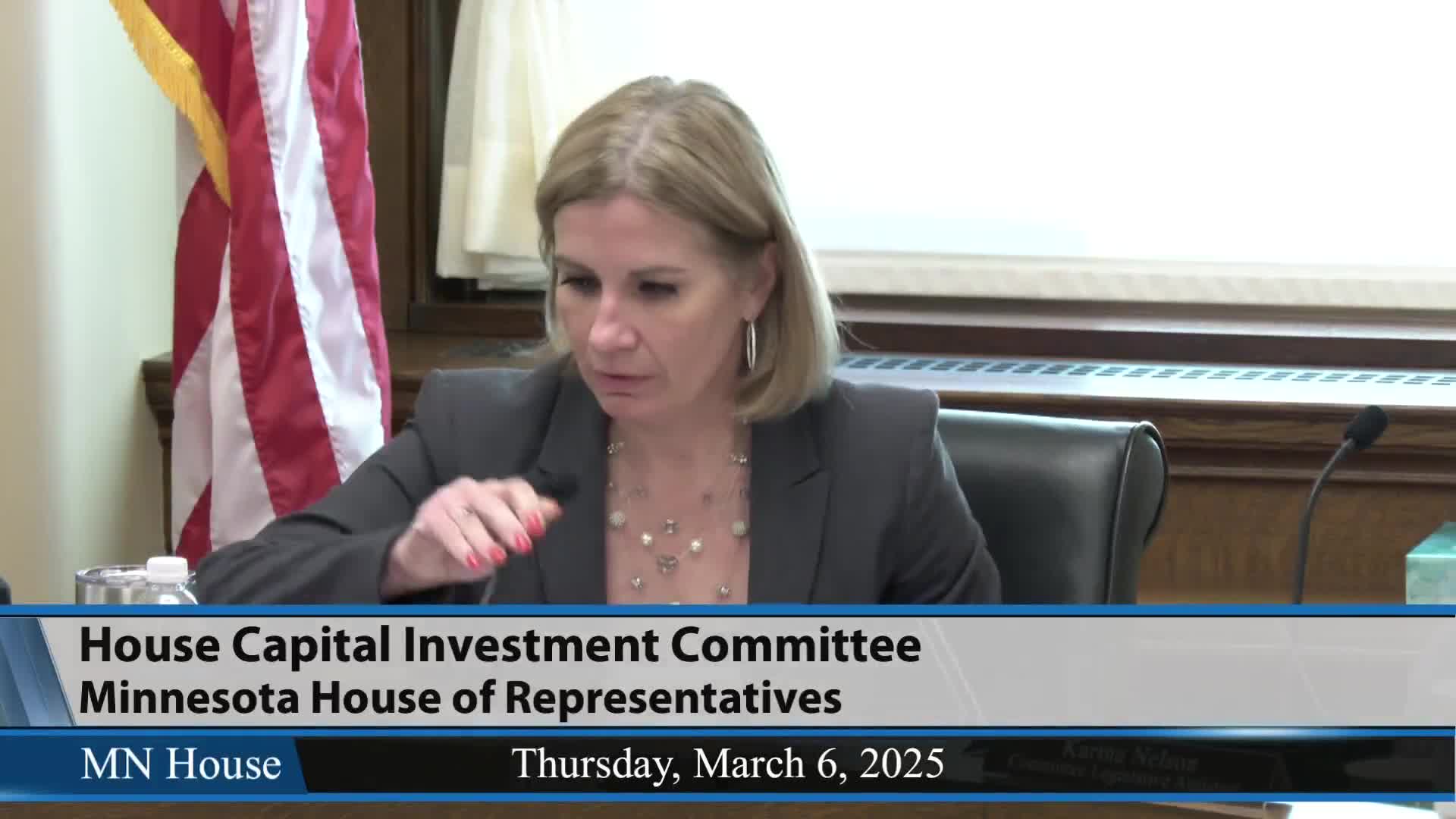
Minn. Capital Investment Committee hears more than a dozen water and sewer bonding requests
Summary
On March 6, 2025 the Capital Investment Committee heard requests from more than a dozen Minnesota cities and towns seeking state bonding for water treatment, sewer, levee and drinking-water projects. Requests ranged from small towns seeking under $1 million to larger cities seeking tens of millions of dollars; no votes were taken.
The Capital Investment Committee on March 6, 2025 heard requests from mayors, city managers and legislators across the state for bonding support to repair and expand drinking-water and wastewater systems.
The requests addressed a common theme — aging infrastructure, public-health concerns and limits on local capacity to finance major projects. Committee members heard presentations from representatives and municipal officials for Henderson, Carver, New Germany, Manchester, Albert Lea, Eagle Lake, Duluth (Lakewood plant), Bloomington, Raymond, Clarks Grove, Minneapolis, a five-city regional project in Goodhue County, Russell, Tracy, Ghent, Hanley Falls, Wood Lake and Cottonwood, among others.
Many cities said federal and state regulatory requirements, limited local tax bases and prior debt have left them unable to cover the full cost of needed upgrades. "With these efforts combined with help from the state, we are closer than we've ever been to seeing this project across the finish line," Mayor Courtney Johnson of Carver said of that city's levee and flood-mitigation plan. Eric Simonson, testifying for Duluth, told the committee that recent EPA enforcement and inspection activity had "dramatically accelerated" the timeline for corrective work at the Lakewood regional water plant.
Details presented to the committee included project totals, prior appropriations and the specific state ask where available. Highlights from testimony and materials provided to the committee: Carver seeks $3,350,000 toward a $13,000,000 levee and flood-mitigation project (the city previously received $6,000,000 and reports $8,750,000 in other funds and $1,200,000 in local contribution); New Germany requested $8,000,000 toward a $10,660,000 wastewater expansion to lift a moratorium on new services; Albert Lea requested up to $37,000,000 to complete remaining phases of a multi‑phase wastewater upgrade (phase 2 cost cited as $25,000,000, with a 50% state request of $12,500,000 as one option); Duluth’s Lakewood Water Treatment Facility requested $21,208,000 (50% of a $42,400,000 package); Bloomington sought $13,000,000 toward a $26,000,000 sanitary sewer upsizing project to support redevelopment; Eagle Lake requested $7,100,000 of a $14,100,000 project; Raymond asked for $4,000,000 to replace an undersized, aging water system with public‑safety implications; Russell requested $4,000,000 to fill a gap in a $13,100,000 two‑phase project following a $9,800,000 Phase 1; Tracy sought $12,000,000 toward a broader $70,000,000 program of water, sewer and stormwater replacement; Wood Lake reported a $4,525,000 ask to close a gap in a $6,200,000 final phase; Cottonwood requested $8,000,000 for a first phase of water and sewer replacement and noted a separate $3,880,000 agreement to join Lincoln Pipestone Rural Water as a supplier. Minneapolis asked for $12,360,000 to rehabilitate a 2.6‑mile transmission main damaged in a December 2022 break. Other towns presented project descriptions and affordability analyses but did not provide a single, consolidated dollar figure during testimony.
Committee members asked questions about prior appropriations, breakdowns of local match and the sequencing of work. Several presenters described work already completed or in progress (engineering reports submitted, pond work completed, prior phases built) and said projects are shovel‑ready if state funds are approved. Officials repeatedly noted the limits of local tax bases in small, rural towns: multiple presenters said proposed projects would push household utility bills well above current levels without state assistance.
No formal motions or votes occurred at the March 6 hearing. Committee staff and members indicated the requests will be considered alongside other bonding priorities; members noted the state’s constrained bonding capacity in the current forecast.
The committee is scheduled to reconvene for another hearing on March 11, 2025. Municipal officials and legislators who testified — and the projects they described — may appear in future bonding proposals the committee considers.