Get Full Government Meeting Transcripts, Videos, & Alerts Forever!
Get email alerts on the Federal Funding Iija Ira Chips topic
No spam. Unsubscribe anytime.
Federal funding uncertainty complicates Minnesota planning; state reports $12.3 billion in awards tracked
Summary
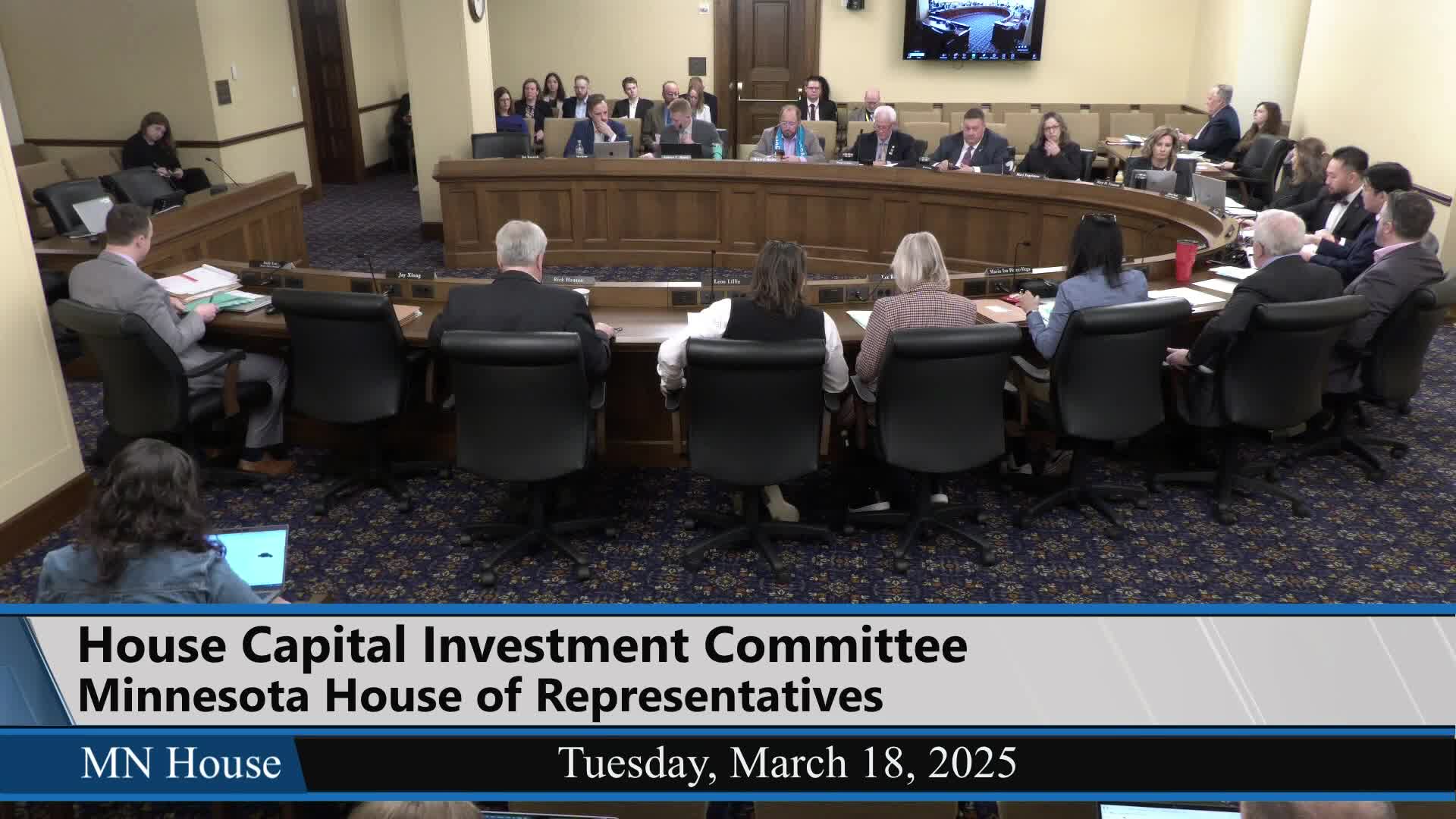
Federal funding freezes, pending federal tax changes and litigation are creating planning challenges for Minnesota projects funded by IIJA, IRA and CHIPS, state and national officials told the House Capital Investment Committee on March 18.
Federal budget actions, administrative funding freezes and litigation are creating uncertainty for Minnesota projects funded by the Infrastructure Investment and Jobs Act, the Inflation Reduction Act and CHIPS, a National Conference of State Legislatures official told the House Capital Investment Committee on March 18.
Brian Wankel, senior legislative director for budgets and revenue at NCSL, said states face “a massive collision of initiatives” — reconciliation, executive funding freezes, tax changes and the debt limit — that together could slow or alter funding that reaches states. “All this is creating uncertainty for states,” Wankel said, advising legislatures to plan contingencies in case federal funds arrive late or are rescinded.
Minnesota Management and Budget officials told the committee the state is actively tracking federal awards and preparing to support local governments and other entities in pursuing funds. Anna Menge, assistant commissioner and state budget director, told the committee that since the last update the enterprise has secured roughly $3 billion more, bringing Minnesota's tracked total to about $12.3 billion. MMB said the $12.3 billion figure combines announced and obligated awards and includes estimated formula allocations through fiscal year 2026.
Leah Corey, enterprise director for federal funds implementation at MMB, described four state work streams: strategy development, coordinated pursuit of opportunities, technical assistance and monitoring of awards. She noted the state maintains an interactive dashboard listing projects funded through IIJA, IRA and CHIPS, and that the enterprise is tracking about 1,800 discrete projects across Minnesota.
Corey outlined three state flexible-match programs created by the 2023 Legislature: an IIJA discretionary match fund administered by MnDOT ($185 million state commitment, which MMB said has helped unlock over $1 billion in federal awards), the State Competitiveness Fund at the Department of Commerce (nearly $17 million unlocking about $90 million), and the Forward Fund at DEED (roughly $224 million in state commitment intended to leverage more than $1 billion in federal and private funds). MMB said those totals include both awards flowing through the enterprise and some larger awards that go directly to local governments.
The committee heard about the state's work on new IRA “direct pay” authorities allowing tax-exempt entities to receive payments for eligible clean-energy projects once projects are placed in service and paperwork is filed. Corey said the state has filed for direct pay on several projects and is awaiting manual review by the IRS. She said the Minnesota Climate Innovation Finance Authority (MNCIFA), a state green bank seeded with a one-time $45 million state appropriation, is offering loans to help entities that lack upfront capital to pursue projects that could later generate direct-pay receipts.
Committee members asked about project-level timing and how to obtain a state-by-state breakdown of IIJA awards. Wankel said the NCSL data packet did not include a per-state DOT spreadsheet but offered to follow up; MMB said it posts an interactive project map on its website and recommended members submit lists of district projects that rely on federal funds so staff can request status updates from federal agencies.
MMB also reported that of the $12.3 billion tracked, roughly $8.5 billion flows directly to the state enterprise (including announced and obligated awards), about $3.6 billion of that has already been spent, roughly $1.5 billion represents future estimated flows and an estimated $2.2 billion are larger awards routed outside the enterprise. Officials warned that "announced" awards are not always obligated or under contract and are the most vulnerable to change.
The committee concluded the panel by urging members to gather project lists from local governments to help state staff and federal partners track at-risk awards.