Get Full Government Meeting Transcripts, Videos, & Alerts Forever!
Get email alerts on the Capital Investment topic
No spam. Unsubscribe anytime.
Committee hears 17 capital investment requests ranging from roadwork to specialized campus; no final votes taken
Summary
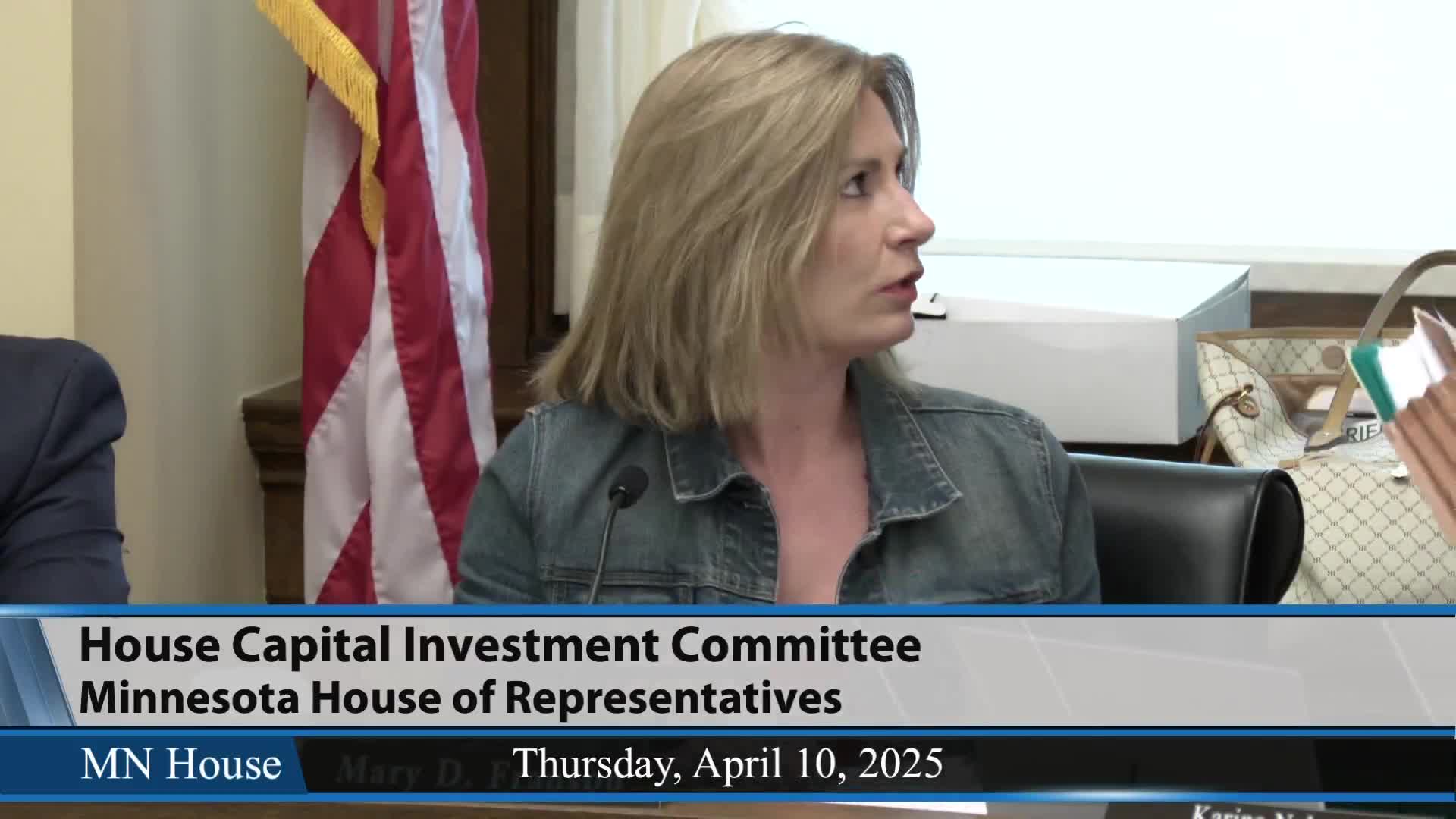
The House Capital Investment Committee heard testimony April 10 on 17 separate capital requests from cities, counties and nonprofit programs across Minnesota, including multimillion‑dollar road and interchange projects, wastewater and lift‑station work, and a proposed permanent campus for Minnesota Independence College & Community (MICC). Committee members did not take final votes on the project requests during the hearing; the only recorded motion was approval of the committee minutes.
The House Capital Investment Committee heard testimony April 10 on 17 separate capital requests from cities, counties and nonprofit programs across Minnesota, including multimillion‑dollar road and interchange projects, wastewater and lift‑station work, and a proposed permanent campus for Minnesota Independence College & Community (MICC). Committee members did not take final votes on any of the project requests during the hearing; the only recorded motion was approval of the committee minutes.
The most prominent asks included a $21,000,000 request from Benton County for the Mayhew Lake Road Safety and Improvement Project, a corridor reconstruction project that county officials say will add roundabouts, expand capacity and build a separated shared‑use path near Sauk Rapids. Benton County Commissioner Jared Gapinski told the committee, “Today we are seeking $21,000,000 for the Mayhew Lake Road Safety and Improvement Project,” and emphasized a documented crash history at five intersections in the corridor. Commissioner Steve Heine described the request as a multi‑phase program; he said phase 1 — construction of a roundabout at the northern project limit near the school — is expected to cost about $8,750,000 and could begin this summer.
Smaller but urgent local requests included a $2,100,000 grant request for a new lift station in Spicer, presented by Mayor Robin DeCappellino and carried by Representative Baker. DeCappellino said the current 2006 lift station is aging, sits on private property and “if it fails, the consequences will be severe — sewage backups, contamination of Green Lake, and serious health hazards.” The city projects about 100 new homes and 32 acres of potential single‑family development over five years and said local resources cannot cover the replacement cost.
Several communities sought road reconstruction or safety funding. Sturgeon Lake asked for $2,700,000 to reconstruct roughly 3.5 miles of streets after engineers identified roads in need of rebuilding; City Engineer Tim Corby said the request assumes a 10% local match and put the total project cost near $3,000,000. Crosby requested $1,800,000 to rebuild First Street North, a project connected to tourism and the nearby Cuyuna recreational area. Slayton sought approximately $2,500,000 from the state for a 0.8‑mile reconstruction project to be split roughly 50/50 with local funding.
Interchange and trunk‑highway requests drew regional framing. Olmsted County Commissioner Michelle Rossman testified for interchange predesign and environmental work on the Trunk Highway 14 corridor between Rochester and Mankato, asking that the committee fund design for two grade‑separated interchanges identified by a corridor study; Rossman said the corridor had “35 crashes at Cassaw 3, including 2 fatalities” in the last decade. Wabasha and Byron presented realignment and interchange requests tied to flood resilience and regional freight movement; Wabasha’s packet noted a $12,300,000 total project cost with a state ask of about $2.9 million and a $5,000,000 congressionally directed allocation that would expire in 2027 without timely state action.
Dakota County and the city of Lakeville described safety and capacity problems at County Road 50 where it passes under Interstate 35, asking for state funds for bridge and interchange work; Dakota County Commissioner Mary Liz Holberg said local partners have already invested substantial funds and proposed a 50% local match. Cottage Grove and Washington County requested $22,500,000 for a County Road 19A and 100th Street realignment to serve a large business park and unlock roughly 500 acres for development; Mayor Myron Bailey said the project would enable access to high‑potential land and protect competitive federal grant funding already secured.
Other requests included: $6,000,000 for a Freeport I‑94 overpass replacement; $1,200,000 (approx.) to complete a missing section of Hornsby Street in Columbus (a submitted figure of $762,000 was mentioned for a portion of the work); a $1,000,000 construction request from Sibley County to reconstruct a county road to relieve a dangerous intersection near a newly built school; a $1,200,000 request to resurface State Highway 74 in Winona County with an “auto seal” surface after MnDOT removed it in 2021 (Representative Jacob said the 2001 auto seal lasted 20 years); Butterfield presented phased sewer and lift station work (a phased state ask of about $7.9 million was discussed); and North Branch requested $4,000,000 for predesign and right‑of‑way work for an interchange along State Highway 95 to route truck traffic away from downtown.
The hearing included one nonprofit capital ask: MICC (Minnesota Independence College & Community) requested $11,000,000 in state funds toward an $18,000,000 permanent, purpose‑built campus in Richfield to expand services for autistic and neurodivergent young adults. MICC CEO Amy Goodmstead said the organization currently operates in a patchwork of rented spaces and serves about 183 individuals each year; the permanent campus would be 27,000 square feet and include classroom and vocational space.
Presenters repeatedly noted reliance on mixed funding: local levies, county state aid, federal competitive grants (including RAISE/RAISE‑type grants and congressional directed allocations), and conditional local matches. Several presenters stressed the need for predesign and environmental work as a prerequisite to applying for larger federal construction grants. Benton County noted it has applied three times for a RAISE grant but has not been accepted to date. Commissioner Karla Bingham said Cottage Grove and the county have already secured $13.6 million in competitive grants for their project and warned that federal funds are at risk if projects cannot advance.
Committee members and presenters asked procedural and scope questions (for example, whether requests were total project costs or phased asks, and whether local matches were committed). Representative O’Driscoll and other bill authors emphasized that many requests are phase‑one or predesign asks intended to position projects for larger federal or local funding in later years.
Votes at a glance - Approval of minutes: Motion to approve made by Representative Frederick; outcome — approved (no roll call recorded). - All capital requests heard: no formal committee votes or final dispositions recorded during the hearing; each request was presented for the record and will await future committee action or inclusion in a bonding package.
The committee adjourned at the end of the hearing without additional votes. Several speakers invited members to view projects in person and pointed to time‑sensitive federal matches or grant deadlines that could affect project feasibility.
Sources: committee testimony and project handouts delivered during the April 10 hearing. Direct quotes in this article are attributed to presenters who spoke on the record at the hearing.