Get Full Government Meeting Transcripts, Videos, & Alerts Forever!
Get email alerts on the Sustainable Aviation Fuel topic
No spam. Unsubscribe anytime.
Minnesota lawmakers hear pitch to build sustainable aviation fuel industry at MSP, tout jobs and farmland markets
Summary
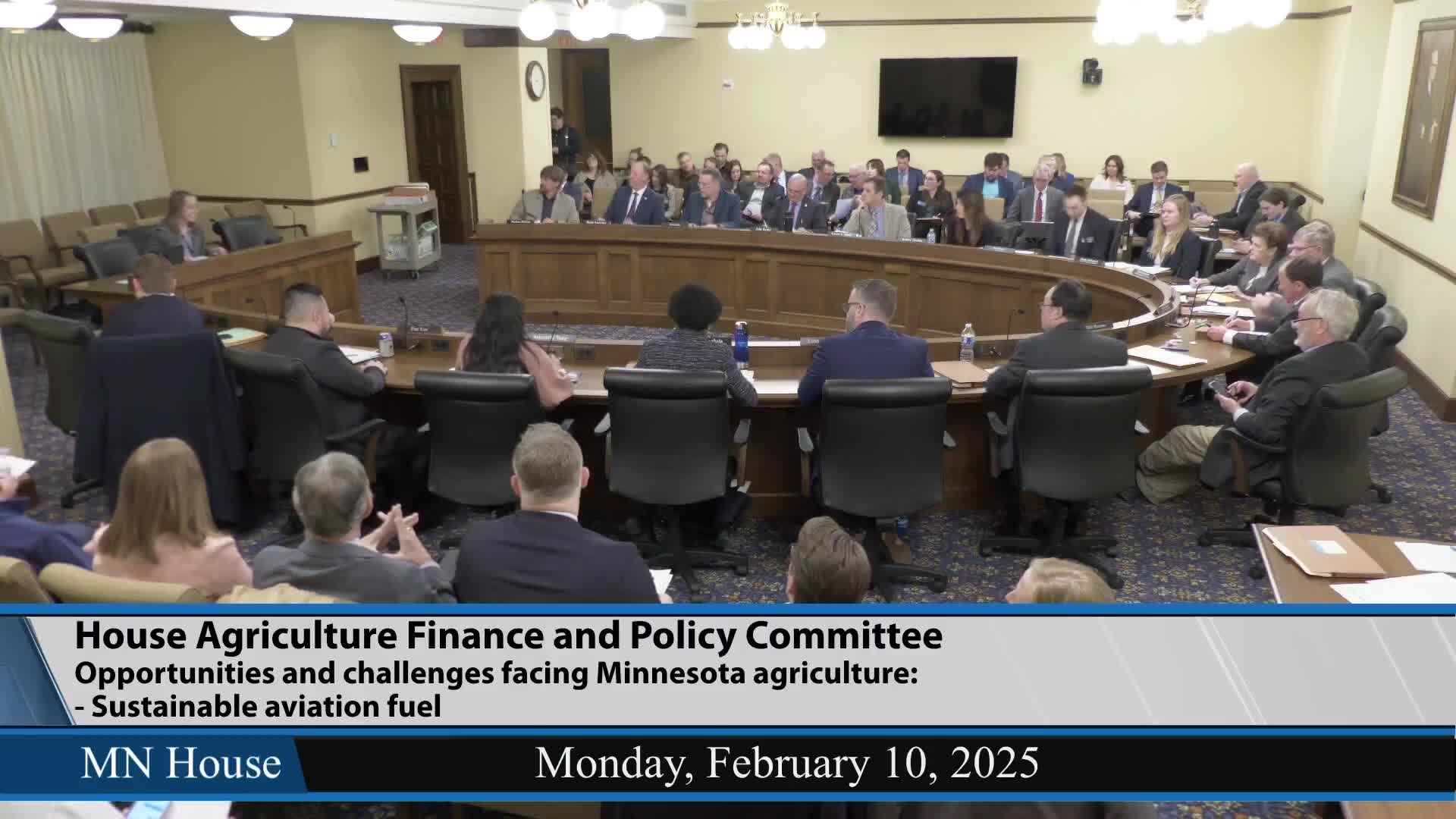
Minnesota officials, airlines and farm groups told the House Agriculture Finance and Policy Committee on Wednesday that the state has a narrow opportunity to build a sustainable aviation fuel (SAF) industry anchored at Minneapolis‑Saint Paul International Airport but will need continued state incentives, clear sustainability rules and faster permitting to scale production.
Minnesota officials, airlines and farm groups told the House Agriculture Finance and Policy Committee on Wednesday that the state has a narrow opportunity to build a sustainable aviation fuel (SAF) industry anchored at Minneapolis‑Saint Paul International Airport but will need continued state incentives, clear sustainability rules and faster permitting to scale production.
"The Wallace Lanigan administration is extremely excited about the opportunities that SAF presents for our agricultural, forestry, and clean energy sectors here in Minnesota," said Andrea Vawbel, deputy commissioner at the Minnesota Department of Agriculture. Vawbel told the committee the 2023 state SAF tax credit was intended to stack with federal Inflation Reduction Act incentives and that the state had supported the program at about $11,600,000 in its budget.
Committee members were told SAF is already certified for use in modern aircraft and can be blended with conventional jet fuel. Delta Airlines and a statewide public‑private partnership called the Minnesota SAF Hub described plans to use Minnesota feedstocks — from used cooking oil to corn, winter camelina and wood residues — to produce low‑carbon jet fuel that can be delivered into the airport’s existing fuel system.
"SAF will make up about 60% of our efforts to get to our net‑zero goal," Jeff Davin of Delta Airlines said, describing SAF as the industry’s primary near‑term lever to cut in‑flight emissions. Davin said Delta uses MSP as a major hub and hopes to source SAF made from Minnesota feedstock for planes departing the airport.
Peter Frosh, chief executive of Greater MSP and a lead organizer of the Minnesota SAF Hub, summarized the hub’s strategy: quickly get SAF into MSP through blending and buying, then recruit refiners to make SAF at scale in Minnesota and expand feedstock acreage and supply chains. Frosh told the committee an independent analysis of building three refineries — each sized at about 50 million gallons per year — estimated roughly 55,000 construction job‑years and about 40,000 operations and supplier jobs across the first ten years of operation.
Speakers from farm and processing groups said corn‑to‑ethanol and other existing renewable‑fuel infrastructure give Minnesota a near‑term advantage. Amanda Bilek, senior public policy director for the Minnesota Corn Growers Association, said running farm‑level production data through the US Department of Energy GREET model reduced feedstock production carbon intensity by 31% compared with the model’s average values for the sampled acres.
Not all testimony was uniformly upbeat. Witnesses flagged three major constraints: supply and cost, measurement of sustainability, and permitting/finance. Davin and industry speakers said global SAF supply is tiny compared with demand: the U.S. aviation goal is about 3 billion gallons of SAF by 2030 for domestic carriers, while global production was reported in testimony as roughly 25 million gallons in 2022, about 140 million in 2023 and roughly 370 million in 2024. Producers said SAF currently costs several times conventional jet fuel.
On sustainability metrics, Frosh and other witnesses urged a national standard and transparent, third‑party verification. Frosh said Minnesota cannot create its own isolated metric and needs to ensure the same rigorous life‑cycle accounting is applied to all producers. Representative Rick Hansen asked directly how sustainability is quantified; witnesses pointed to the GREET model and discussed the need to include water‑quality and biodiversity measures in any robust assessment.
Speakers also warned of integrity risks in feedstock supply chains. Joe Smentek of the Minnesota Soybean Growers Association cited international cases where so‑called "used cooking oil" originated from virgin palm oil and urged rules that favor and verify domestic feedstocks and processing to avoid fraud that could undermine carbon claims.
The Minnesota SAF Hub described recent accomplishments: a blending facility under construction near MSP to route SAF into the airport, a private consortium that has committed to purchase initial supplies, a first flight out of MSP last September using camelina‑based SAF, and a public announcement from a company called DG Fuels proposing a multibillion‑dollar refinery near Moorhead. Frosh said DG Fuels’ announced project would be a roughly $5 billion plant producing about 193 million gallons per year if it proceeds.
Committee members asked staff and witnesses about next steps. There was no committee action or vote during the hearing. Witnesses urged the committee to preserve state incentives, work with federal tax credits such as those in the Inflation Reduction Act and the current federal clean‑fuel tax provisions, and streamline permitting to keep investment in Minnesota rather than in neighboring states.
The committee heard detailed questions about carbon accounting, the role of feedstock practices such as fertilizer use and manure management, and how to prevent perverse market effects that could disadvantage Minnesota growers. Testimony emphasized a multi‑pathway approach — corn‑to‑jet, HEFA (renewable hydrocarbons from oils), forestry residues, municipal waste and others — will be necessary to meet airlines’ stated goals.
No formal committee direction or binding decision was recorded at the hearing; members signaled interest in further briefings and in coordinating state incentives with federal rules to preserve the state’s competitive position.
Looking ahead, advocates said Minnesota’s combination of feedstocks, existing ethanol and oil‑processing infrastructure, university research and a major airport give the state an opening — but success will require federal policy certainty, clear measurement standards and timely state permitting and investment.