Get Full Government Meeting Transcripts, Videos, & Alerts Forever!
Get email alerts on the Rural Demographics And Health topic
No spam. Unsubscribe anytime.
Center for Rural Policy: population shifts, nursing‑care declines and mental‑health workforce gaps in rural Minnesota
Summary
The Center for Rural Policy and Development presented trends showing aging-driven natural population decline in rural counties, rising job vacancies, substantial reductions in nursing‑care capacity in rural areas and shortages in the mental‑health workforce and children's mental‑health services.
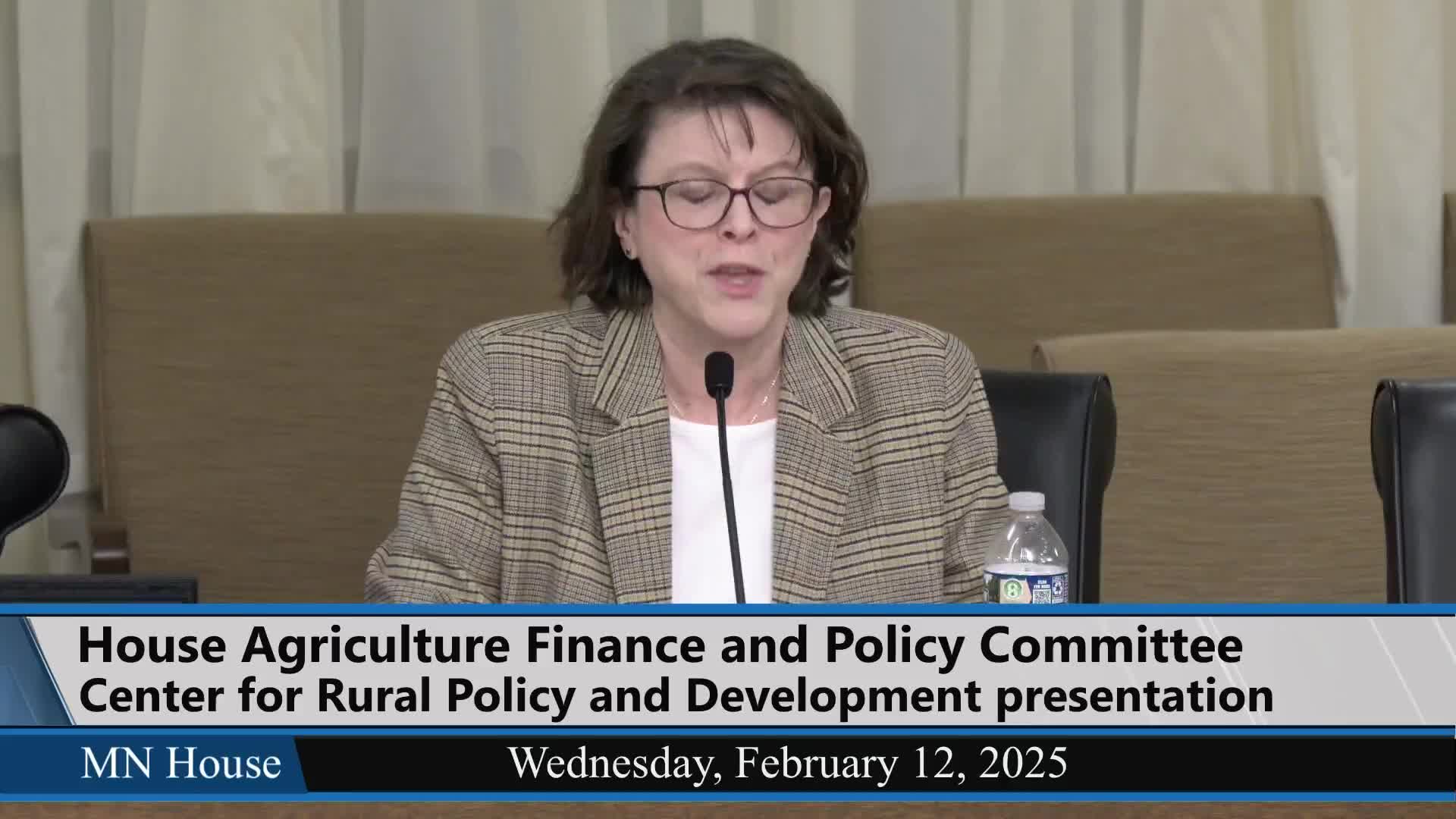
The Center for Rural Policy and Development briefed the Agriculture Finance and Policy Committee on statewide rural trends including population change, job vacancies, nursing facility capacity and mental‑health access.
Kelly Asch, senior researcher, summarized demographic trends showing that natural change (births versus deaths) is producing population declines in many rural counties because deaths now outnumber births. Asch said the pattern is strongest in the most rural counties and that positive population outcomes increasingly depend on in‑migration — both domestic and international — to offset natural decline. Asch noted that 21 Minnesota counties had lower population in 2023 than in 2010, a significant improvement from 46 counties earlier in the decade.
The center highlighted statewide job‑vacancy rates that are elevated above historical norms: the seven‑county metro had a 4.6 percent vacancy rate while the Northeast region reached about 6.6 percent; vacancies were lower than 2021 peak levels but remain high compared with a healthy range of roughly 3.0–4.5 percent.
Asch and Marnie Warner (vice president of research) also reported a substantial long‑term decline in nursing‑care beds: statewide data showed about a one‑third reduction in licensed nursing beds since 2005, with the steepest declines in the most rural counties (roughly 40–42 percent). The center identified two drivers: long‑term shifts in how elder care is delivered (more assisted living and home‑based care options) and workforce shortages that have led some facilities to close wings or take beds offline because they cannot staff them.
On mental health, Warner presented data showing rising mortality from suicide and drug overdose since about 2009, with suicide rates highest in the state’s most rural county group. She said Minnesota’s Native American population and farmers are groups of particular concern. Children’s mental health shows additional strain: Warner cited increasing reports of self‑harm among girls aged 10–19 and rising emergency‑department visits for suicidal ideation and severe anxiety among adolescents, especially since the pandemic.
Warner and Asch emphasized workforce constraints: roughly 60 percent of mental‑health workers are over age 55, and provider availability per capita declines with rurality (for example, the ratio cited in testimony was about 1 provider per 197 residents in metropolitan areas versus 1 per 741 residents in isolated rural areas). The center said higher‑education capacity is a bottleneck (faculty shortages and accreditation‑linked faculty‑to‑student ratios limit enrollment), and that rural clinics sometimes cannot afford to host trainees because reimbursement rates lag.
The center recommended bolstering prevention and early‑intervention services, expanding school‑linked mental‑health programs and primary‑care behavioral integration, supporting workforce pipelines and planning for future elder‑care capacity. Committee members asked about data crosstabs and special populations (for example, Amish communities and undercounts) and about policy details underlying long‑term care shifts. The center said it is conducting follow‑up work on access to mental health care for people of color in rural Minnesota and will share results with stakeholders.