Get Full Government Meeting Transcripts, Videos, & Alerts Forever!
Get email alerts on the Pfas Removal Fee Report topic
No spam. Unsubscribe anytime.
MPCA outlines fee options, cost estimates for PFAS removal from drinking water and wastewater
Summary
The Minnesota Pollution Control Agency presented a PFAS removal report offering fee‑based funding options and preliminary cost estimates for sampling, treatment and source‑reduction measures; MPCA officials said uncertainty about PFAS product use and reporting will complicate fee design and revenue forecasting.
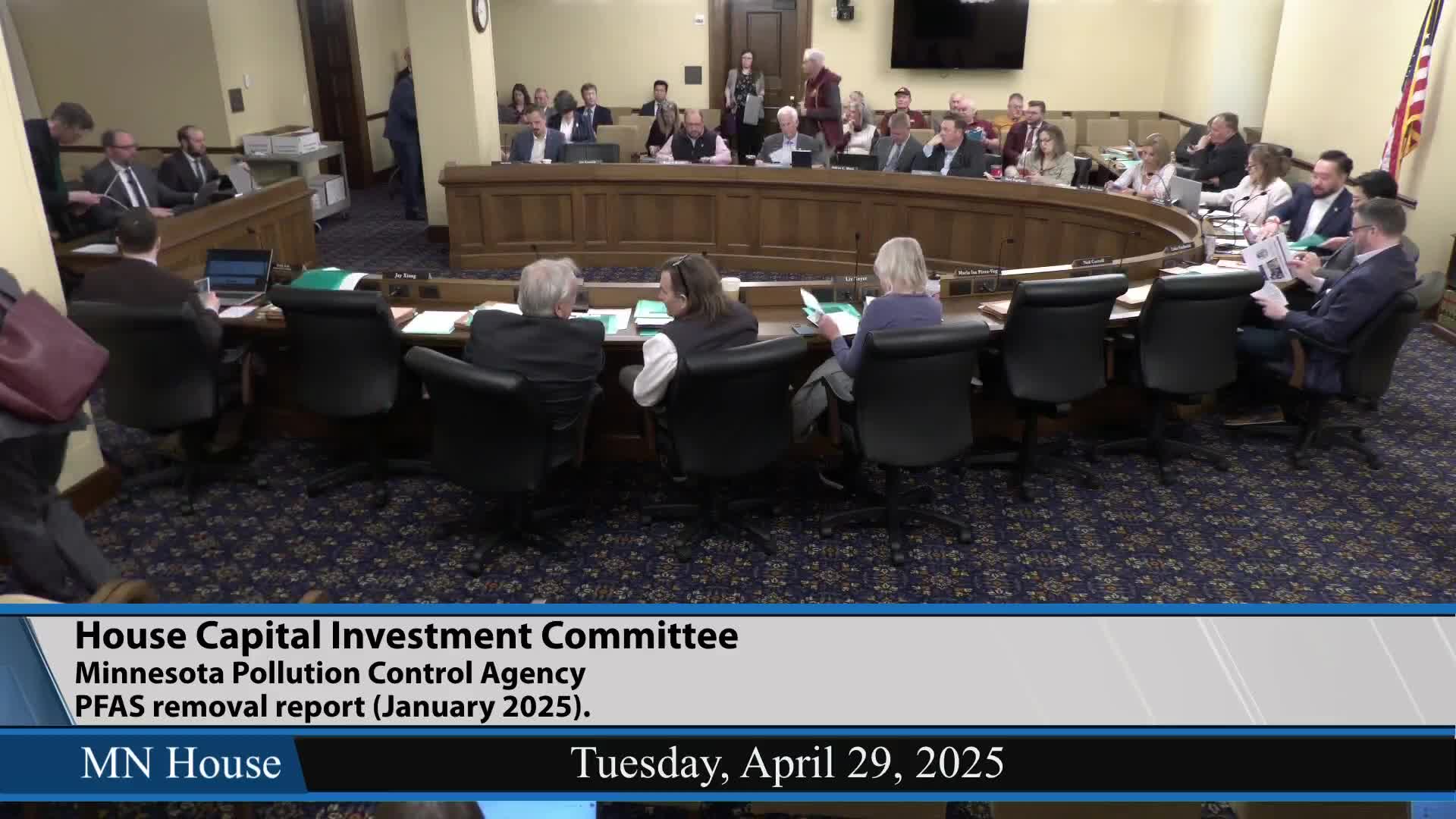
Kurt Koudelka, assistant commissioner at the Minnesota Pollution Control Agency, and Fox Char, the agency’s PFAS coordinator, briefed the Capital Investment Committee on a legislatively requested PFAS removal report on April 29. The report evaluates how a fee program could fund PFAS removal from drinking water and wastewater, and it presents a menu of policy choices for lawmakers.
MPCA staff said three foundational design choices would drive results: who pays (the universe of manufacturers and users subject to a fee), how the fee is structured (per‑pound rates vs. revenue‑target models) and the fee revenue target (how much money to raise to pay for treatment and programs). The agency recommended a target‑based approach in which the legislature sets a revenue target for PFAS remediation or treatment programs and the fee is divided among payers according to statutory criteria, citing precedent in other Minnesota fee programs such as the dry cleaner account.
The presentation highlighted major uncertainties: federal and state reporting systems are changing, confidential business information can limit data, and the number of entities that would be subject to a fee could range from a handful to thousands depending on definitions and thresholds. MPCA staff offered preliminary cost estimates: about $163 million to provide PFAS treatment for identified community drinking water systems (rough initial estimate); sampling 10% of private wells statewide could cost roughly $580 million, and treating the contaminated 2% of those sampled was estimated at about $7.3 million; wastewater source‑reduction and regional pretreatment work was estimated in the range of $7 million to $85 million; by contrast, end‑of‑pipe treatment at wastewater plants could run into tens of billions (the agency cited an illustrative $23.3 billion estimate for broad back‑end treatment approaches).
Agency witnesses emphasized that current removal technologies (granular activated carbon, ion exchange) remove PFAS but do not destroy it; residual media must be managed off‑site and Minnesota has no in‑state hazardous‑waste incinerator for destruction. The MPCA said promising destruction technologies exist but are not yet proven at facility scale and are the subject of ongoing pilot work. The agency’s report recommended that the legislature (1) statutorily identify who would be subject to fees, (2) set an overall fee revenue target tied to chosen projects and (3) decide how to allocate that target among fee payers.