Get Full Government Meeting Transcripts, Videos, & Alerts Forever!
Get email alerts on the Broadband Deployment topic
No spam. Unsubscribe anytime.
Office of Broadband Development outlines BEAD allocation, mapping and digital equity plans
Summary
The Office of Broadband Development (DEED) briefed the committee on broadband mapping, Border-to-Border grants, BEAD eligibility and the state's Digital Equity Act planning; officials cited remaining gaps, funding amounts and forthcoming subgrantee selection rounds.
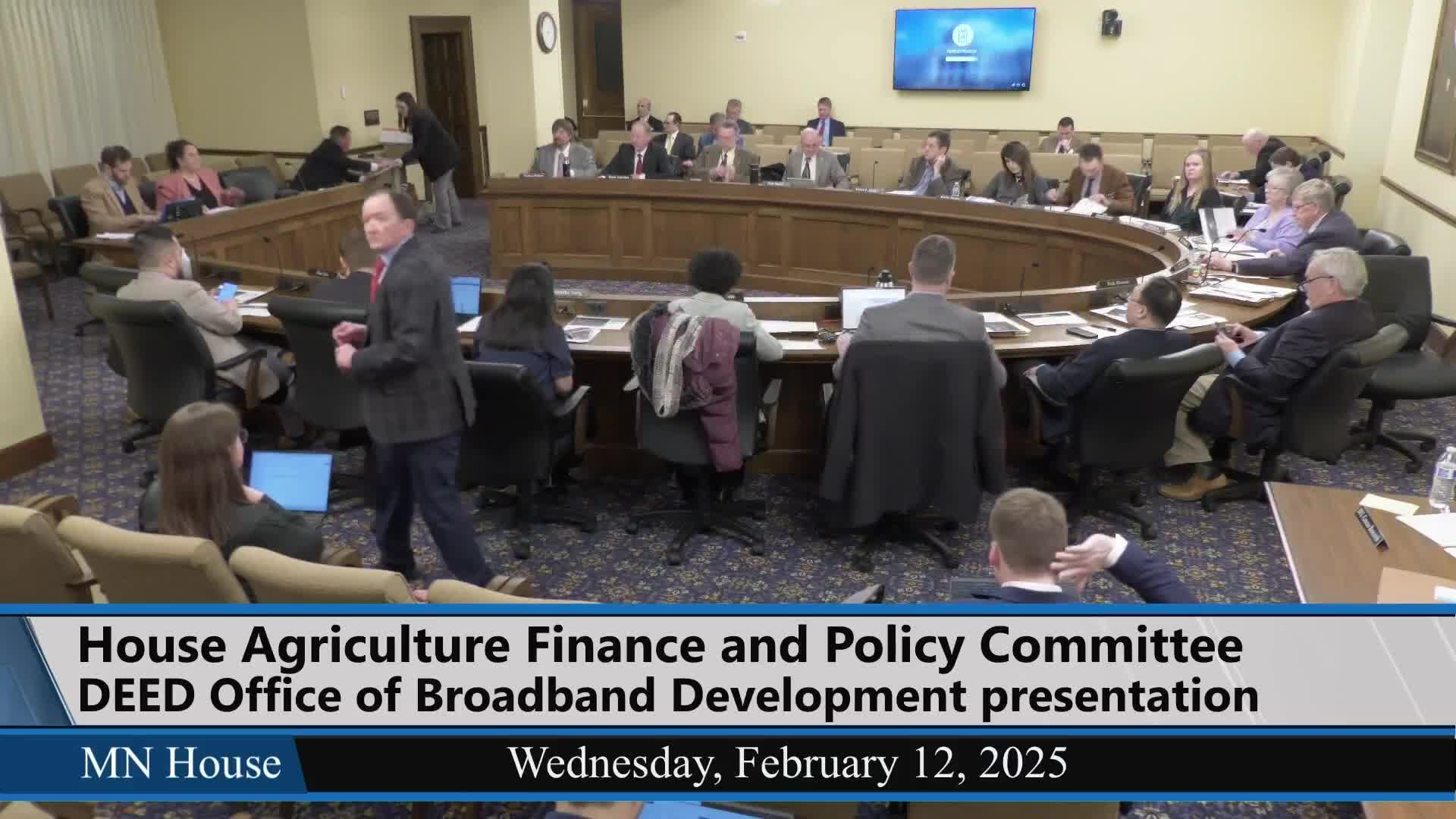
The Minnesota Office of Broadband Development (DEED) told the Agriculture Finance and Policy Committee it has completed mapping updates, closed state grant site visits and is preparing to administer federal BEAD (Broadband Equity, Access and Deployment) and Digital Equity Act funds.
Bridal Mackey, executive director of the Office of Broadband Development, summarized state and federal programs, eligibility counts and timelines. Mackey said December 2024 mapping showed about 143,000 homes and businesses without access to 25/3 Mbps and about 189,000 without 100/20 Mbps; under BEAD definitions roughly 81,000 locations were eligible for BEAD funding after a federal challenge process and subsequent refinement.
Mackey explained the state's Border-to-Border Grant program (up to 50 percent cost share on eligible locations) and the Low Population Density program (up to 75 percent cost share). The state has invested more than $400 million in broadband grants through multiple rounds, she said, with local providers contributing additional private investment. The line extension program — a reverse auction that requires household registration and offers up to $25,000 per location — has had three award rounds; about 5,700 locations self‑registered and roughly 2,200 were approved in awarded rounds.
On federal funds, Mackey described the BEAD allocation to Minnesota of $652 million and the Digital Equity Act capacity grant of $12 million. The state completed NTIA’s challenge process and had NTIA approve the final BEAD location list; the office is running a prequalification portal for providers through February and expects to open initial subgrantee selection rounds in March–April, with the first round focused on fiber-only projects. DEED plans three subgrantee selection rounds and continued due-duplication of locations as other funding sources become available.
Mackey said a state RFP estimated the cost to install fiber for every location in Minnesota would be much higher than BEAD funds alone — roughly $2 billion for universal fiber — while doing fiber to BEAD-eligible locations would cost approximately $99 million under the contractor’s analysis. She said that modeling indicated some locations will be served by alternative technologies because available funds and cost considerations will not support fiber everywhere.
Committee members asked about metro-area gaps, eligibility for line-extension if a household uses satellite service, administrative funds for program management and provider concerns about program requirements. Mackey said low‑orbit satellite is not treated as “reliable broadband” under the state definition and therefore a location currently using such service could be eligible for a line extension. She said Minnesota has access to planning and administrative funds from federal allocations (including a $5 million planning allowance), that the state allocated capital projects dollars ($130 million) for broadband, and that the office is coordinating with permitting and land‑use agencies to handle the expected workload. Mackey acknowledged provider concerns with federal program requirements and said DEED is advocating with NTIA to make participation more attractive while encouraging providers to prequalify.
No formal committee action was taken during the presentation; members requested follow-up on the approved BEAD plan, details on digital equity program design and lists of local projects by district.