Get Full Government Meeting Transcripts, Videos, & Alerts Forever!
Get email alerts on the University Capital Request topic
No spam. Unsubscribe anytime.
University of Minnesota requests $200 million for HEAPR, $20 million for FARM; seeks funding for Washington Avenue Bridge barriers
Summary
The University of Minnesota asked the Capital Investment Committee for $200 million in HEAPR funding, $20 million for a design of a new research farm and roughly $8 million to install suicide‑deterrent barriers and lighting on the Washington Avenue Bridge.
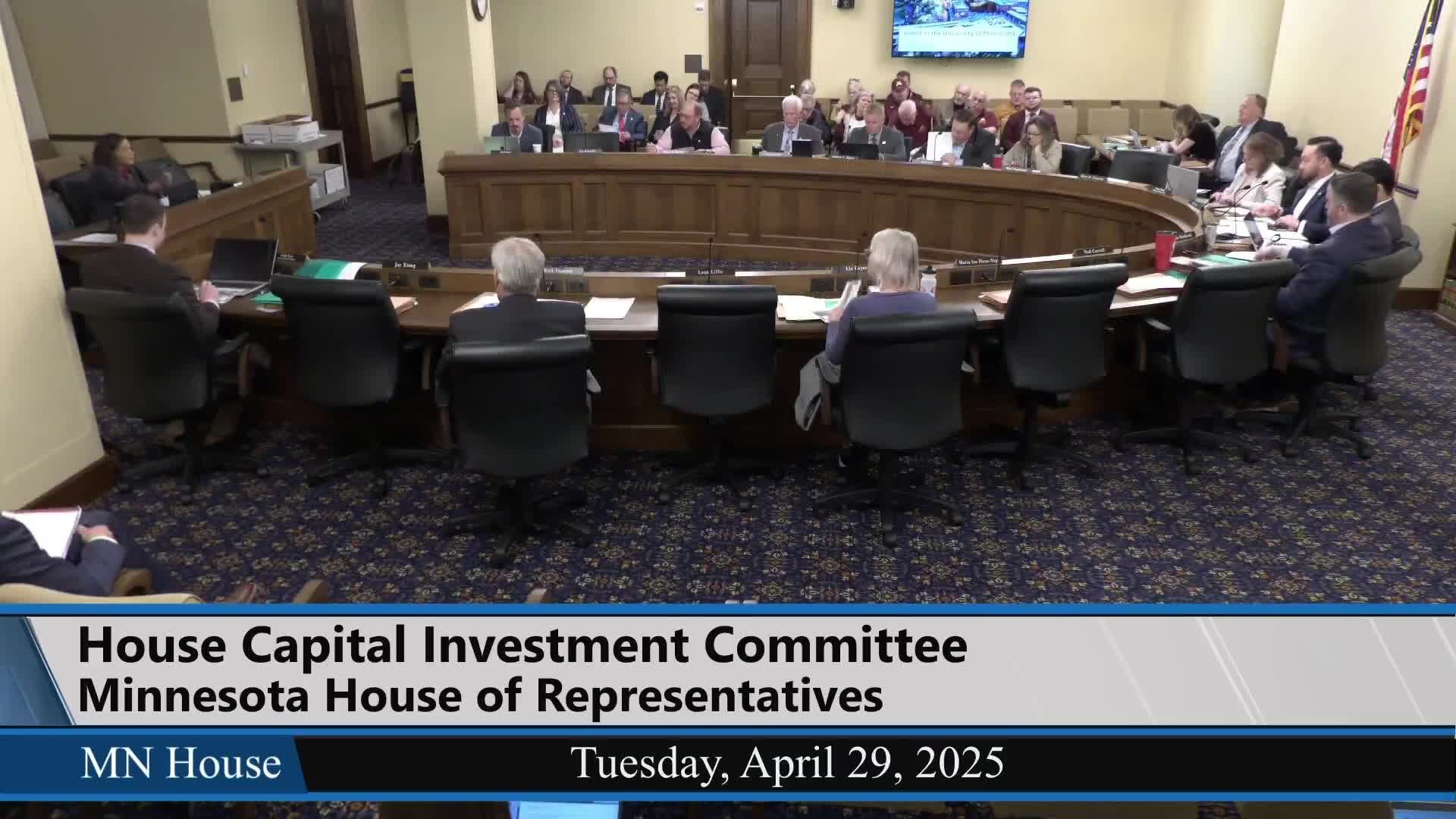
Alice Roberts Davis, vice president for University Services at the University of Minnesota, presented the system’s 2025 state capital request to the Capital Investment Committee on April 29, urging predictable funding for building renewal and outlining three priorities: a $200 million request for HEAPR (Higher Education Asset Preservation and Replacement), a $20 million design request for the Future of Advanced Agricultural Research in Minnesota (FARM), and funding to install suicide‑deterrent barriers and lighting on the Washington Avenue Bridge.
Roberts Davis said the university manages about 30,000,000 square feet of space, of which roughly 8,800,000 square feet is in poor or critical condition. She described HEAPR as the university’s primary tool for reinvesting in aging facilities; with $200 million, she said the university could address more than 100 projects in 75 buildings. The FARM project — a 1,300‑acre site in Mower County proposed in partnership with the Hormel Foundation — would use modern agricultural technologies for research, outreach and workforce training; the university requested $20 million for design.
The university also asked the committee to consider funding suicide‑deterrent railings and lighting on the Washington Avenue Bridge, a double‑deck connector across the Mississippi River that carries about 20,000 pedestrians and 7,000 cyclists daily. Roberts Davis said the university had spent about $78,000 on temporary fencing and an additional $25,000 contract to keep fencing in place; the estimated cost for permanent barriers and lighting is about $8,000,000. Hennepin County owns the bridge and the university would proceed with county approvals and permitting if funding were provided. Committee members pressed for timeline details; Roberts Davis said a funded project could be designed and permitted in roughly 90 days and take about 12 months to construct while keeping the bridge functional throughout staging.
Roberts Davis emphasized that state bond funding for higher education has become more variable and said the university’s 10‑year renewal need is about $6 billion. She gave a campus example: the Food Science and Nutrition building on the St. Paul campus (built 1956) needs electrical and HVAC upgrades to support modern laboratories and equipment. The university said it typically spends a large share of state capital funding quickly after appropriation and that about 90% of expenditures return to Minnesota companies.