Get Full Government Meeting Transcripts, Videos, & Alerts Forever!
Get email alerts on the Rural Mental Health topic
No spam. Unsubscribe anytime.
Legislatively funded rural mental health specialists say demand from farmers has surged
Summary
Two legislatively funded rural mental-health specialists described a rise in agrarian stress, calls for help, and training work with providers and families. They asked lawmakers to note the program’s capacity limits and the need for continued support.
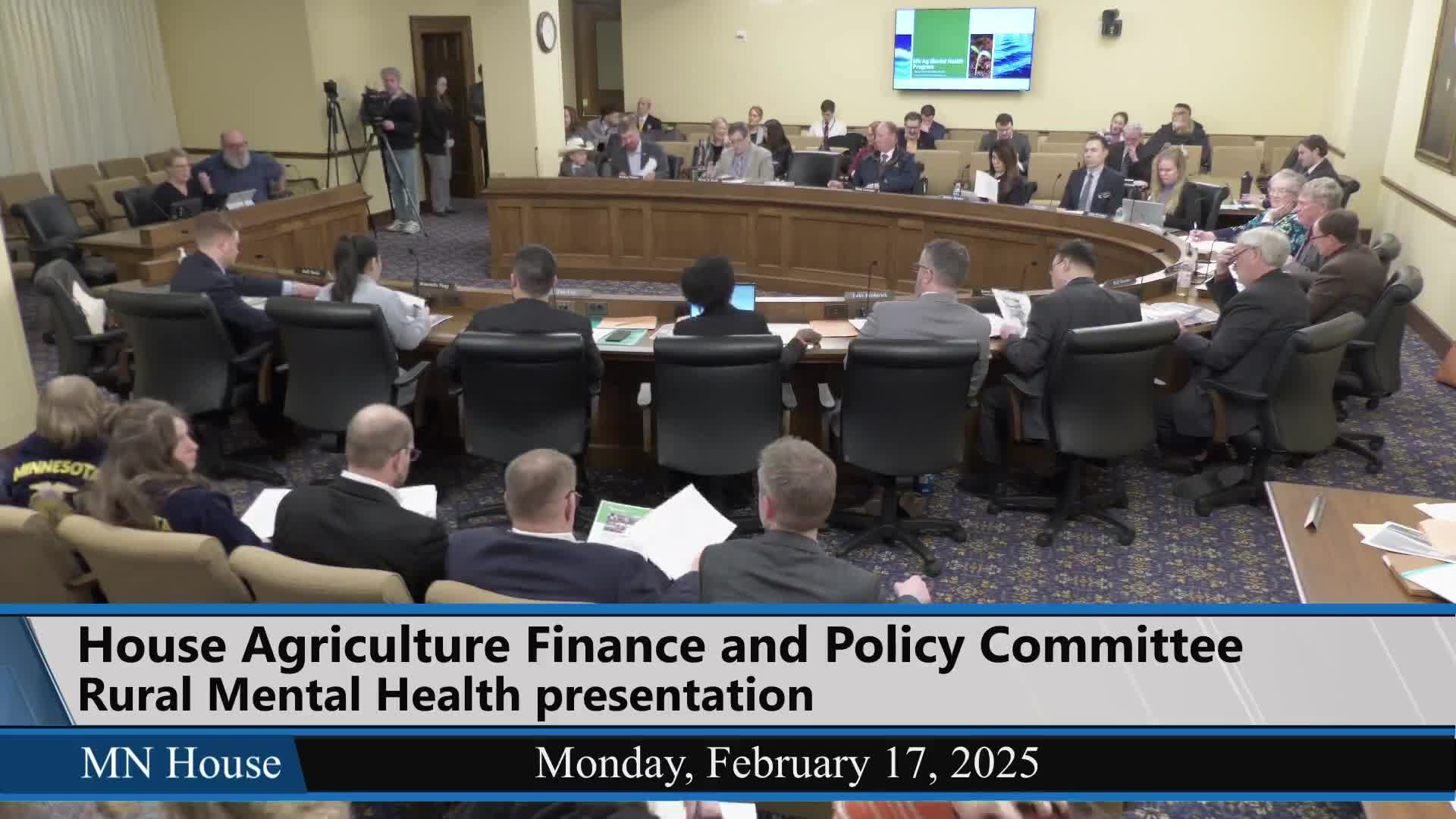
Monica McConkie and a second legislatively funded rural mental‑health specialist (identified in testimony as Mr. Matthews) told the House Ag Finance and Policy Committee that they provide no‑cost, farm‑competent counseling, crisis support, suicide-prevention training, and outreach to agricultural families across Minnesota.
"From my perspective, the most common presenting problems that arose in 2024 ... were stress, of course, depression, anxiety, relationship issues, farm family member conflict, especially during transition succession planning, as well as substance use," Monica McConkie said. She added that in 2024 she provided roughly 652 client sessions and about 650 requests for help via calls and emails, plus a slate of trainings for providers and community groups.
Ted Matthews (testimony identified him as the program’s other specialist) described program features that distinguish the rural specialists from general‑purpose clinics: immediate hotline responsiveness, no cost to the caller, travel to farms, and an agricultural competence the specialists say is essential to trust and effective care.
Why it matters: Committee members and presenters discussed the program’s role as a frontline resource during farm downturns and natural disasters. Representative Hansen and others asked whether tribal communities and farm workers are being reached; presenters said demand already exceeds current capacity and acknowledged outreach and cultural‑competence needs. Committee staff noted a base appropriation (listed in committee materials) for mental‑health grants of roughly $520,000 for the biennium. Presenters said expanding service capacity would require additional funding.
Discussion details: Presenters emphasized that agricultural stressors include uncontrollables (weather, commodity prices), legal and regulatory conflicts, and family dynamics tied to transition. McConkie described a suicide‑loss support group that meets monthly for families with agricultural ties.
Ending: The specialists thanked the committee for prior support and said that expanding services or broadening the program’s scope would require additional resources. The committee took no funding action during this hearing.