Get Full Government Meeting Transcripts, Videos, & Alerts Forever!
Get email alerts on the Mda Budget And Policy topic
No spam. Unsubscribe anytime.
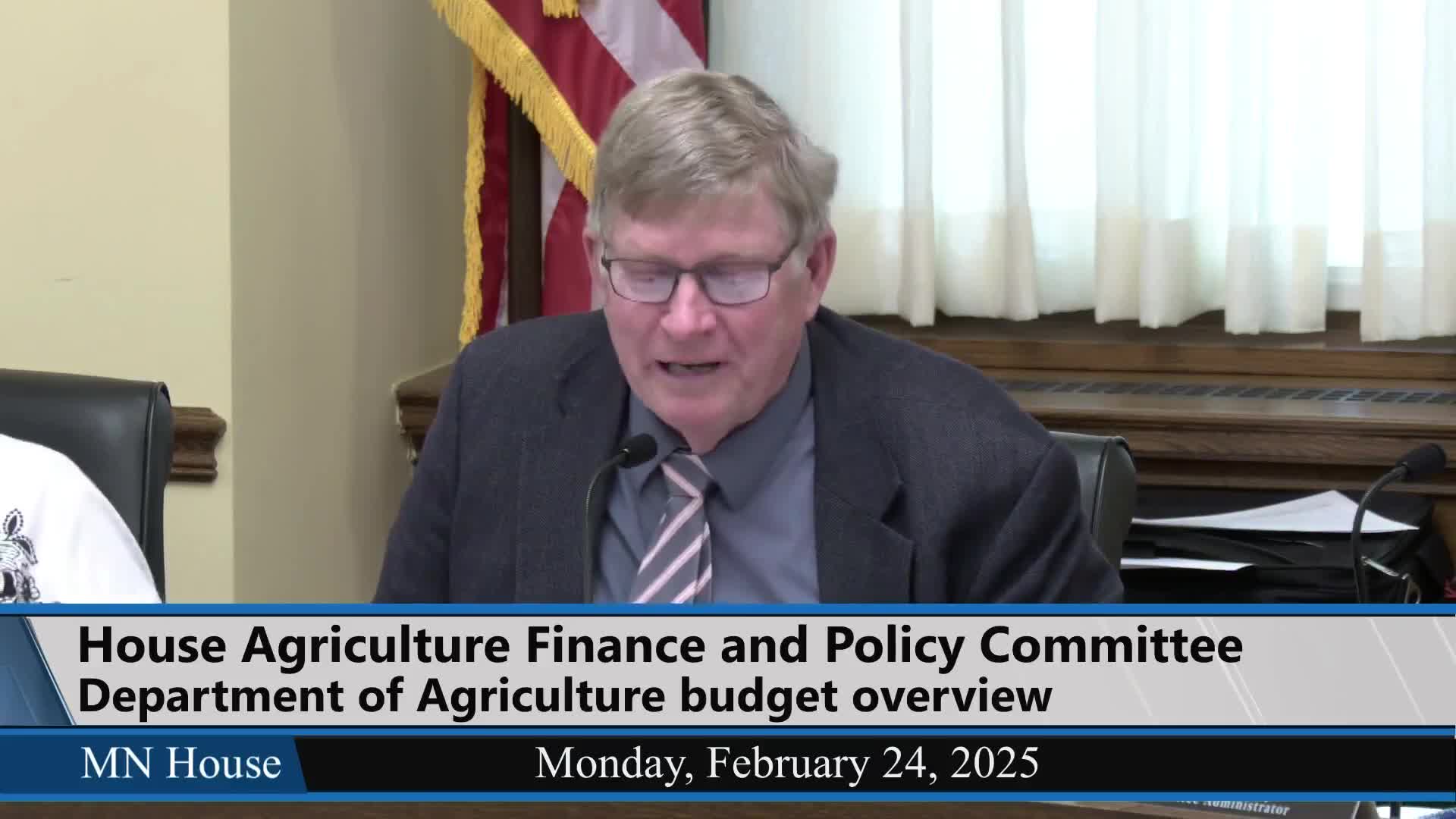
Department of Agriculture outlines budget requests and statutory changes including biofuels, AGri grants and licensing updates
Summary
The Minnesota Department of Agriculture presented to the House Agriculture Finance and Policy Committee a set of budget requests and statutory changes intended to modernize licensing, expand grant eligibility and adjust fee schedules while asking for modest additional general‑fund support to maintain current services.
The Minnesota Department of Agriculture presented its budget requests and a package of statutory changes to the House Agriculture Finance and Policy Committee, describing modest general‑fund operations requests and a wide set of program and fee adjustments the agency says will modernize licensing and expand eligible uses of existing grant programs.
Why it matters: the proposals would change who qualifies for state AGRI grants, adjust fee schedules that fund regulatory services, and shift eligibility rules for biofuels and livestock investment grants — decisions that affect producers, retail fuel sites, cooperatives and small businesses across Minnesota.
Top items and agency rationale: Deputy Commissioner Andrea Vawbel and MDA staff listed several items the governor proposed or the agency supports.
- General fund request: MDA asked for $557,000 in fiscal 2026 and $1,127,000 annually thereafter to maintain current service levels and absorb rising operating costs including rent and employer-paid benefits.
- Food licensing modernization: MDA seeks statutory amendments to modernize food licensing (chapters 28A and 31) to simplify administration and create a new category for home food processors; fees would be adjusted (no net general-fund change reported).
- Livestock investment grant expansion (AGRI): the agency proposed expanding eligibility to tribal governments and local units of government, broadening the definition of livestock to include smaller or specialty species (rabbits, aquaculture, alpacas) and changing matching rules to a tiered approach (50% of first $20,000; 20% of next $220,000) rather than the prior flat 10% of the first $500,000.
- Administrative allowance: MDA proposed raising the AGRI administrative allowance from 6.5% to 7.5% to reflect increased pre‑award risk assessments and post‑award monitoring workload.
- Biofuels infrastructure grant adjustments: the agency proposed changing the maximum number of retail petroleum dispensing sites owned by a prospective grantee from 10 to 20 to widen eligibility for farm cooperatives and other applicants.
- Good Food Access program changes: MDA proposed statutory simplifications and renaming the program to the Food Retail Improvement and Development Grant (FRIDGE) to reduce perceived stigma and make the program easier to navigate for smaller retailers.
- Grain licensing and seed reporting: MDA proposed updates to grain buyer and grain storage facility fee schedules (no general-fund change) and reducing seed tonnage reporting frequency from four times per year to two.
- Milk marketing modernization: the agency proposed licensing reforms for entities that purchase milk directly from Minnesota dairy producers, including new fiscal reporting requirements and adjusted fees to increase accountability for entities that pay producers.
- Ag BMP and Ag BNP (loans/grants): proposals include increasing the Ag BMP appropriation cap, clarifying loan eligibility and adjusting timelines (for example, shortening encumbrance for certain RFA down payment assistance from two years to six months), and removing “pilot” status for an agricultural microloan program and allowing land purchases with that product.
- Green fertilizer and sustainable aviation fuel: MDA proposed a $3,000,000 reduction to a previously authorized $7,000,000 green fertilizer appropriation (leaving $4,000,000 available) and noted a governor’s tax‑bill-carried proposal for $5.3 million in fiscal 2026–27 and $2.1 million ongoing for sustainable aviation fuel support.
Agency controls and staffing: Vawbel told the committee the department takes the OLA audit recommendations seriously and has hired a compliance coordinator and an agencywide grants coordinator reporting to the commissioner’s office. She described practices MDA uses for grant oversight: not advancing money ahead of time, 10% retainage, reconciling every payment request and doing site visits on grants over $25,000 even if not strictly required by the Office of Grants Management.
Committee questions and next steps: members asked for more detail on rent increases affecting MDA’s world‑class lab building (a projected multi‑year increase that would be funded from agency operating budgets unless the Legislature provides a general‑fund appropriation). Representatives also asked for clarification on expanding eligibility for livestock grants and for examples where local units of government or tribal governments might participate.
What happens next: MDA’s proposals will be considered in committee and during the broader budget process; committee members asked for follow‑up on some items including rent impacts and the departments’ definitions for terms such as “family member” used in RFA loan language.