Get Full Government Meeting Transcripts, Videos, & Alerts Forever!
Get email alerts on the Wolf Elk Depredation Compensation topic
No spam. Unsubscribe anytime.
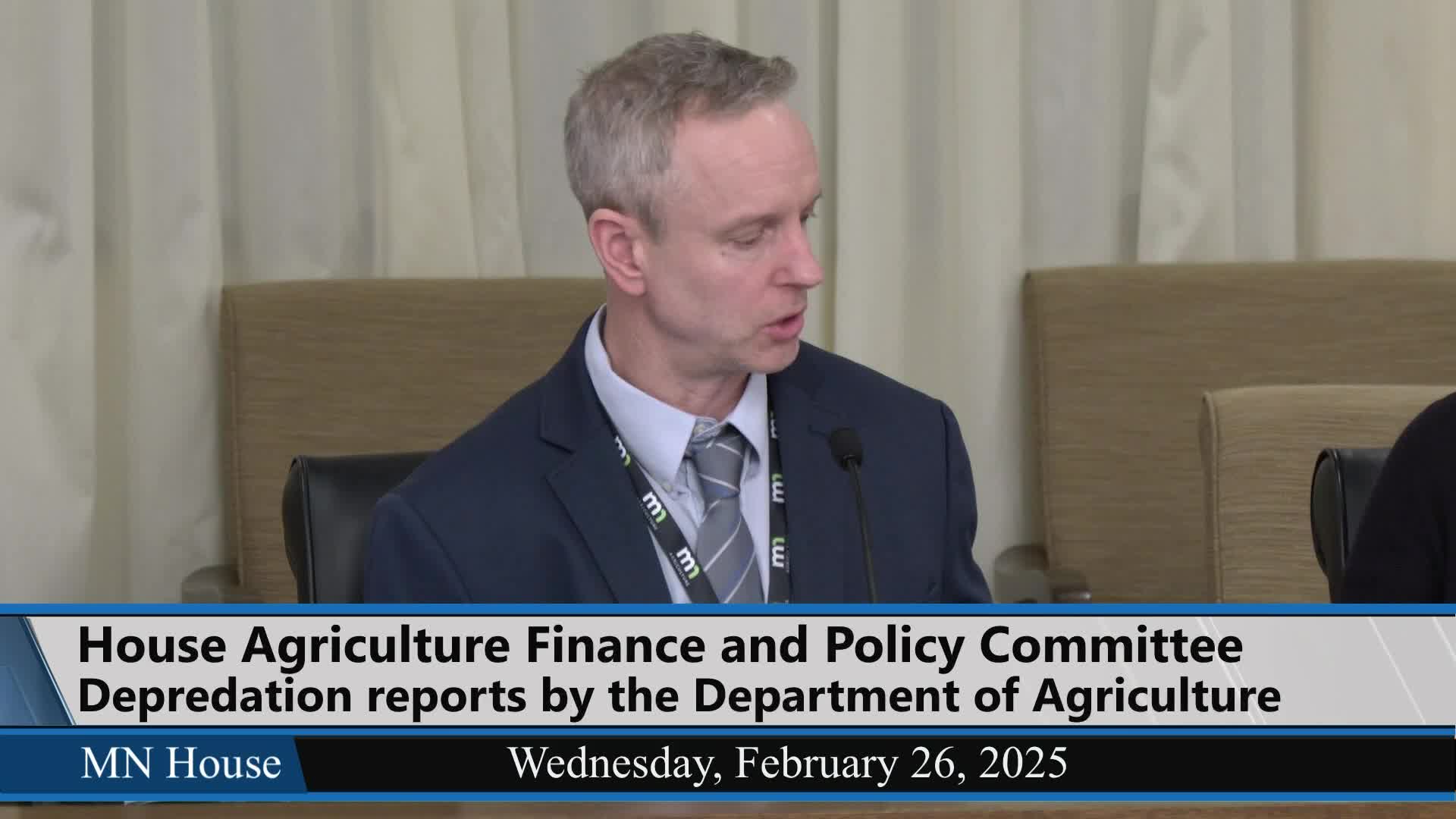
Department of Agriculture reports rising wolf and elk depredation claims; committee hears funding requests
Summary
The Department of Agriculture reported increased wolf and elk damage claims, a growing backlog and recommendations to strengthen claim evaluation and abatement. Producers and farm groups asked the committee for immediate funding to cover unpaid claims.
The Minnesota Department of Agriculture told the House Agriculture Finance and Policy Committee that wolf and elk depredation payments and prevention grants have trended upward, the state faces a backlog of unpaid claims and the department needs both sustained appropriations and clearer links between abatement and compensation.
Mark Abrahamson, plant protection director at the Department of Agriculture, said the department has a long-standing wolf-compensation program and a separate program to compensate crop and fence losses caused by elk. He told the committee that both programs have seen rising payments and that the agency’s appropriations have been exhausted in recent years.
“We have about $20,000 that are on our backlog to pay next fiscal year in July 2026,” Abrahamson said regarding wolf claims, and he reported a roughly $45,000 backlog for elk claims. Abrahamson said the $20,000 per‑producer cap for elk compensation dates to 1987 and is increasingly inadequate.
Why it matters: Farmers in affected counties told the committee that unpaid claims cause immediate cash‑flow problems and that expanding elk range could raise damage levels in new areas. The department recommended improving field-evaluation capacity, linking compensation to abatement where feasible, and considering funding mechanisms that carry over between biennia.
Producer testimony: Jake Thompson, president of the Minnesota State Cattlemen’s Association and a cow‑calf producer, described recent losses he said were driven by wolf activity and said the state ran out of wolf‑depredation funds in 2024 even though the statutory appropriation was $175,000. "Producers simply cannot be reimbursed where there is no funding for it to happen," Thompson said.
Stakeholder views: Stu Lohrey of Minnesota Farmers Union and Hunter Peterson of Minnesota Farm Bureau urged increased appropriations and said depredation affects a wide set of producers, from commercial operations to backyard flocks. Lohrey described an example in which a drought hampered field evidence of a depredation event and noted that some producer losses may not be captured in verified counts.
Agency recommendations and constraints: Abrahamson said the department has relied on crop adjusters to do field evaluations for elk but has lost its last trained adjuster and now has a temporary agreement with USDA APHIS Wildlife Services to provide evaluations. He said that long‑term evaluation capacity will cost more than in past years and that abatement measures under DNR authority should link more formally to compensation to reduce repeated losses.
Legislative response: Representatives and witnesses discussed immediate measures to get funds to producers and longer-term statutory changes. Representative Jerry Burkel brought multiple bills to the committee to provide emergency and biennial appropriations for depredation payments.
Closing: Abrahamson said the department will work with DNR, stakeholders and legislative staff to refine recommendations. Committee members signaled interest in both short‑term appropriations and legislative fixes to claim evaluation and the $20,000 cap.