Get Full Government Meeting Transcripts, Videos, & Alerts Forever!
Get email alerts on the Farm Business Management Fbm topic
No spam. Unsubscribe anytime.
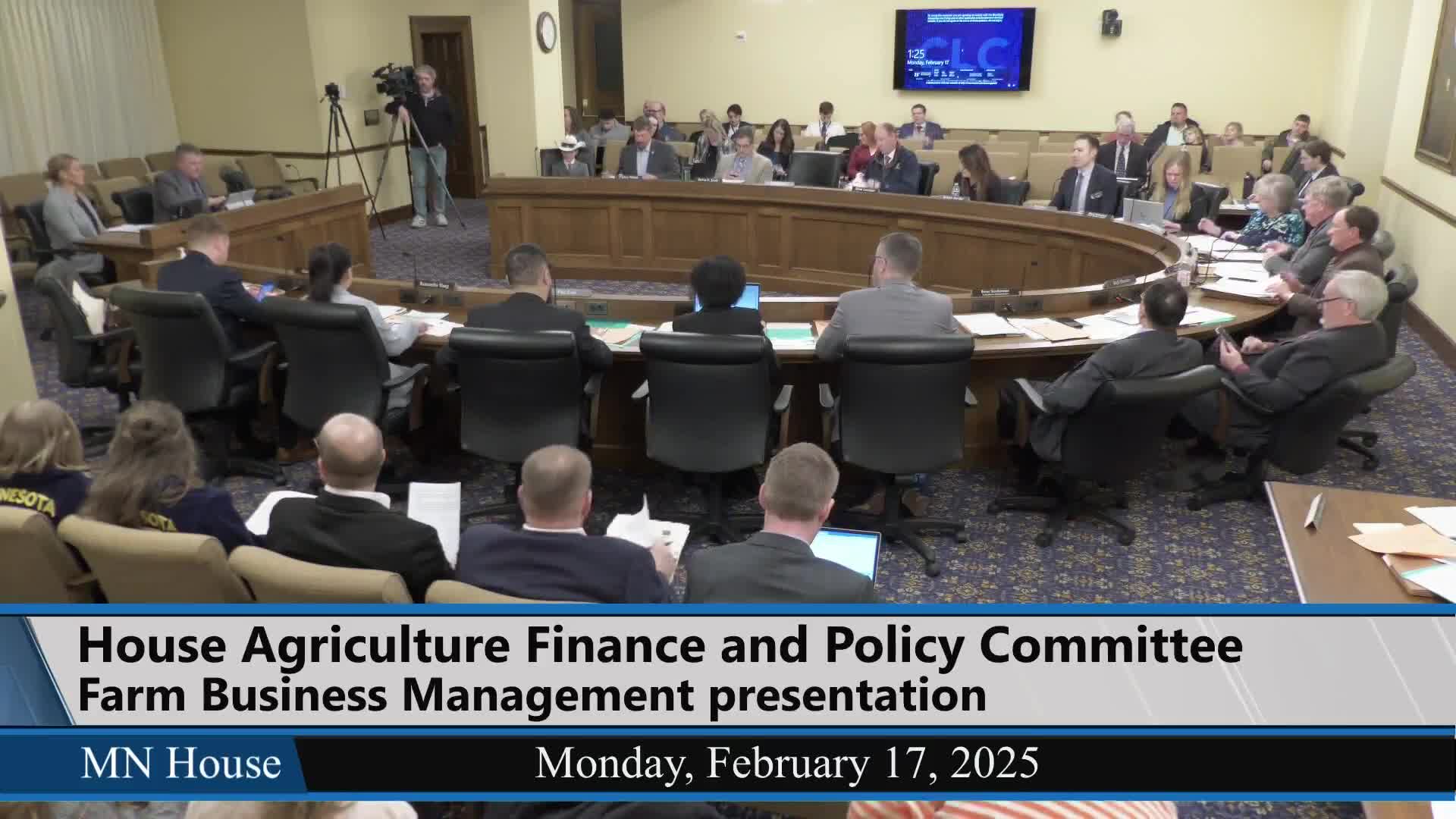
Lawmakers hear testimony on Farm Business Management; Representative Nelson moves bill to increase challenge-grant funding
Summary
Minnesota State Farm Business Management instructors and college leaders described the one-on-one farm education program and urged increased funding for Farm Business Management (FBM) challenge grants. Representative Nelson introduced House File 653 to add $750,000 per fiscal year to FBM challenge-grant funding; the committee laid the bill over.
Keith Olander, lead of the Northern Center of Excellence for Agriculture at Minnesota State Colleges and Universities, and Tina Labrune, director of the Southern Ag Center of Excellence and longtime FBM instructor, described Farm Business Management (FBM) as a seven-college, one-on-one farm education program used by beginning and established producers to analyze records, benchmark performance and plan for transition.
"All 65 faculty, all 3,000 students will be utilizing that software to produce FinBin," Olander told the committee, referring to the enterprise data set FBM uses for benchmarking. He said FBM students range in age from 18 to 84, with roughly 30% classified as beginning farmers (less than 10 years experience), and that the program is field-based and data-driven.
Tina Labrune said FBM instructors act as a trusted advisor for farm families, supporting financial literacy, benchmarking, marketing, crop insurance, nutrient management, and transition planning. She also described three staffing challenges: retention, replacement and recruitment of FBM instructors. Labrune said challenge-grant funding has helped close cost gaps between colleges and the FBM program and provides accountability through program parameters.
Representative Nelson introduced House File 653 to increase the FBM challenge-grant line by $750,000 per fiscal year. Committee staff clarified the funding: the bill would increase the FBM line (current law base cited by staff as $2,250,000) by $750,000 each fiscal year, which staff said amounts to $1,500,000 additional over the biennium if adopted. Several farmers and Farm Bureau representatives testified in support, describing direct benefits such as scholarship-first access for beginning farmers and FBM instructors' role in stabilizing farm businesses during downturns.
Why it matters: FBM enrollment and outcomes provide farm-level financial benchmarking (FinBin) that policymakers and USDA analysts use. Presenters told the committee the program helps farmers improve profitability (Olander cited a learner-reported figure of approximately $17,632 benefit over time) and that FBM becomes especially important when farm incomes decline.
Final action: Representative Nelson moved House File 653; the committee laid the bill over for future consideration. Staff and FBM center leaders said they will provide additional evaluation results and a 10‑year study of FBM challenge grants to the committee when available.
Ending: Committee members asked about access for beginning farmers, operating loan timing, and the program’s tuition model; FBM leaders said colleges and the centers work to mitigate tuition barriers and that increased grant dollars would keep instructor caseloads manageable.