Get Full Government Meeting Transcripts, Videos, & Alerts Forever!
Get email alerts on the Biofuels Grants Audit topic
No spam. Unsubscribe anytime.
Legislative auditor finds controls adequate for bioincentive payments but flags problems in biofuels infrastructure grants
Summary
The Office of the Legislative Auditor told the House Agriculture Finance and Policy Committee that its performance audit of two Department of Agriculture programs found the incentive payments program for renewable energy and renewable chemicals operated without written findings, while the competitive biofuels infrastructure grant program had control weaknesses.
The Office of the Legislative Auditor told the House Agriculture Finance and Policy Committee that its performance audit of two Minnesota Department of Agriculture programs found the incentive payments program for renewable energy and renewable chemicals operated without written findings, while the competitive biofuels infrastructure grant program had control weaknesses.
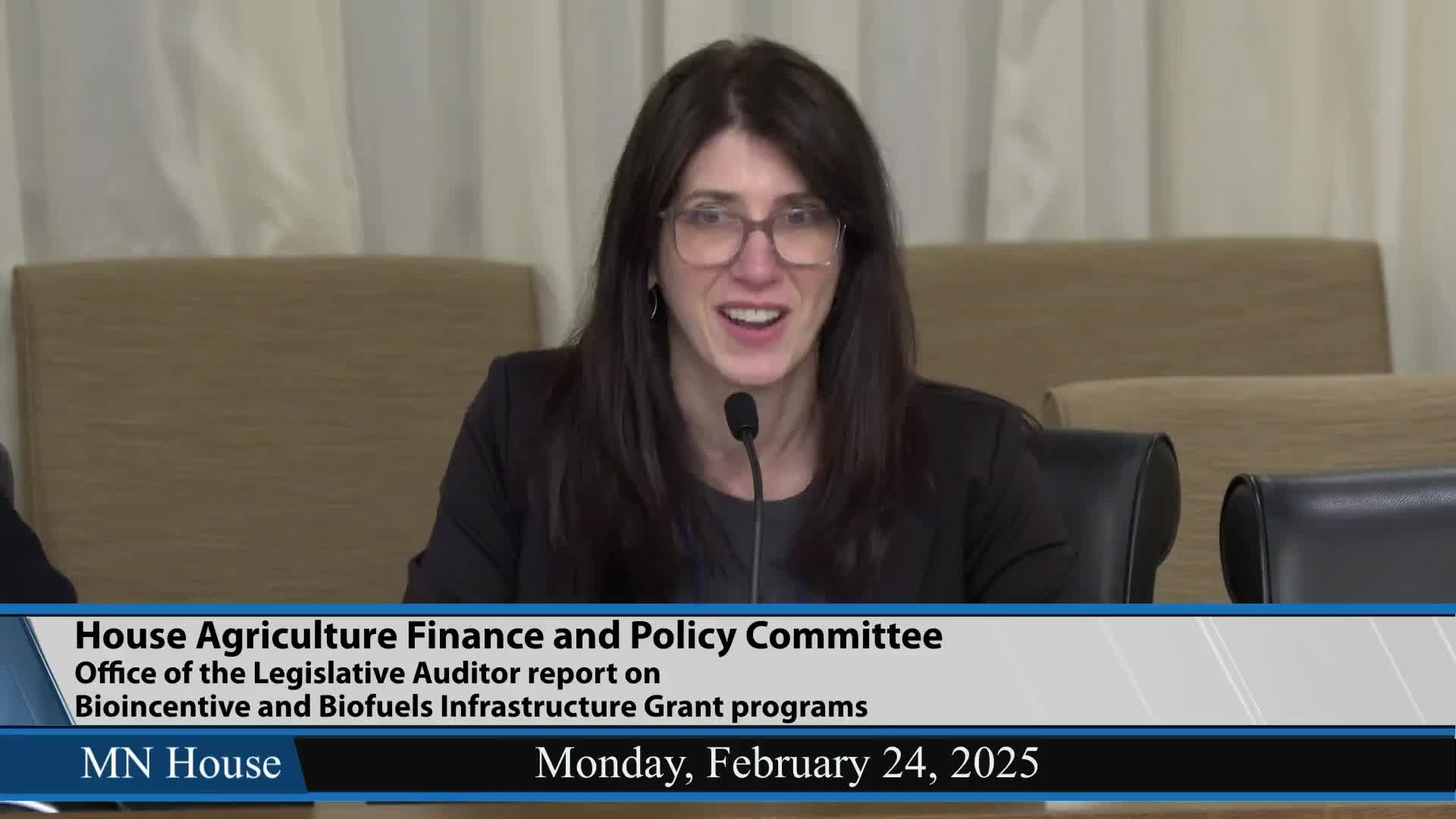
The audit, presented by Lori Lison (Deputy Legislative Auditor, Financial Audit Division) and Valentina Stone (project manager), examined MDA activity from July 1, 2021, through Jan. 31, 2024, and included site visits to producers and retail fueling locations. “For the incentive program, we really didn't — we didn't have any findings. It was operating well,” Lison told the committee.
Why it matters: the two programs support production of advanced biofuels, biomass thermal energy and renewable chemicals and fund retail upgrades so stations can dispense higher-ethanol blends. Those programs involve multi‑million-dollar payments and are intended to expand markets for agricultural feedstocks and reduce greenhouse-gas intensity in fuels.
Key findings: the OLA reported the department paid roughly $12.1 million in incentive payments during the audit period and identified no findings for that program. For the biofuels infrastructure grant program, auditors flagged three categories of problems: (1) roughly $19,000 in payments for costs the auditors said were not associated with qualified equipment; (2) about $358,000 in payments for costs not included in grantee budgets or paid to vendors not specified in contracts; and (3) roughly $1.213 million paid to a single grantee for equipment that the grantee ordered before the contract was executed, contrary to grant rules. The OLA also found widespread noncompliance with required progress reporting: none of the grantees submitted fall 2022 reports, and 27 of 44 grantees did not submit required reports in 2023, the auditors said.
Valentina Stone summarized the reporting concern: auditors found that “the templates only asked if grantees completed the projects, but didn't ask where in the progress the grantees were,” and that two grantees later told auditors they were no longer planning to proceed because costs had risen.
Department response: Deputy Commissioner Andrea Vawbel told the committee the department generally agrees with the audit recommendations and has acted to recover funds. She said the department has followed OLA recommendations and has reclaimed the bulk of the $18,894 the auditors recommended for recoupment. Vawbel also described agency practices auditors cited as strengths, including not advancing full grant payments, maintaining a 10% retainage, and conducting site visits before final payments. She told the committee the department has hired an agencywide compliance coordinator and a grants coordinator to strengthen oversight and grant administration.
Committee reaction and follow-up: members praised the audit and the department's response. Representative Jacob called it “one of the cleanest reports” he has seen and commended the department’s internal controls. Committee members asked about the consequences for grantees that fail to submit required progress reports; Stone pointed to Office of Grants Management policy that calls for withholding payments until reports are received.
What the audit recommended: OLA recommended that MDA recoup identified ineligible costs, strengthen grant reporting templates and enforce the requirement that grantees submit progress reports before receiving payments. OLA also recommended better documentation of procurement timing to ensure payments are not made for equipment ordered before contracts were in place.
What happens next: MDA told the committee it is implementing OLA recommendations, has begun reclaiming funds, and will tighten reporting templates and payment controls. Committee members requested continued monitoring and follow-up from the department and auditors.