Get Full Government Meeting Transcripts, Videos, & Alerts Forever!
Get email alerts on the Avian Disease Board Of Animal Health topic
No spam. Unsubscribe anytime.
Minnesota turkey industry urges state support as avian diseases spread year-round
Summary
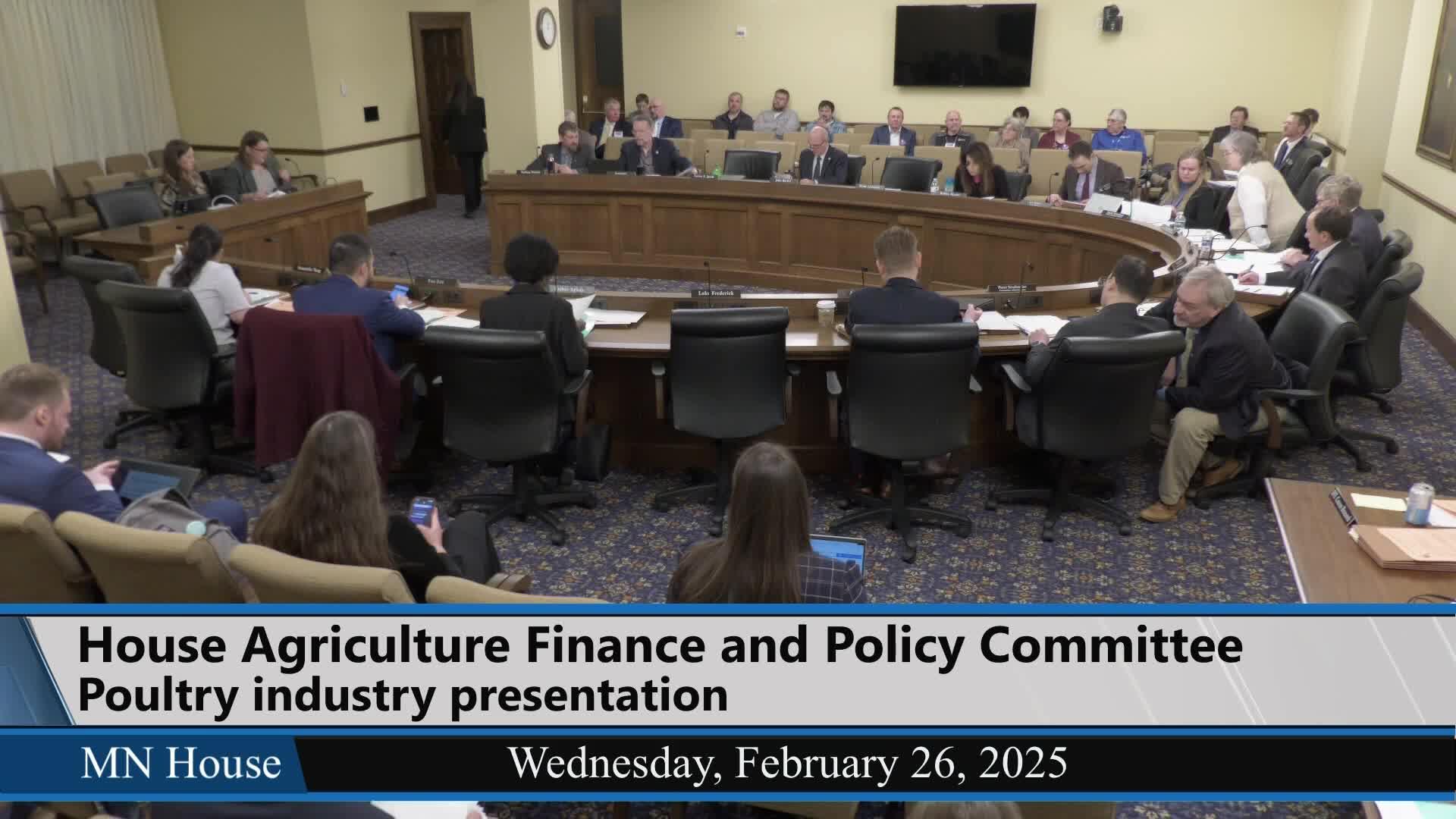
Turkey growers and the Board of Animal Health told the House Agriculture Finance and Policy Committee that highly pathogenic avian influenza and avian metapneumovirus have caused heavy losses and that state funding and federal cooperation are needed to sustain testing, response and worker protections.
Members of Minnesota’s turkey industry and the state veterinarian told the House Agriculture Finance and Policy Committee on the day’s first panel that avian disease response requires steadier funding and federal cooperation as outbreaks continue year-round.
The testimony underscored two viruses. Minnesota leads the nation in turkey production, and industry representatives said highly pathogenic avian influenza (HPAI) remains a continuing threat while avian metapneumovirus, a contagious respiratory disease that is not classified as a foreign animal disease, arrived in Minnesota in spring 2024 and has caused substantial losses.
“The pile of mortality at the end of the barn is one that our farm hadn’t seen before,” said Erica Swatsky, a sixth-generation turkey farmer from Kensington and a board director on the Minnesota Board of Animal Health. Swatsky described a November 2023 HPAI event on her farm in which her flock was depopulated and crews built compost piles, and she said her subsequent restocked flock later tested positive for avian metapneumovirus. “A silent barn is not only sad, but it’s truly very eerie.”
Why it matters: Committee members and industry representatives said the Board of Animal Health and the Minnesota Department of Agriculture need sufficient operating and emergency funds to sustain response teams, testing, indemnity payments and worker protections. Industry witnesses and the state veterinarian described prolonged staff demands, an expanding disease landscape and uncertainty about federal funding and federal staffing.
Dr. Brian Hayes, state veterinarian and executive director for the Minnesota Board of Animal Health, told the panel that the character of HPAI has changed. “We can no longer refer to this as a foreign animal disease,” Hayes said, adding that the virus appears to be endemic in the environment and is detected year-round. Hayes said Minnesota recorded a new D1.1 strain in November and that, in 2024, avian metapneumovirus caused a large number of producer-reported illness events.
On federal indemnity and testing: Farmers and officials said indemnity for depopulation and most outbreak response costs for HPAI come from federal funds. Swatsky said indemnity and cleanup “are all federal dollars.” Dr. Hayes explained that the USDA rolled out a pilot milk surveillance program that requires PCR testing of milk from a representative sample of dairies; the state Department of Agriculture is submitting samples and the Board of Animal Health would lead any on-farm response if positives are found in milk.
Committee members asked whether the federal indemnity and cooperative-agreement funds are at risk. Ashley Coles, executive director of the Minnesota Turkey Growers Association, and agency staff said the indemnity program itself is not at risk but noted delays and “preapproval” steps in federal reimbursement. A department official said funds are generally distributed as reimbursements and that the state began a limited milk-testing rollout after receiving a preliminary federal funding approval; the state is using some emergency funds to avoid delays while reimbursement details are finalized.
On worker and public health protections: Members pressed officials on protections for the people who work on farms and in processing facilities. Dr. Hayes said most human H5N1 cases to date have been in people directly involved in depopulation or working with sick animals. He said the Board of Animal Health coordinates with the Minnesota Department of Health to provide PPE, confidential testing and monitoring for exposed workers, and that the state is recognized for rapid PPE distribution and testing access.
Staffing and federal capacity: Hayes and other witnesses raised concerns about federal staffing and capacity to support long-running outbreaks. Hayes said the Board of Animal Health receives roughly 20 percent of its funding from USDA cooperative agreement funds, and those cooperative funds are not guaranteed annually. He told the committee that local USDA presence has been reduced by one staff member and that national-level staff reductions and hiring freezes add uncertainty to lab confirmation and research support.
What the industry requested: Coles said the Minnesota Turkey Growers Association supports House File 979 and House File 1101, both of which appeared later on the committee agenda. Multiple witnesses urged the committee to prioritize the Board of Animal Health, sustain the agricultural emergency account and ensure funding for field response, testing and worker protections.
Closing note: Committee members signaled interest in further hearings and budget language. The presenters closed by stressing the daily toll on producers and response staff: “Our job has always been to save animals, keep animals healthy,” Hayes said, and added that prolonged depopulation duty and outbreak response is taking a mental and operational toll on veterinary staff and producers.