Get Full Government Meeting Transcripts, Videos, & Alerts Forever!
Get email alerts on the Agriculture Education Malsi topic
No spam. Unsubscribe anytime.
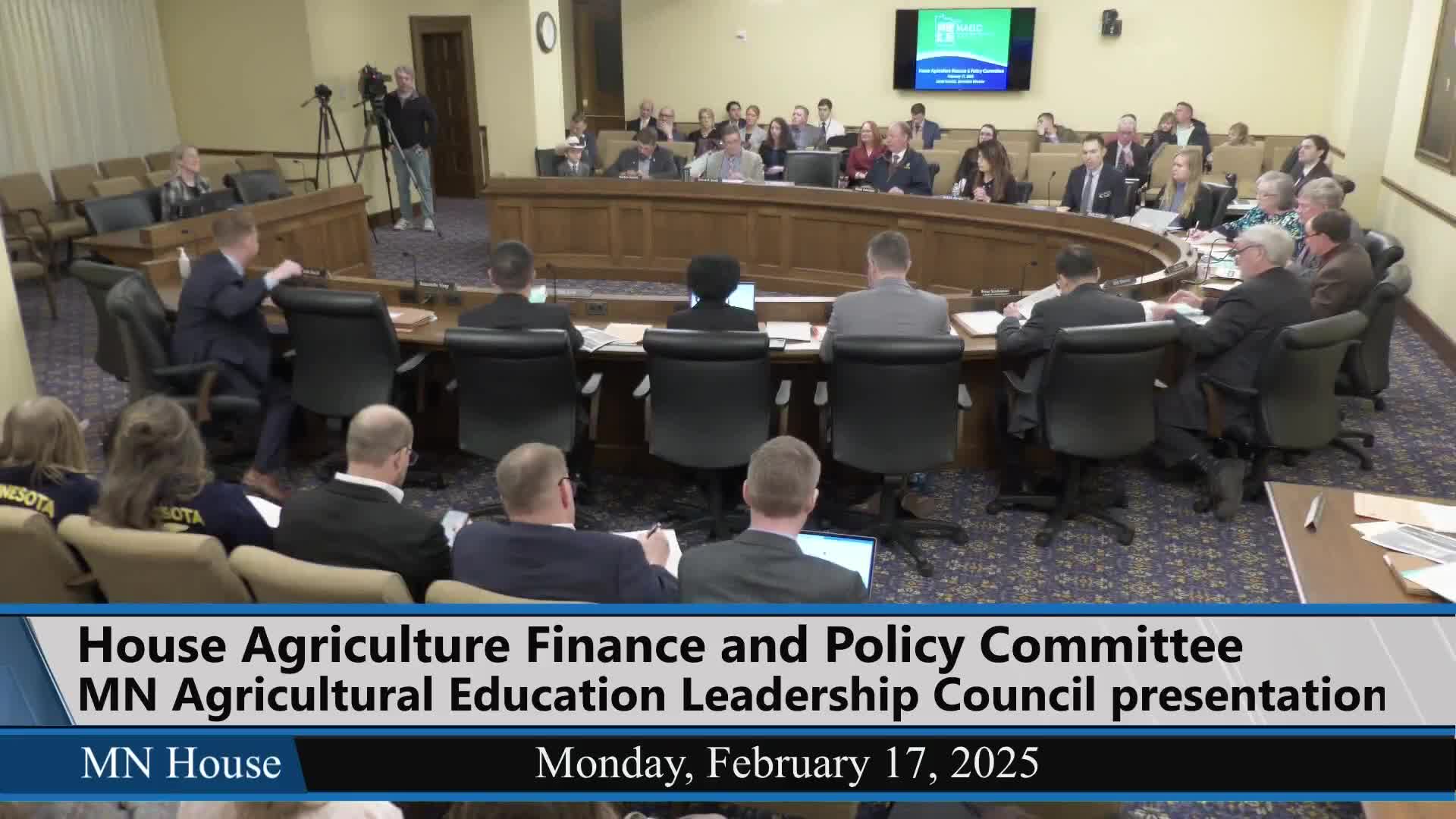
Committee hears request to double annual grant funding for Minnesota Agriculture Education Leadership Council
Summary
The House Ag Finance and Policy Committee heard a presentation from the Minnesota Agriculture Education Leadership Council (MALSI) and considered House File 711, which would increase grant funding and support for agriculture teacher recruitment and retention. Committee members laid the bill over for further consideration.
Sarah Dornick, executive director of the Minnesota Agriculture Education Leadership Council (MALSI), told the House Ag Finance and Policy Committee that MALSI uses most state funding to pass grants through to school and postsecondary agriculture programs and to support teacher recruitment and retention.
MALSI receives a baseline appropriation of $250,000 per fiscal year that supports program grants and a small operations budget, Dornick said. "We send 92% of our funds that we receive back out to the state," she told the committee. She said last biennium MALSI received a one-time increase and that earlier funding helped the council expand grants and teacher programs statewide.
The request accompanying House File 711 would add $250,000 per fiscal year to MALSI's grant appropriation, Dobrick and supporters told the committee — an additional $500,000 over the two-year biennium. Hunter Peterson of the Minnesota Farm Bureau Federation testified in support, saying the organization appreciates MALSI's work to promote ag education through partnerships with groups such as FFA and 4-H.
Why it matters: MALSI funds support classroom equipment, greenhouse and garden projects, postsecondary teacher preparation and a suite of programs intended to recruit and retain agriculture, food and natural resources (AFNR) teachers. Committee members pressed on where the funds go and whether MALSI follows state grants-management best practices.
Representative Hansen asked whether MALSI must follow the Office of Grants Management processes put in place in recent years. Dornick replied that MALSI operates grants through the Minnesota Department of Agriculture, attends Office of Grants Management webinars, and generally follows the same rules; she noted most of MALSI's grants fall below thresholds that trigger additional steps. Ken Sabry, a committee staff member, confirmed MALSI's current base appropriation is $250,000 per fiscal year and that the proposal would double that line.
Discussion details and context: Dornick said MALSI’s grant work reached 33 projects in the most recent funding cycle, supporting about 220 school-based AFNR programs and roughly 45,000 students in grades 7–12. She described specific uses: classroom equipment, greenhouse and garden infrastructure, ag literacy grants with Minnesota 4‑H, and postsecondary support such as upgrading equipment used in teacher preparation. Dornick also outlined a teacher recruitment and retention strategy (STAR pilot participation, mentorship programs, scholarships, internship support) and described an FBM (Farm Business Management) challenge-grant formula that distributes funds to colleges in increments tied to progress and program parameters.
Representative Harder moved to lay House File 711 over at the end of the hearing; the committee laid the bill over for later consideration. No final appropriation was adopted during the hearing.
Ending: Committee members did not vote on an appropriation; House File 711 was laid over. Committee staff and MALSI said they will provide additional detail as requested and MALSI plans to send committee members a written copy of its AFNR education blueprint and program evaluations.