Get Full Government Meeting Transcripts, Videos, & Alerts Forever!
Get email alerts on the Agriculture Budget topic
No spam. Unsubscribe anytime.
House committee lays over omnibus ag finance bill with biofertilizer pilot and broadband installer change
Summary
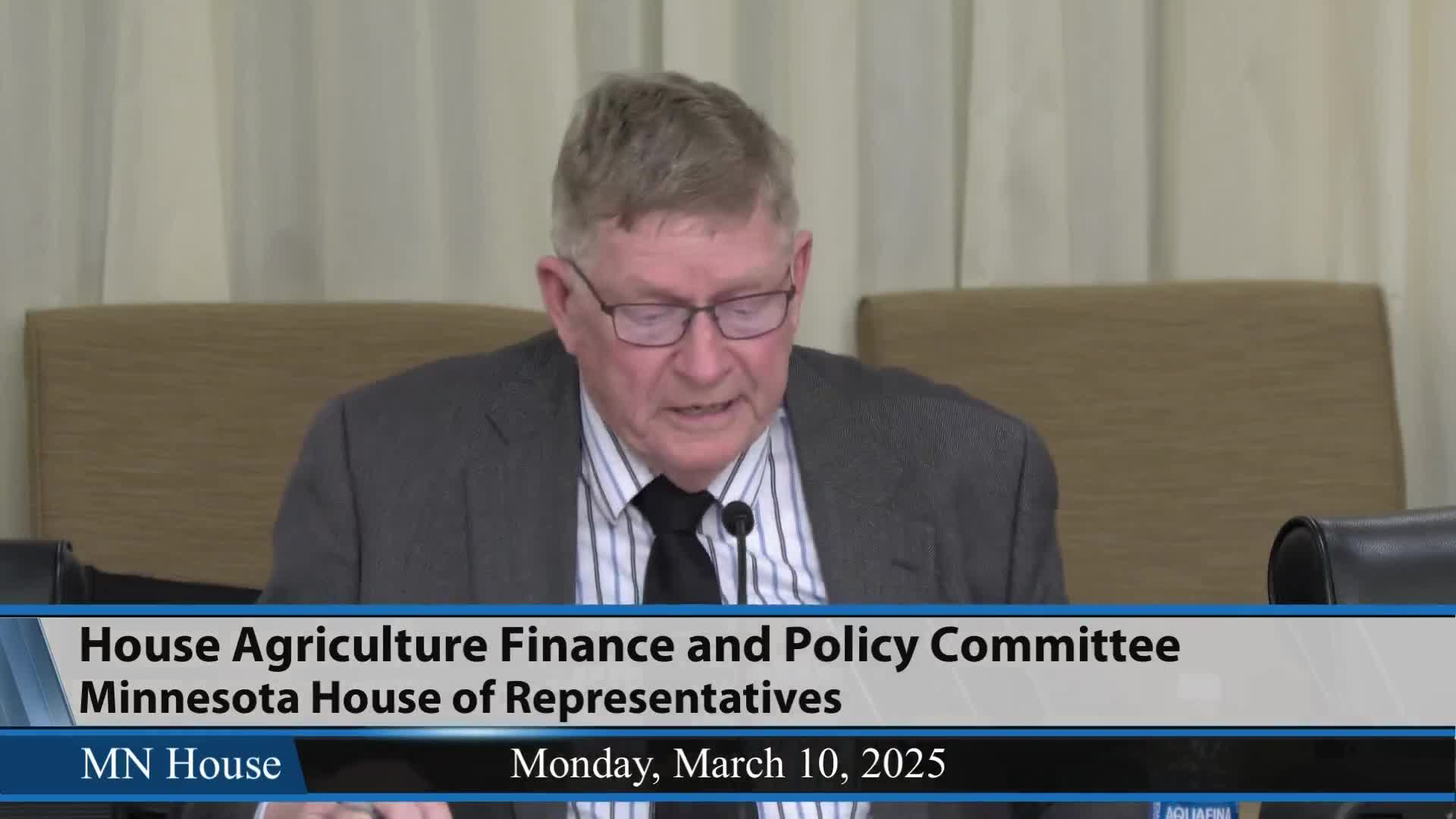
The House Committee on Agriculture Finance and Policy laid over House File 1704 (DE3) on March 10 after a presentation of spending changes that would raise the ag budget base by roughly $17 million and add programs including a biofertilizer incentive pilot and a delay/flexibility provision for the state's broadband installer law.
The House Committee on Agriculture Finance and Policy on Monday, March 10, laid over House File 1704 (DE3), an omnibus agriculture finance amendment that would increase the committee's net general fund appropriation by about $17,070,000 for fiscal years 2026-27 and includes new and one-time spending for meat inspection, county agricultural inspectors, livestock processing, and a biofertilizer incentive pilot.
The amendment matters because it would add operating increases for the Minnesota Department of Agriculture, the Board of Animal Health and the Agricultural Utilization Research Institute (AURI); replenish an agricultural emergency account and fund unpaid depredation claims for wolves and elk; and create a new per-acre incentive tied to reduced commercial nitrogen fertilizer use. The measure also contains a separate article that modifies requirements for broadband installers, a provision several broadband industry and labor witnesses said is necessary or contentious depending on their perspective.
Kent Savory, house fiscal analyst, walked members through a line-by-line spreadsheet showing changes from the base. He identified a committee net general fund impact of $17,070,000 in FY 2026-27 and $7,810,000 in FY 2028-29. Major items in the DE3 include a $2,000,000 one‑time appropriation for county agricultural inspectors; recurring increases for meat inspection and Board of Animal Health operating adjustments; $1,250,000 per year for a biofertilizer innovation and efficiency program in 2026-27 (with tail amounts noted in the spreadsheet); and designated carve-outs and allowable spending limits within the AGRI account for programs such as farm-to-school and Good Food Access.
Tom Peterson, Commissioner, Minnesota Department of Agriculture, told the committee the department appreciated the bill but that the administration’s position was to support the governor’s budget until broader fiscal targets were set. "A lot of the things too may, may, kind of work themselves out in the next couple of weeks, with our federal funding situations," Peterson said, describing uncertainty about federal funding that could affect state programs.
Witnesses representing producers and farm groups generally supported portions of the DE3. Hunter Peterson, public policy specialist, Minnesota Farm Bureau Federation, endorsed the operating adjustments and funding for depredation payments and livestock and meat processing, while urging attention to funding priorities. Stu Lohrey, government relations director, Minnesota Farmers Union, supported operating increases and investments in livestock processing but objected to a $3,000,000 reduction to the green fertilizer grants and flagged cuts to the emerging farmers office. Laura Schreiber, government relations director, Land Stewardship Project, urged restoring or increasing funding for farm-to-school and the emerging farmers office and noted recent federal funding uncertainty for farm-to-school programs.
On the biofertilizer provision (Section 11), Cameron Henning, commercial agronomist for Pivot Bio, described one class of products farmers could use to participate. "Biological products...do not leach and do not volatilize and therefore do not contribute to high nitrate in the water or nitrous oxide in the air," Henning said, explaining that some microbial seed treatments aim to supply part of a crop’s nitrogen needs and that the proposed program would require documentation such as a crop nutrient management plan and a minimum enrollment of 40 acres.
County agricultural inspection funding drew separate testimony. Bob Dunning, Stearns County agricultural inspector, thanked the committee for the proposed appropriation and outlined inspectors’ responsibilities enforcing the noxious weed law, education and biological control programs.
The DE3 also contains an article (Article 2, Section 3) that delays or modifies aspects of the broadband installer certification law enacted last year. Industry groups and unions testified at length. Melissa Wolf, executive director, Minnesota Cable, said the existing law as passed last year would "disqualify thousands of experienced broadband installers from doing the work of connecting homes with broadband" without additional flexibility; she characterized the DE3 language as providing "additional time, flexibility and clarity" to implement the new training and certification requirements. Representatives of the Minnesota Telecom Alliance and other providers described the provision as a needed fix; labor witnesses including Kevin Pranas of LiUNA urged the committee not to reduce training requirements and recommended referral to the Labor Committee. Jamie Fitzke of CenterPoint Energy said utility damage investigations show excavators were found at fault in the majority of recent telecom damages and urged robust safety training.
Committee members debated process and timing. Several members argued the bill should move now given uncertainty in federal funding and recent shortfalls in state program accounts; other members objected to the timing and to including the broadband changes in an agriculture omnibus, saying some provisions had not previously had hearings and that a broader bipartisan process was needed. Chair Anderson said the bill increases the ag base and addressed immediate department needs; opponents said further negotiation was required.
There were three formal procedural actions recorded: a motion to approve the previous meeting’s minutes (approved as corrected), Representative Anderson’s motion to put House File 1704 before the committee and to move the DE3 amendment, and the committee’s final procedural action to lay over House File 1704 and the DE3 amendment for further consideration. The committee scheduled its next meeting for Wednesday, March 12, 2025 at 1 p.m.
Votes at a glance: no final passage votes were taken on the DE3 or the underlying House file; the minutes were approved as corrected by voice vote. The DE3 and House File 1704 were laid over.
Members and witnesses requested continued negotiation on program funding levels, and several testifiers asked the committee to preserve or restore funding for farm-to-school, the emerging farmers office, and green fertilizer grants. The bill text directs some program rules and reporting responsibilities (for example, the biofertilizer program requires rulemaking and documentation of reduction rates), but many allocations are subject to further committee action and fiscal target setting.