Get Full Government Meeting Transcripts, Videos, & Alerts Forever!
Get email alerts on the Broadband Digital Opportunity topic
No spam. Unsubscribe anytime.
Committee renames broadband office to include digital opportunity, adopts technical amendments
Summary
House File 2279 would rename the state's Office of Broadband Development to include a focus on digital opportunity and update goals to emphasize access, adoption and affordability; the committee adopted two technical author's amendments (A1 and A2) and laid the bill over for possible inclusion in future legislation.
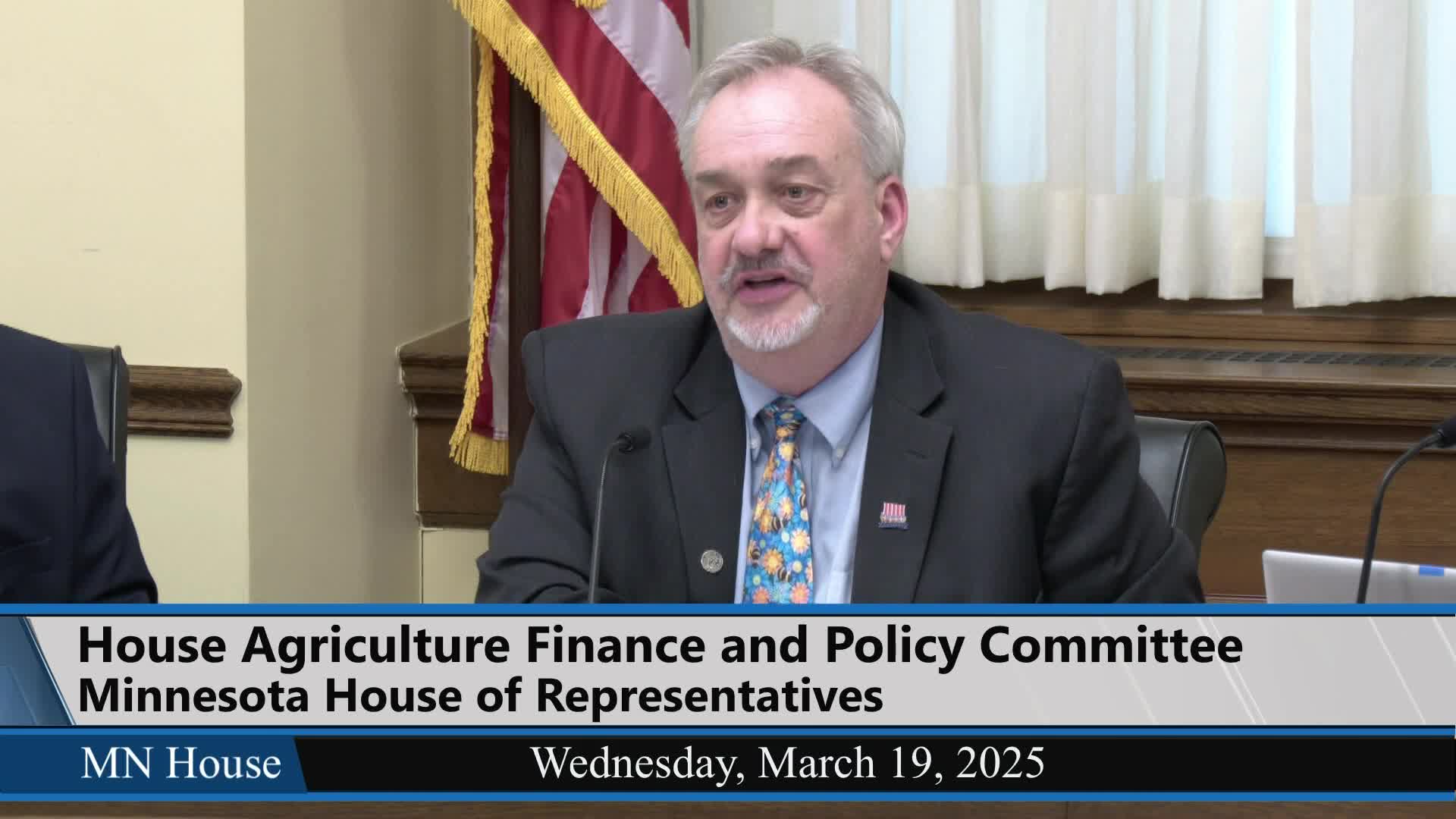
Representative Vang presented House File 2279, which renames the Office of Broadband Development to the Office of Broadband Development and Digital Opportunity and aligns state terminology with federal digital-opportunity planning. The committee adopted an A1 technical amendment and an A2 amendment that deleted grant-establishment language and aligned terminology with federal language; both amendments were adopted by voice vote and the bill was laid over.
Representative Vang and Hennepin County testifiers emphasized that broadband is necessary infrastructure for education, health care, farm operations and small businesses. Mika Baer, Hennepin County Office of Broadband and Digital Inclusion, described personal experience growing up on a dairy farm where lack of service impeded education and farm operations; she said her county sees both rural gaps and urban affordability or wiring gaps in multifamily housing. Phil Essington, Hennepin County director of Broadband and Digital Inclusion, and Director Mackey (Department of Employment and Economic Development) said the state should remain technology-agnostic and pair infrastructure investment with outreach, digital skills and device programs to increase adoption.
Members asked about alternatives to fiber (for long driveways and sparse rural properties), subsidy programs for monthly service, and how expanding the statute to include device access and digital skills affects federal funding eligibility. Director Mackey said Minnesota has a Digital Opportunity Plan under the federal Digital Equity Act and noted the Affordable Connectivity Program previously provided household subsidies during COVID; the state currently does not have a permanent subsidy program. The committee heard that statute defines “served” and “unserved” thresholds (100/20 Mbps served target and 25/3 Mbps unserved threshold) and that grant-funded builds must be scalable to higher speeds.
Why it matters: Members and testifiers framed the change as aligning state statutory goals with federal digital-opportunity policy and broadening program goals to address not only infrastructure but adoption, affordability and device access for underserved households.
Votes and next steps: The committee adopted both author’s amendments (A1 and A2) by voice vote and laid House File 2279, as amended, over for possible inclusion in future legislation. No appropriation was included in the bill as presented.