Get Full Government Meeting Transcripts, Videos, & Alerts Forever!
Get email alerts on the Broadband Certification topic
No spam. Unsubscribe anytime.
House committee advances bill to modify broadband installer certification timeline and staffing rules
Summary
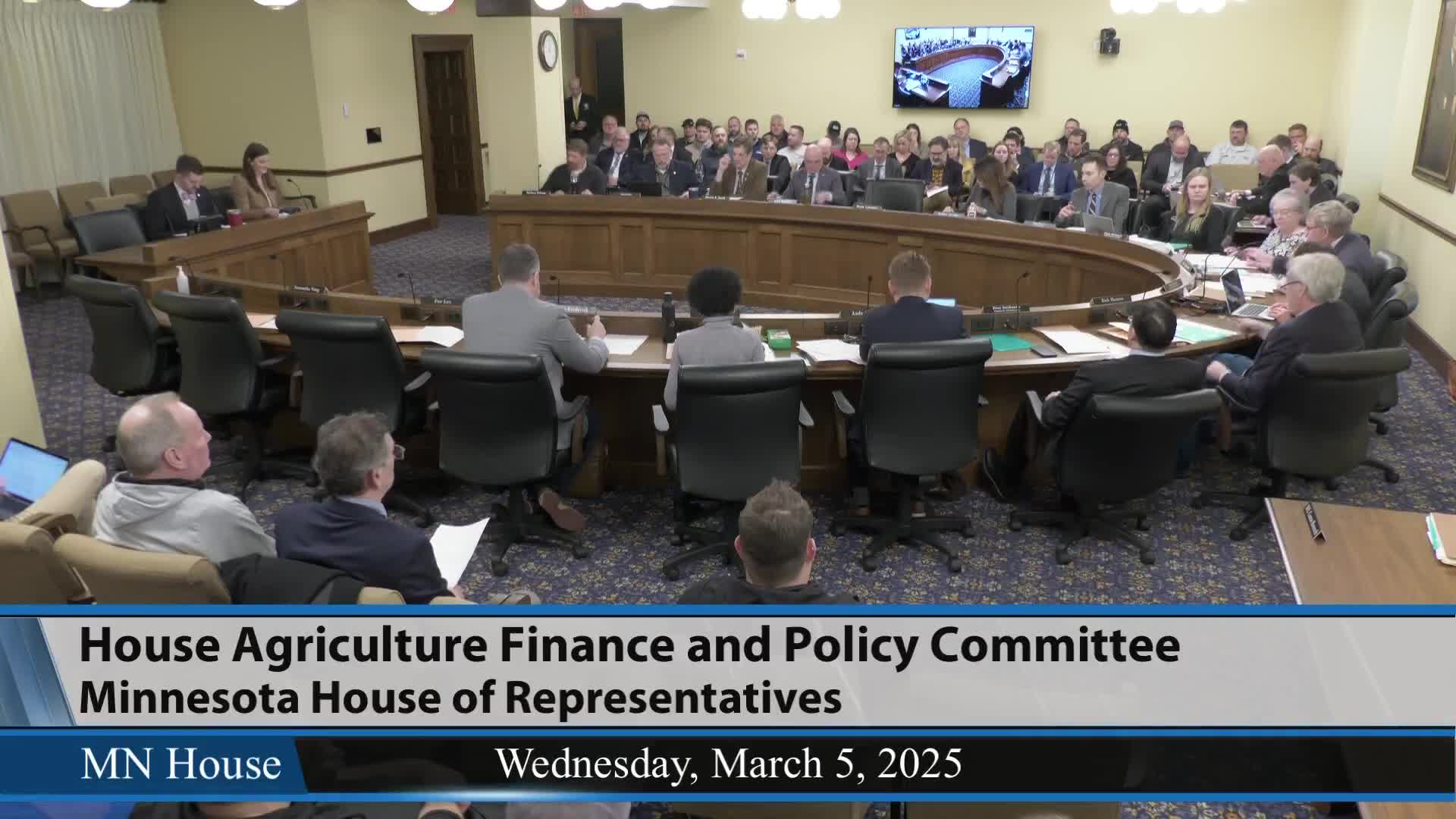
The House Agriculture Finance and Policy Committee approved an amended bill to change how Minnesota implements last year’s telecommunications installer certification, including clarifications on staffing and a deadline extension for parts of the metro area; the measure moves to the general register after a 7–6 roll-call vote.
Representative Schultz moved House File 47, an amendment to the state telecommunications installer law, and the House Agriculture Finance and Policy Committee voted to send the bill to the general register after approving an A1 amendment.
The bill as amended would adjust parts of last year’s certification requirement for underground telecommunications installers, clarifying staffing requirements for directional boring and creating more flexibility on the timing and delivery of the mandated training. Representative Michael Schultz, sponsor of the bill, told the committee the goal is “to make this workable for us” while preserving safety standards and allowing broadband deployment to continue.
The bill’s proponents said the current law requires every broadband installer to complete a new 40‑hour training program and pass an exam by a July 1, 2025 deadline for the 7‑county metro area. Melissa Wolf, executive director of the Minnesota Cable Communications Association, told committee members that “without a deadline extension, there will not be enough certified trainers to meet demand and the state will not have enough compliant workers before the 07/01/2025 deadline.” She said the hands‑on portion of the training cannot be completed until the ground thaws in many parts of the state, which she said leaves providers with three “impossible choices” including pausing projects or working out of compliance.
Industry witnesses urged changes that they say preserve safety but avoid disrupting broadband projects that rely on federal funding. Brent Christensen, president and CEO of the Minnesota Telecom Alliance, said his group has an approved installer program with the Department of Labor and Industry and that the statute is “not about safety — it’s about creating a new education program.” Joel Hansen of Associated Builders and Contractors said his group expects to enroll about 1,000 workers and “do not think it's possible to get every employee that needs the certification prior to the 07/01/2025 deadline,” and urged extending the deadline to Jan. 1, 2026.
Labor and safety advocates urged caution. Kevin Prentice of Laborers’ International Union (LiUNA) said the law was crafted to address high rates of damage to underground utilities and warned that reducing training from 40 hours to 10 would “undermine efforts to ensure that workers in safety‑critical roles know what they’re doing.” Crystal Gores, damage prevention manager at CenterPoint Energy, described a jump in telecom‑related strikes on buried facilities and told the committee that “having the safety certified installers, which is outlined in this law, would absolutely help” reduce the leading causes of damage.
Committee members questioned whether the bill removes important safety safeguards or merely clarifies implementation. Representative Schultz said the bill does not repeal safety training requirements and that further technical work remains to define which on‑site roles must be certified. Representative Hansen urged the work to happen in committee rather than after the bill leaves the committee.
The committee approved the sponsor’s A1 amendment on a voice vote, then approved the motion to send House File 47 to the general register on a roll call. The chair voted aye; the committee recorded 7 ayes and 6 nays and the motion passed.
Votes at a glance: Chair Anderson — Aye; Representative Harter — Aye; Representative Hansen — No; Representative Smith — No ("in its current form"); Representative Agbaje — No; Representative Buerkle — Aye; Representative Frederick — No; Representative Gander — Aye; Representative Jacob — Aye; Representative Lawrence — Aye; Representative Lee — No; Representative Nelson — Aye; Representative Vang — No. Total: 7 ayes, 6 nays.
Committee members and testifiers said the next steps should focus on technical clarifications — especially a clearer definition of “job site” and which roles must be certified — and on timelines so the state can meet federal broadband funding deadlines without halting construction or risking safety.
Ending: The bill will proceed to the general register; supporters and opponents said further stakeholder work is needed before final enactment.