Get Full Government Meeting Transcripts, Videos, & Alerts Forever!
Get email alerts on the Rural Finance Authority topic
No spam. Unsubscribe anytime.
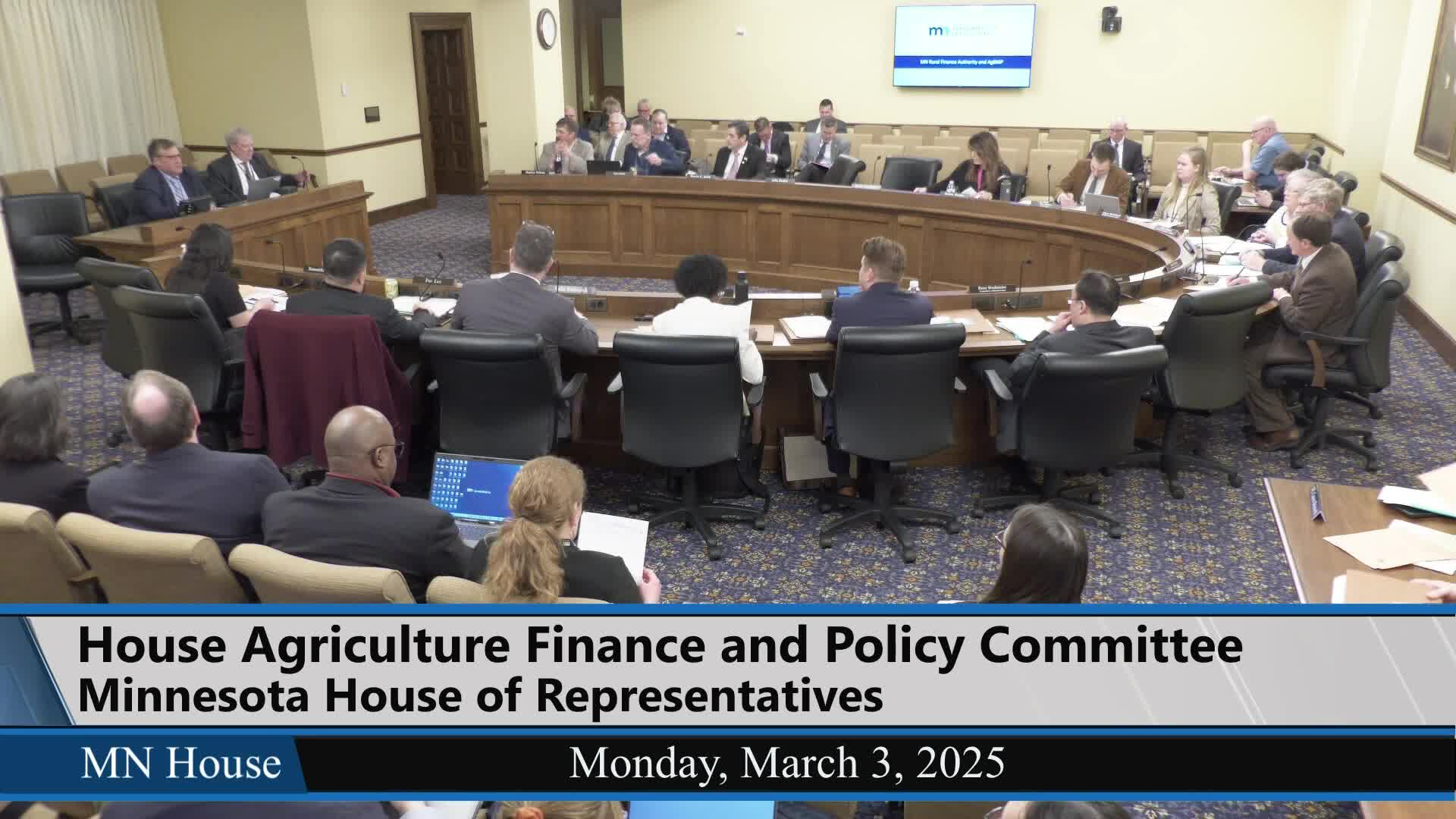
House Ag Finance Committee hears Rural Finance Authority briefing, approves referral for bonding bill
Summary
Chair Anderson called the committee to order and the House Agriculture Finance and Policy Committee heard a Rural Finance Authority briefing and voted to refer House File 770 to the Capital Investment Committee after adopting technical amendments.
Chair Anderson called the House Agriculture Finance and Policy Committee to order and the committee heard a presentation from the Minnesota Department of Agriculture’s Rural Finance Authority (RFA) on lending programs that serve Minnesota farmers.
The RFA, which Commissioner Tom Peterson described as “our bank for many different loan programs,” told the committee that its bond-funded and revolving loan funds are expected to be exhausted around December 2026 unless replenished. The committee adopted an amendment to House File 770 and referred the bill to the Committee on Capital Investment.
The RFA presentation, delivered by Commissioner Tom Peterson and Matt McDevitt (Ag Finance Supervisor, RFA), outlined the authority’s loan types and recent activity. McDevitt said the RFA administers 13 loan programs that partner with local lenders and use a shared‑risk model where the local lender closes loans and the RFA purchases about 45% of the loan.
Key figures cited during testimony: - Last bonding authorization: $50,000,000 (2023); about $39,000,000 remained at the time of the presentation. - The RFA has made more than 4,000 loans totaling roughly $417,000,000, with loan losses of just under $700,000 over that entire period (about 24 loans). - The authority expected to exhaust available funds by December 2026 if no new bonding is authorized.
McDevitt described major programs: the beginning farmer loan (popular, about 70% of RFA loans; current interest rate cited at about 5% and net‑worth limits adjusted for inflation), an agriculture improvement loan for facilities and equipment, disaster recovery loans (0% interest and interest‑only first two years for some disaster loans), and a new USDA‑backed meat and poultry intermediary lending program funded by a $15,000,000 USDA grant.
Farmer testimony supported replenishment. Matt Hardy of Rust Hill Ranch, who said the RFA beginning farmer loan helped him buy 40 acres, told the committee the program “helped me purchase my own farm” and that the lower rate “saves me enough interest, each month, for example, to purchase 1 ton of hog feed.” Hunter Peterson of the Minnesota Farm Bureau told the committee the RFA “plays a critical role in ensuring that farmers, especially beginning farmers and those facing financial distress, have access to the capital they need.”
Committee action: Chair Anderson moved that House File 770 be re‑referred to the Committee on Capital Investment. The committee adopted an A1 amendment to correct a typographical error and an oral amendment reducing an issuance‑cost figure from $30,000,000 to $30,000; members voted by voice to adopt the amendments and to refer the bill. The transcript records voice votes (ayes) but does not record numerical tallies.
The committee discussion and the bill referral make bonding authority available for the RFA to draw on before anticipated shortages in late 2026. Committee members and testifiers emphasized RFA programs’ role in supporting beginning farmers and in responding to emergencies such as avian influenza and drought.
Ending: With the motion prevailing by voice vote, House File 770 was referred to the Capital Investment Committee. The RFA presenters and farmer testifiers said they would continue to work with lawmakers on timing and specific needs if new bonding authority is approved.