Get Full Government Meeting Transcripts, Videos, & Alerts Forever!
Get email alerts on the Deer Fencing Cwd topic
No spam. Unsubscribe anytime.
Industry and DNR clash over fencing rules and penalties for deer farms; committee hears House File 40
Summary
House File 40 would remove statutory language requiring physical‑contact barriers between farmed cervids and wild deer and would eliminate statutory authority to revoke registrations and seize or destroy animals for escapes; deer‑farming groups said costs and unclear DNR guidance have driven producers from the industry, while the DNR warned the
Representative Burkel brought House File 40 for committee consideration. The bill would strike statutory language that requires secondary physical barriers to prevent contact between farmed cervids and free‑roaming wild deer and would remove statutory authority that allows revocation of herd registrations and seizure and destruction of animals after escape incidents or uncorrected fence deficiencies.
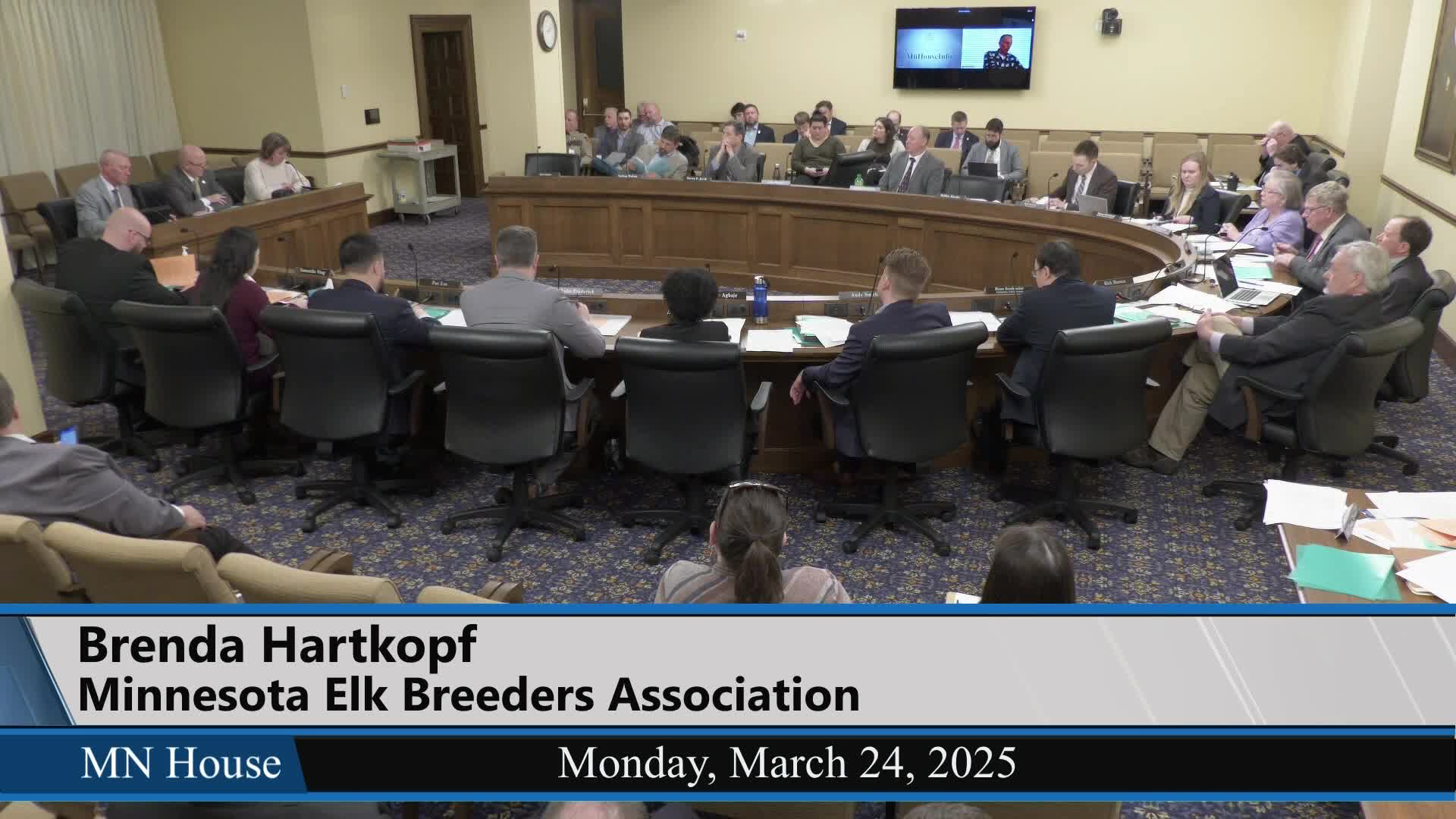
Multiple industry witnesses — including Brenda Hartkopf (Minnesota Elk Breeders Association), Tim Sprecht (Minnesota Deer Farmers Association), Scott Fear (president, Minnesota Deer Farmers) — testified in support. They described the secondary‑fencing requirement as an extremely costly, often impractical, and inconsistently interpreted mandate that has driven producers from the business. Scott Fear estimated the cheapest fence option for his farm would be about $50,000 and said some producers face costs up to $78,000; several producers reported fines and reinspection fees while they await clear, affordable DNR guidance.
Industry witnesses also said the DNR guidance documents provided to producers are advisory and may not create binding approval, leaving producers uncertain whether costly improvements will satisfy regulators. "If I talk on my behalf, I mean, the cheapest version of this fence... would be around $50,000 just for my farm," Fear testified.
Lieutenant Colonel Robert Garecki, assistant director for the DNR Enforcement Division, testified for the agency and opposed the change. Garecki told the committee the statutory fencing and enforcement provisions are intended to reduce nose‑to‑nose contact and lower the chance of CWD transmission; he said removing statutory penalties would leave regulators with only monetary penalties and weaken incentives to prevent escapes. The DNR provided data showing escapes had fallen since the 2023 law: "we only had 3 in 2023 and 2 in 2024," Garecki said. He also said only about 10 farms were currently noncompliant and that the agency continues to work with those producers.
The bill drew sharply divergent stakes: industry witnesses said the rules and penalties are driving legitimate agricultural operations out of the state, while the DNR warned the changes would reduce compliance incentives and increase disease risk. Representative Burkel argued the statute treats registered farms differently than other landowners and described current enforcement as a regulatory taking; he cited state statute recognizing cervid farming as agricultural production.
The committee laid House File 40 over for further consideration.