Get Full Government Meeting Transcripts, Videos, & Alerts Forever!
Get email alerts on the Phthalates Testing Foods topic
No spam. Unsubscribe anytime.
Committee advances bill to require phthalate testing and public reporting for packaged foods
Summary
The House Agriculture Finance and Policy Committee heard testimony on House File 44, a bill that would require food manufacturers to test packaged products for orthophthalates and make results public; an author amendment narrowed the bill and was adopted, and the bill was laid over for possible inclusion in future legislation.
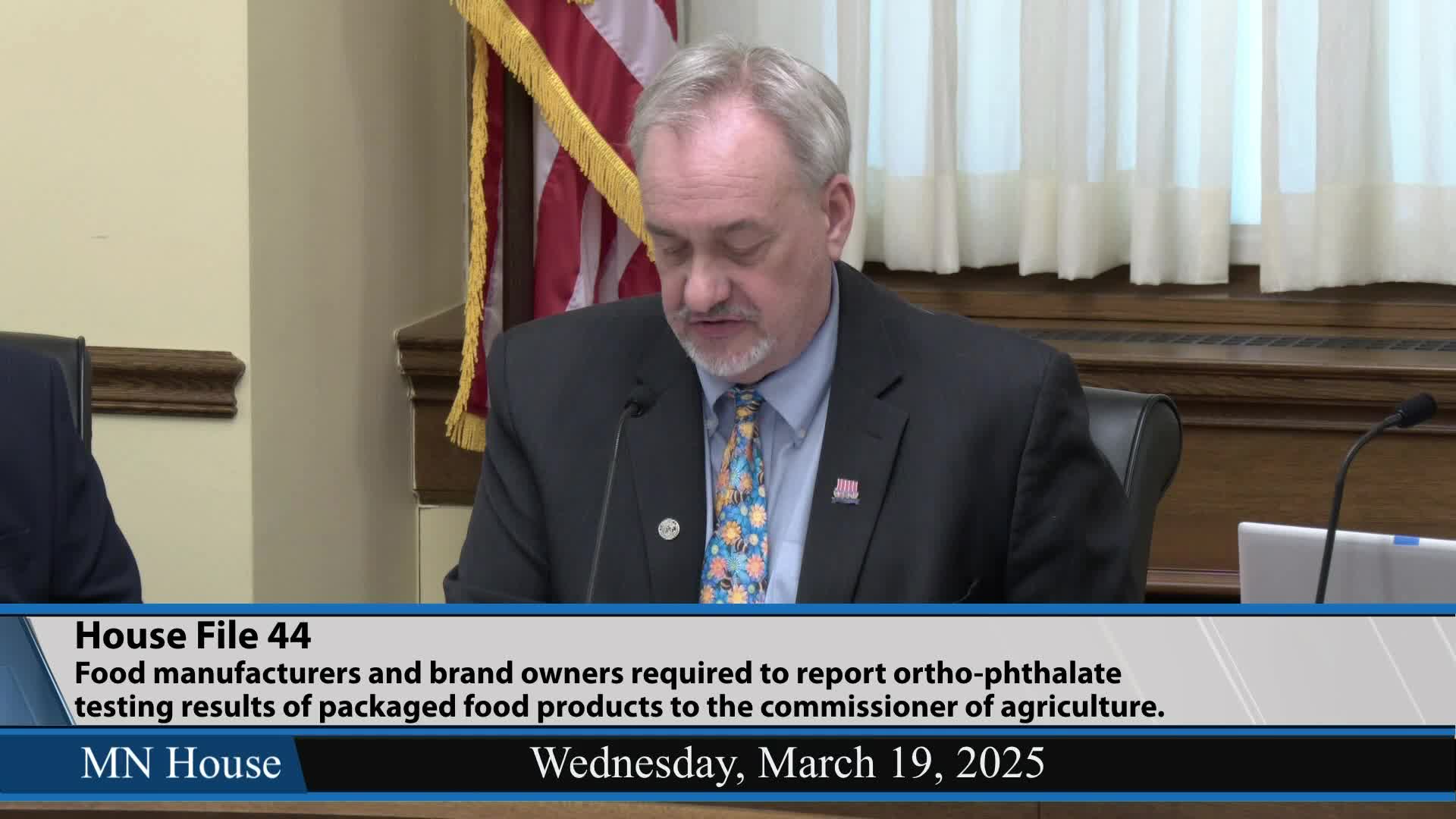
House Agriculture Finance and Policy Committee members took up House File 44, a bill that would require food manufacturers to test packaged food products for orthophthalates and publish the results online, during a committee meeting that included in-person and virtual testimony.
Supporters said the measure is meant to inform consumers and prompt manufacturers to reduce contamination. “We want food manufacturers to do a phthalate test once every two years and to make the results public,” Laurie Olinger of the Coalition for Plastic Reduction told the committee. Hannah Resendiz Olson, a community health specialist and fellow with Health Professionals for a Healthy Climate, said phthalates are endocrine-disrupting chemicals that pose elevated risks to infants and children. Michael Hansen, a senior scientist with Consumer Reports, described testing the group conducted of 85 packaged foods and said the organization found phthalates in nearly all items tested.
The bill’s author, Representative Curran, brought an A1 author's amendment that deleted a reporting requirement that the author said produced a heavy fiscal note; the committee adopted the A1 amendment by voice vote. After extensive testimony from public-health advocates, consumer groups, and food-industry representatives, Representative Curran renewed his motion that House File 44, as amended, be laid over for possible inclusion in a future bill; the committee laid the bill over.
Why it matters: Proponents framed HF 44 as a transparency measure intended to give shoppers information so manufacturers will reduce phthalate levels. Consumer groups cited studies and Consumer Reports testing indicating orthophthalates can leach from packaging into food and may be associated with adverse health outcomes. Industry groups warned the bill, as originally drafted, posed practical and legal challenges and could impose costs on small producers.
Supporters’ case: Testifiers emphasized public health and consumer right-to-know. Olinger said manufacturers already perform many tests and that public posting of phthalate test results would be a “bare minimum” step. Hansen (Consumer Reports) described his organization’s January 2024 testing and said many products contained levels that research has linked to health problems.
Industry concerns: Darren Broton of Minnesota AgriGrowth and Andrew Morley of the Minnesota Chamber of Commerce said the bill as drafted was “unworkable” in part because there is no established U.S. health-based concentration standard for phthalates in food. Morley warned of limited laboratory capacity and potential litigation if concentrations are published without federally recognized health thresholds. Minnesota AgriGrowth urged policymakers to identify phthalate sources — packaging, processing, or environmental contamination — before imposing mandates.
Committee discussion and next steps: Members asked about implementation timing, whether federal datasets or private apps could provide equivalent information, and how the bill could avoid imposing costs on small “mom and pop” food producers. Representative Curran said the bill’s core goal is informational: to learn what is in products and make that data public; he said he is open to changing implementation dates and to relying on existing testing where appropriate. The committee did not set a final deadline or concentration thresholds; Curran said those technical determinations would follow further work.
Votes and formal action: The committee adopted the author’s A1 amendment by voice vote and laid House File 44, as amended, over for possible inclusion in future legislation.
Ending: Committee members agreed to continue conversations with industry, public-health officials and state agencies to refine implementation details, testing cadence and options for relying on existing credible testing data.