Get Full Government Meeting Transcripts, Videos, & Alerts Forever!
Get email alerts on the Fertilizer Local Production topic
No spam. Unsubscribe anytime.
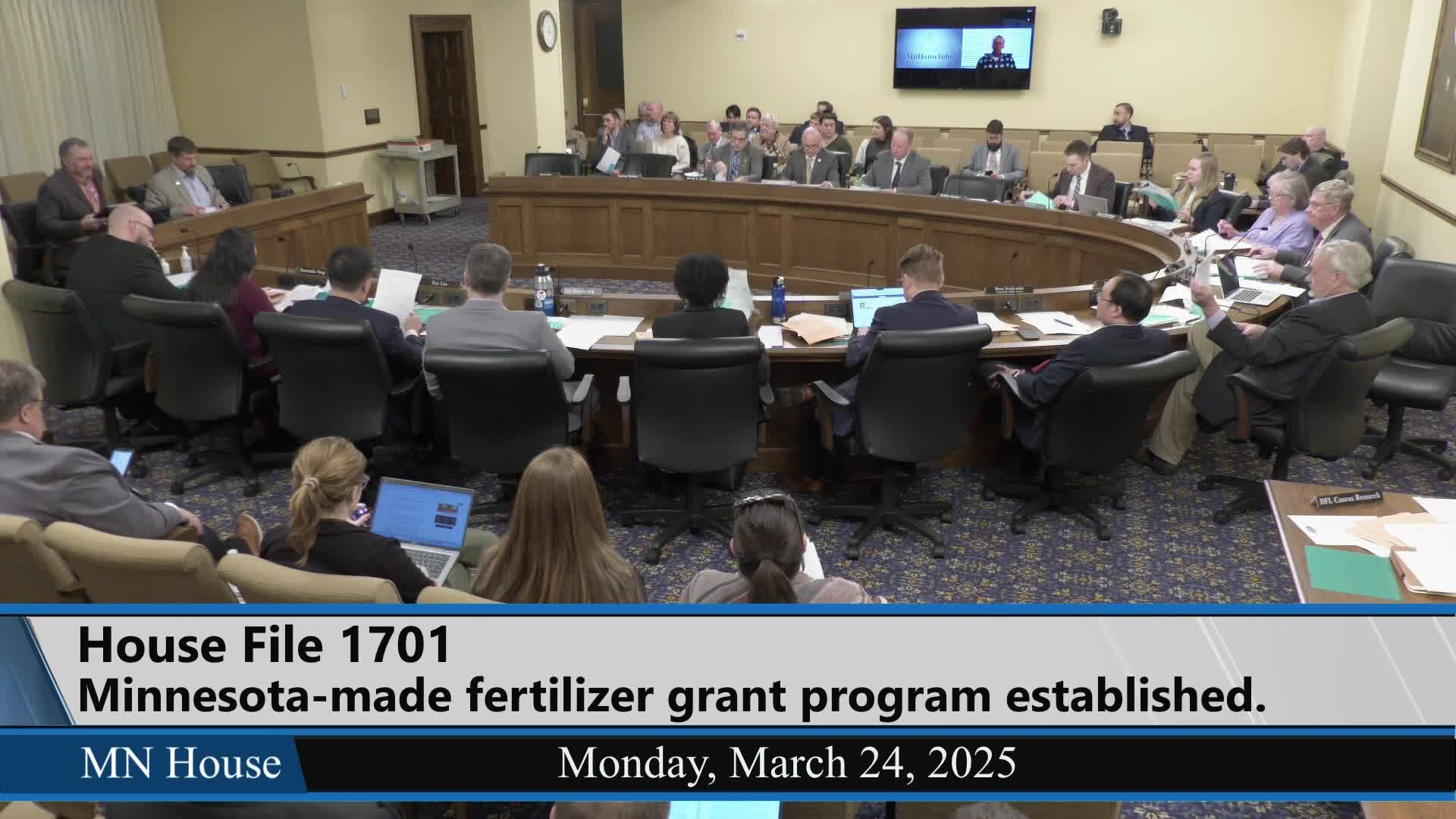
Committee hears bill to create Minnesota‑made fertilizer grant program using industrial co‑products
Summary
Representative Nelson presented House File 1701, a bill to establish a competitive grant program to convert industrial and agricultural co‑products into blended Minnesota‑made fertilizers.
Representative Nelson presented House File 1701, a bill to establish a "Minnesota‑made" fertilizer grant program that would fund projects turning co‑products and by‑products into blended, usable fertilizer.
Randy Terstig, a family farmer from Olivia who testified for the bill, told the committee that U.S. dependence on imported potash (largely from Canada, Russia and Belarus) and recent price volatility make local nutrient production strategically important. Terstig described co‑products available in Minnesota — animal manures, sugar‑beet calcium residues, potassium from wood ash and other biological outputs — and said small, locally sited plants that blend and pelletize such materials could sell specialty and retail products and reduce hauling and storage issues. "It's very simple, these nutrients if they're removed they need to be replaced," he said, describing nutrient removal rates for typical corn, soybean and alfalfa crops.
Terstig estimated small processing plants would likely cost in the $2–5 million range and argued that grant support would help multiple small operations build processing capacity to serve farmers, gardeners and specialty producers. He also said blended products can supply micronutrients and biological inputs that support soil health beyond standard N‑P‑K formulas.
Committee members raised fiscal objections to appropriating public dollars to private businesses. Representative Hansen asked whether grants would be competitive; Representative Nelson confirmed the bill envisions a competitive grant program rather than a named recipient. Members asked for guardrails to ensure state funds prioritize new production capacity and public benefit rather than subsidizing routine operations.
Outcome: Representative Nelson moved to lay House File 1701 over; the committee laid the bill over for additional development and analysis.