Get Full Government Meeting Transcripts, Videos, & Alerts Forever!
Get email alerts on the Childcare Safety And Cameras topic
No spam. Unsubscribe anytime.
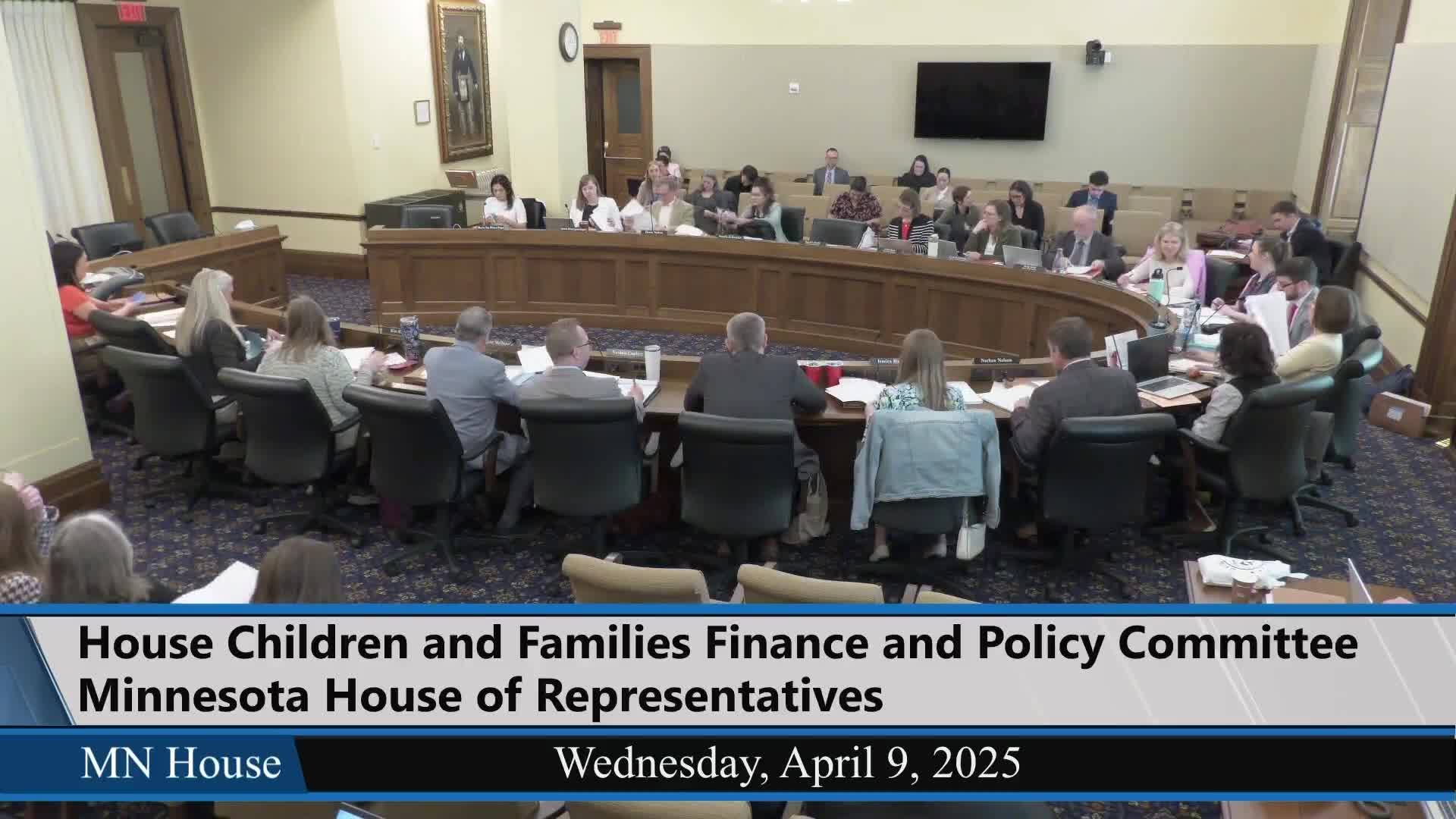
Children and Families committee debates HF 2436; camera mandate fails on 7-7 tie, bill laid over
Summary
The House Children and Families Committee considered House File 2436, the committee's omnibus children and families bill, debated multiple amendments including a proposed mandate for cameras in licensed child care centers, and rejected the camera mandate on a 7-7 tie; the bill was laid over to the committee's next meeting.
The House Children and Families Committee considered House File 2436, the committee's children and families omnibus bill, debated more than a dozen amendments and tied 7-7 on an amendment that would have mandated cameras and a 60-day storage standard for licensed child care centers; the amendment failed and the committee laid the bill over to its next scheduled meeting.
The bill discussion cut across several topics: child care safety and a contentious camera mandate, direction for remaining IT modernization funds tied to the Social Services Information System (SSIS), and a set of budget adjustments and targeted grants (food bank aid, SNAP outreach, diaper distribution, and workforce-related proposals). Committee co-chairs led the markup and multiple members and department staff testified on implementation timelines, costs and operational concerns.
Why it matters: HF 2436 contains program and funding changes that affect counties, licensed child care centers and human services IT systems statewide. The camera debate drew the most sustained floor-level exchange: proponents said routine video would increase accountability and provide evidence in abuse investigations; opponents warned that a statewide mandate could impose one-time installation and ongoing storage costs on small providers and raise data-privacy and operational risks for centers without legal or IT capacity.
Arguments and votes on camera language
Chair West (chair of the Children and Families Committee) framed the bill and pressed for a camera requirement he said would give investigators and families evidence in serious cases. West told members the committee had considered cost estimates and a grant program to offset one-time installation costs and that vendors offering daycare-focused camera systems exist. At one point West rejected the suggestion of an opt-out for parents: "Absolutely not, that's unacceptable," he said when discussing an opt-out idea raised during negotiations.
Vice Chair Hansen described a competing approach: rather than an immediate statewide mandate, she urged a more incremental path or a study process to preserve negotiation leverage with the Senate and to avoid leaving the issue without any outcome. Hansen said she wanted the committee to "leave this session with something" but voiced concern that a full mandate could be difficult to carry through negotiations in the other body.
Several members expressed practical concerns about costs and operational burdens for smaller and family-home providers. Representative Hicks and others warned that centers in Greater Minnesota with limited staff and legal support might struggle to comply with retention, access-logging and privacy requirements, and could face unintended closures. Representative McDonald and Representative Kolter pushed back, saying cameras are a modest cost relative to the expense of care and that footage provides accountability and protection for children and for providers.
The committee took a roll-call vote on the A2 amendment (the camera mandate as presented in the DE amendment). The roll call recorded seven yes votes and seven no votes, so the amendment failed (tie). The committee then laid the bill over to its next scheduled meeting to continue negotiations.
Other adopted and considered amendments
- Amendment A13 (technical corrections to the DE): adopted by voice vote after unanimous member support. Chair West moved the amendment; Chair Katiza Wooten voiced support for the technical fixes.
- Amendment A14 (inserts language from a Representative Peggy Scott bill altering calculation of child-support cost-of-living adjustments): adopted by voice vote after the author and chair said the bill's changes were intended and agreed.
- Amendment A20 (clarifies direction for remaining IT modernization funds from a 2023 $20,000,000 allotment not related to SSIS): adopted by voice vote. Chair Katiza Wooten and Chair West said the amendment tightens department direction for use of those leftover funds so the money better advances IT goals.
Withdrawn amendments
Several members moved amendments and then withdrew them after discussion and commitments to continue work: Representative Sensamura withdrew an amendment that would have required the Bureau of Criminal Apprehension (BCA) to retain certain fingerprints for five years and alert the Department of Human Services (DHS) if arrests for disqualifying crimes occurred; Representative Zalesnikar withdrew an amendment to delay rollout of the Minnesota African American Family Preservation Act (MAFPA) implementation timelines outside the seven-county metro; Representative Perez Vega withdrew two separate amendments (A11 and A12) after discussion about existing base funding and matching federal opportunities; Representative Sensamura also withdrew an amendment to subsidize or provide free childcare to child care workers (A16) with an intent to pursue the concept in the workforce committee.
Failed or not-adopted amendments
- A6 (additional food-bank support targeted at smaller food banks): the amendment failed on a voice vote. The chair noted other committees and bills have additional food funding and said the underlying DE already contained $1,500,000 for food-related supports.
- A17 (inserting a youth-proposed program): not adopted on voice vote.
- A18 (diaper distribution grant funding): not adopted on voice vote.
- A19 (create a task force to study camera data storage, cybersecurity and parental voice): not adopted on voice vote. The author (Vice Chair Hansen) said the task force was intended to make the camera proposal more negotiable; proponents of the mandate argued a task force would merely delay action.
IT modernization / SSIS timeline and county concerns
Members pressed department staff about the SSIS modernization timetable. Jennifer Summerfeld from the Department of Children, Youth and Families told the committee, "We don't have an exact date" for SSIS completion and said the department has hired a consultant who is developing a roadmap; an earlier consultant had been replaced and the new contractor is expected to produce more details in the coming months.
Several representatives argued implementation of major program changes (for example, aspects of MAFPA) should align with SSIS readiness so counties are not required to implement new work on a system they regard as unstable. Members said Hennepin and Ramsey counties received $2.5 million each to help implement MAFPA in the pilot metro rollout; representatives from greater Minnesota said full statewide implementation would require significantly more funding and county capacity.
Votes at a glance (selected recorded outcomes)
- A13 (technical corrections): adopted (voice vote) - A14 (child-support COLA language): adopted (voice vote) - A20 (direction for remaining 2023 IT modernization funds [$20,000,000 allotment referenced]): adopted (voice vote) - A6 (additional food-bank funds): failed (voice vote) - A11 (SNAP outreach funding proposal moved then withdrawn by author) - A12 (withdrawn by author) - A3 (background-check/fingerprint retention for BCA, author withdrew) - A16 (child care worker subsidized childcare): withdrawn by author - A17 (youth program insertion): failed (voice vote) - A18 (diaper distribution grant): failed (voice vote) - A19 (camera task force): failed (voice vote) - A2 (camera mandate/60-day retention as presented in the DE): roll call 7 yes / 7 no; amendment failed
Quotes from the hearing
- Chair West (Children and Families Committee): "Absolutely not, that's unacceptable." (discussing an opt-out suggestion during negotiations)
- Jennifer Summerfeld, Department of Children, Youth and Families: "We don't have an exact date" (on when the SSIS modernization will be completed; the department has hired a consultant to lay out a roadmap)
- Vice Chair Hansen: "I don't want to see this just turn to dust." (arguing for a path that would leave the committee with negotiable language)
- Chair Katiza Wooten: "We have $500,000 in the agreement for House file 19 15." (noting the signed fiscal agreement includes funding for the companion camera bill elements and that much of HF 1915 text is included in the DE aside from the mandate language)
What comes next
The committee laid HF 2436 over to its next scheduled meeting for further negotiation and to allow chairs and authors to continue refining technical, fiscal and program language. Several members said they will continue working with agencies (the Department of Children, Youth and Families; DHS), county representatives, and cybersecurity experts as needed before the bill returns to committee.
Ending note
Committee chairs said they will reconvene with remaining time scheduled the following day to continue markup of HF 2436 and related issues affecting child care safety, SSIS modernization and targeted grants for food security and family support.