Get Full Government Meeting Transcripts, Videos, & Alerts Forever!
Get email alerts on the Fentanyl Exposure topic
No spam. Unsubscribe anytime.
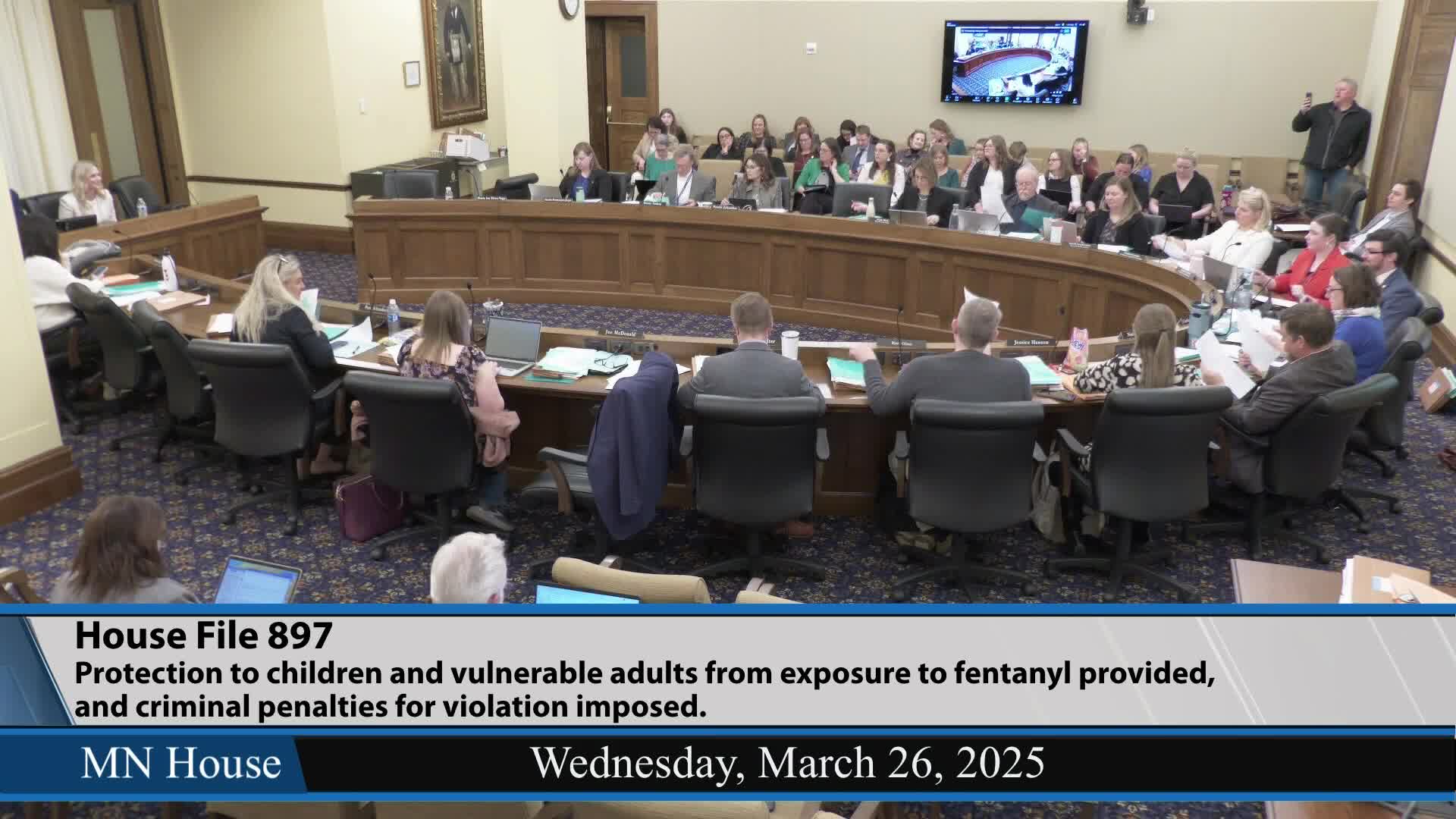
Committee forwards bill to criminalize knowingly exposing children or vulnerable adults to fentanyl to Public Safety
Summary
House File 897 would add fentanyl to the statute that criminalizes exposing children and vulnerable adults to methamphetamine. Testifiers including prosecutors and advocacy groups urged the change, citing fentanyl's extreme potency and rising poisonings; the committee re‑referred the bill to Public Safety.
The committee voted to re‑refer House File 897 to the Public Safety Committee after testimony from prosecutors, advocacy groups and impacted community members calling for heightened penalties when caretakers knowingly expose children or vulnerable adults to fentanyl.
Rep. Knudson, the bill’s author, told the committee the legislation aligns the criminal penalty that now covers methamphetamine with fentanyl because "exposure to the poison that is fentanyl is a likely death sentence." Several testifiers—prosecutors and community advocates—detailed fatal and nonfatal overdoses and pointed to large percentage increases in infant fentanyl exposures nationwide.
Advocates argued fentanyl’s potency—where milligrams can be lethal—creates a unique public‑safety risk for infants and vulnerable adults. Sebastian Mesa, an assistant county attorney, and other prosecutors said current statute (which covers methamphetamine exposure) should be extended to include fentanyl so similarly situated offenders receive similar penalties.
Members asked how the law would operate in public settings such as transit where people might smoke or ingest fentanyl near others. Prosecutors said the bill focuses on knowingly causing or permitting exposure and that prosecutorial discretion and case facts would govern enforcement; they noted hypothetical fact patterns (for example, a child seated adjacent to a person ingesting fentanyl) could, in extreme circumstances, support charges.
Questions also addressed the definition of "vulnerable adult" and whether the change could unintentionally affect communal living situations. Prosecutors and the bill author said the bill uses the existing criminal definition of vulnerable adult and does not change that definition; supporters said the new language mirrors the current methamphetamine provision and is intended to close a statutory gap.
Representative Knudson renewed her motion to re‑refer the bill to Public Safety; members approved the referral by voice vote and the bill will proceed to that committee.
Public testimony included parents and community members who described personal exposure concerns on transit and in housing. Testifiers urged additional investments in Narcan distribution and treatment alongside criminal penalties.