Get Full Government Meeting Transcripts, Videos, & Alerts Forever!
Get email alerts on the Childcare Monitoring And Integrity topic
No spam. Unsubscribe anytime.
Committee adopts video‑monitoring and attendance amendments for large child‑care providers; expansion amendment fails 7‑6
Summary
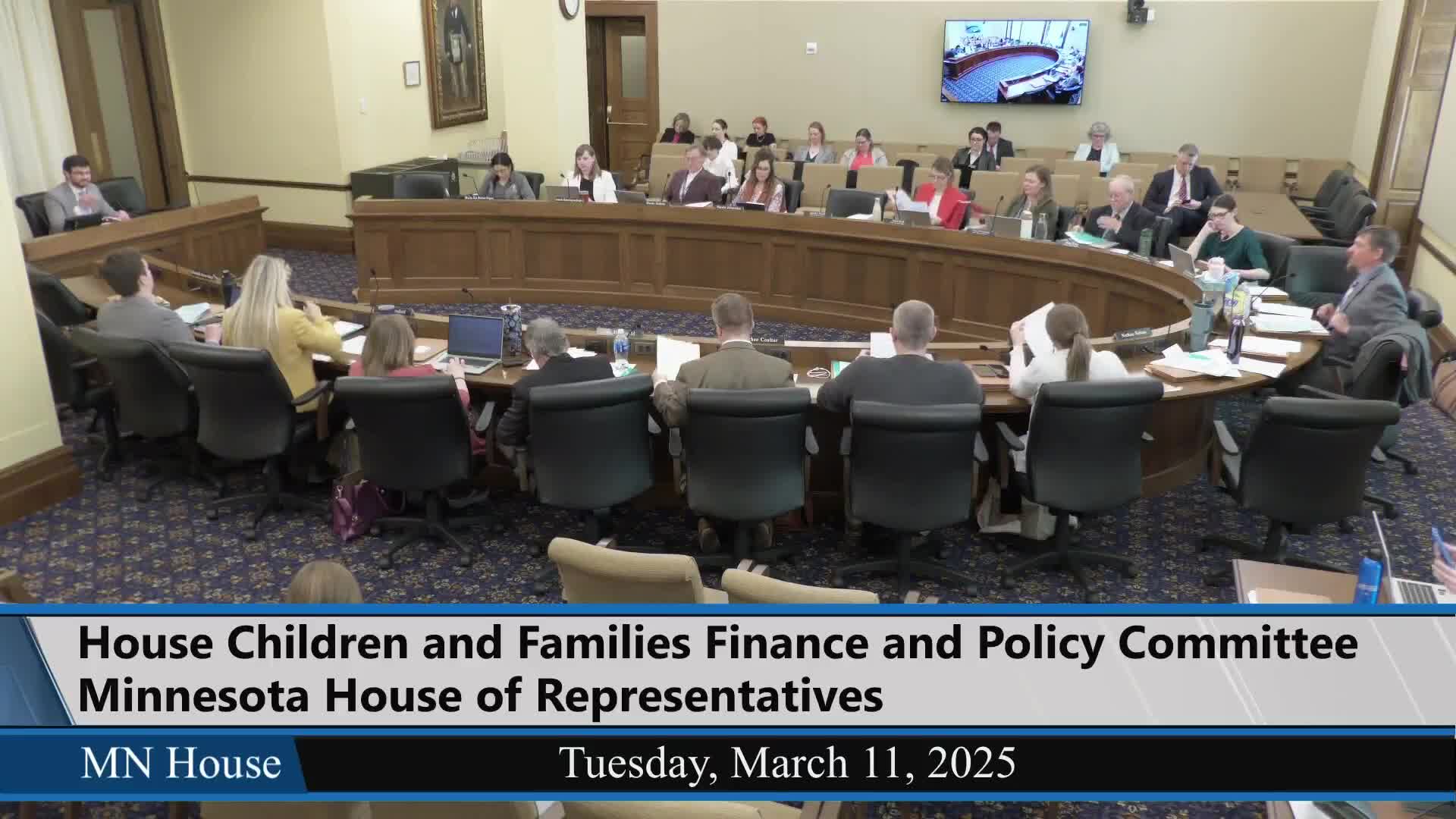
The Children and Families Committee on Oct. 12 adopted an A7 amendment to House File 1916 that adds video monitoring and electronic attendance requirements for large child‑care providers and re‑referred the bill to the Committee on Judiciary.
The Children and Families Committee on Oct. 12 adopted an A7 amendment to House File 1916 that adds video monitoring and electronic attendance requirements for large child‑care providers and re‑referred the bill to the Committee on Judiciary. An amendment (A6) that would have removed the dollar threshold and applied the requirements to all providers failed on a roll call vote, 7 nays to 6 ayes.
Representative West, the bill author, said HF 1916 "introduces essential safeguards to Minnesota's childcare system" and framed the changes as measures to address alleged fraud and program vulnerabilities in the Child Care Assistance Program (CCAP) and early learning scholarships. West cited 62 active investigations and a recent news report that found some centers without children present during daytime visits.
Under the A7 amendment adopted by the committee: - Providers receiving $1,000,000 or more in CCAP funds (and providers receiving comparable early learning scholarship funds under the amendment) would be subject to the monitoring requirements. (The underlying bill previously set a $500,000 threshold.) - Video monitoring must cover public entrances and exits to the facility and entrances and exits to areas where a parent or legal guardian signs children in and out. The department may request footage for verification and may follow up with an in‑person inspection if it identifies red flags. - The amendment reduced the proposed footage retention period from 90 days to 30 days and set a minimum camera quality in the bill text at 720p; committee discussion noted that cloud storage with 30‑day retention can be materially less expensive than retaining 90 days of footage. - The bill includes electronic attendance monitoring and reinstates language increasing accountability for provider billing (including perjury provisions discussed by the author).
Representative Kolter asked the committee to clarify where cameras would be placed; committee counsel (Ms. Mott) and bill sponsors pointed to the amendment language specifying coverage of facility public entrances and entrances/exits where guardians sign children in or out.
Representative Coulter moved an amendment (A6) to remove the dollar thresholds so that any provider receiving any CCAP or early learning scholarship funding would be subject to the requirements. Coulter said, "what's good for the goose is good for the gander," arguing that providers receiving smaller amounts can still receive sizable sums and should be held to the same standards. Chair West and other members argued a $1,000,000 threshold targets the concentrated set of largest recipients (the sponsor cited roughly 73 providers who met the higher threshold) and avoids imposing compliance costs on many small providers.
A roll call was requested; the clerk recorded the vote as 7 nays and 6 ayes and the A6 amendment was not adopted. The committee then adopted the A7 amendment and re‑referred House File 1916 to the Committee on Judiciary.
Representative Hansen raised privacy and safety concerns about expanded video monitoring, noting a recent Minnesota arrest in which video monitoring software was misused to produce exploitative material. "Can you just give me some reassurances ... how this bill will protect against that?" Hansen asked. West said the amendment keeps the process demand‑driven (the commissioner must request footage) and noted that footage could be kept on closed CCTV systems rather than always being cloud‑connected; he also said security and criminal‑penalty questions were appropriate for the Judiciary Committee and signaled willingness to pursue enhanced penalties for misuse as the bill moves forward.
Next steps: With the A7 amendment adopted, House File 1916, as amended, will be considered by the Committee on Judiciary, where sponsors indicated they will work on security safeguards and potential criminal‑penalty language.