Get Full Government Meeting Transcripts, Videos, & Alerts Forever!
Get email alerts on the Background Checks And Data Sharing topic
No spam. Unsubscribe anytime.
Panel advances bill to share child exploitation alerts with background-check system after daycare abuse case
Summary
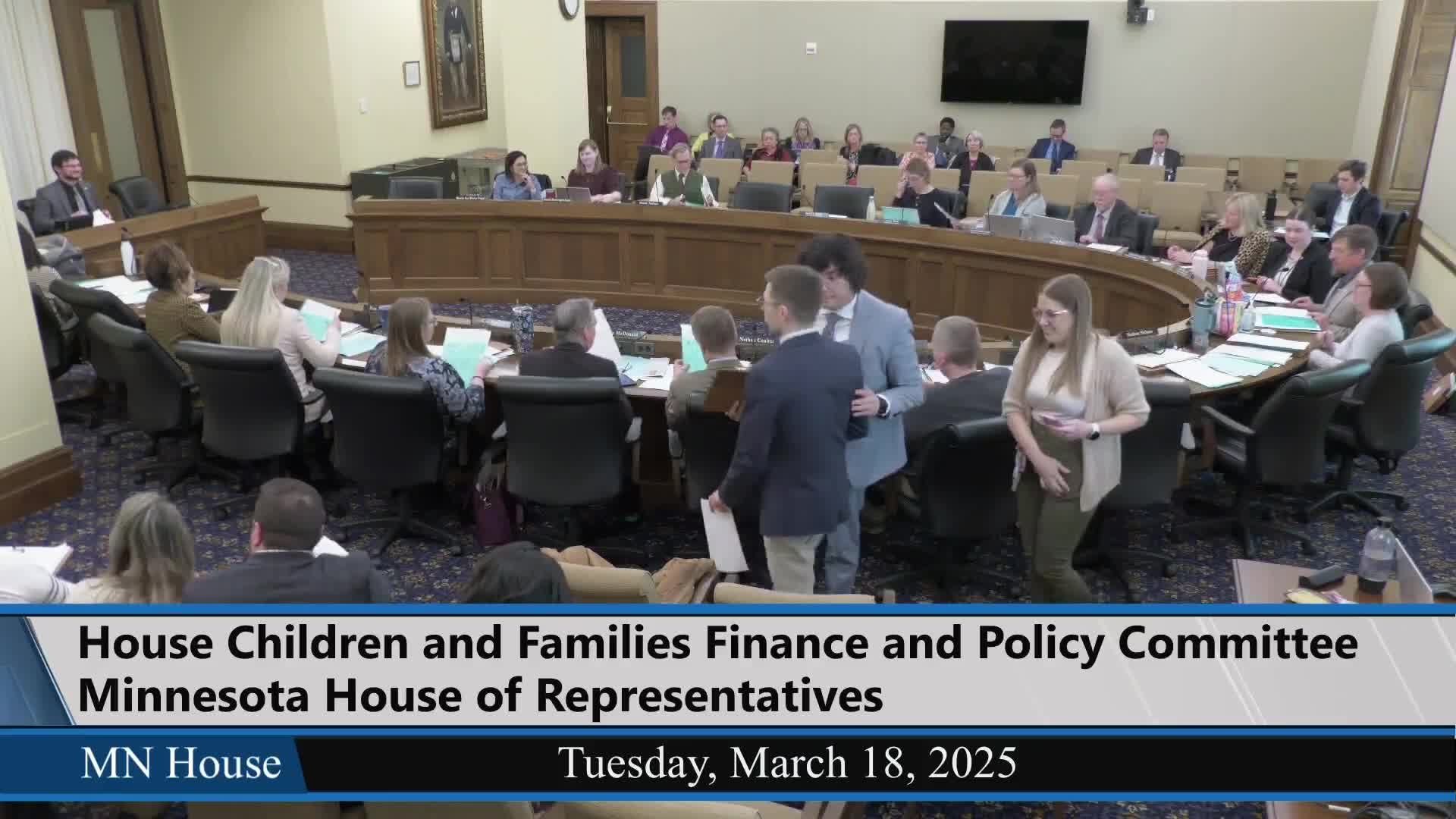
The committee voted to re‑refer House File 2,226 to Judiciary after testimony that background checks did not reflect repeated National Center for Missing and Exploited Children (NCMEC) alerts in a case where a daycare employee later was arrested for possession of child sexual-abuse material.
The Children and Families Committee voted Oct. 12 to re‑refer House File 2,226 to the Judiciary Committee after hearing testimony that gaps in interagency data sharing allowed a person under repeated alerts for child sexual‑abuse material (CSAM) to continue working in child care.
Sponsor Representative [West] introduced the bill and described it as legislation to allow a limited data interface so that alerts the Bureau of Criminal Apprehension (BCA) receives from the National Center for Missing and Exploited Children (NCMEC) would be available to the agency that handles childcare background studies. The sponsor said providers need a higher standard when hiring people who work with children.
Victim testimony: Adrian Lundeen Hornung, a parent whose daughter was identified as a victim in a Minneapolis daycare case, described the personal and family trauma and urged passage. “This event has left my family traumatized,” he said, describing ongoing effects on his daughter and family life.
Provider testimony: Huang Murphy, CEO of People Serving People, told the committee that the BCA had received repeated NCMEC alerts about the offender over several years but that the state’s background‑check process did not surface that information for daycare employers. Murphy said the result was at least three childcare employers hiring a person who had multiple alerts and who later was arrested for possession of child exploitation material. Murphy urged a “simple data sharing process” — a yes/no indicator that could be returned to DHS during a background check.
Privacy and process questions: Members pressed staff and witnesses about data privacy, the potential to interfere with criminal investigations, and the legal limits of background studies. Committee discussion focused on ways to provide childcare providers with timely protection while preserving investigatory integrity. Supporters said the bill’s draft limits the detail shared with employers to avoid undue reputational harm and to avoid alerting subjects of ongoing investigations.
Action taken: The committee voted to re-refer House File 2,226 to Judiciary by voice vote. Sponsors and members said they will coordinate with BCA, DHS and Public Safety committees to resolve technical and legal issues before further action.
Ending: Lawmakers said they view the measure as a narrowly targeted fix to prevent known-risk individuals from working near children while respecting investigative processes and privacy law.