Get Full Government Meeting Transcripts, Videos, & Alerts Forever!
Get email alerts on the Childcare Regulation topic
No spam. Unsubscribe anytime.
Committee lays over broader childcare regulation bill after extended debate on qualifications and safety
Summary
Chair Torkelson’s House File 628, which moves multiple childcare requirements from rule to statute and changes staffing qualifications, was laid over for possible inclusion in an omnibus bill after lengthy public testimony and member questions about safety, medical plans and age/ratio limits.
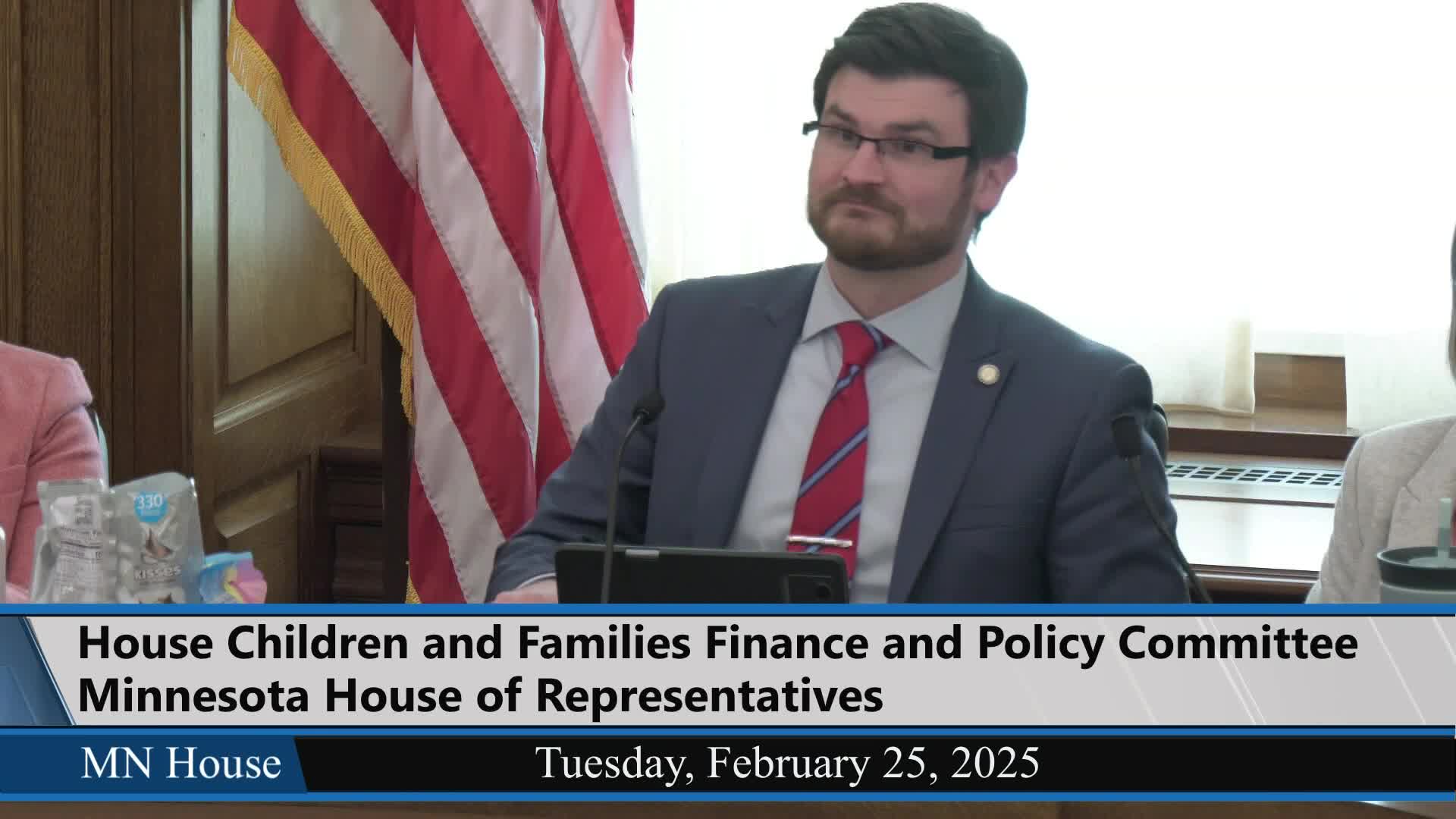
The Committee of Children and Families Finance Policy laid over House File 628 as amended after an extended hearing that included provider testimony, detailed questions from committee members and participation from nonpartisan staff and licensing officials.
Chair Torkelson, who is also chair of the House Ways and Means Committee, introduced the bill and moved DE1 to put the bill “in the shape” the author prefers. The committee adopted the DE1 amendment by voice vote; Chair Torkelson then moved to lay the bill over for possible inclusion in a later omnibus measure.
House File 628 covers multiple aspects of childcare regulation, including staff qualifications, the director role, records required for each child, group-size and ratio language, and where particular requirements should sit — in statute versus rule. Maria Harms, owner and director of Snug as a Bug Child Care in Redwood Falls, described regulatory complexity and said current and proposed standards risk narrowing the hiring pool and increasing costs.
Harms testified: “Regulatory standards…should address safety oriented policy. However, within these important guidelines there are many sub parts that are not beneficial; in fact, [they] cause issues for providers.” She urged the committee to focus on safety-oriented requirements and to avoid unnecessary burdens that she said contribute to staffing shortages.
Members pressed on several specifics. Representative Sensamura asked about the bill’s effect on affordability and on the amount of family and medical information centers would be required to hold. Harms replied that centers already collect emergency contacts and medical/dental information but argued the state should not require “extensive information” that centers do not necessarily use in emergencies.
Representative Coulter asked whether the bill removed qualifications for substitute teachers or the 240-hour annual limit on substitutes; the bill sponsor and testifier said that was not the sponsors’ intent and that substitutes would still need required trainings and familiarity with the center.
Members raised concerns about medical and inclusion protections. Representative Perez Vega asked whether a center could be prevented from collecting critical medical information for children with chronic conditions; the testifier and DHS licensing staff told the committee centers currently use medication authorization forms and develop individualized plans when a child has a medical need, and that training and often a parent/provider plan are typically used rather than converting centers into medical providers.
Nonpartisan staff clarified that some language in the bill reflects current rule moved into statute; for example, the DE1 retains language allowing temporary exceptions to maximum group-size rules for short events such as visiting a fire truck, while ratios still apply.
Several members voiced opposition to lowering qualifications or to any change that might reduce access for children with disabilities. Representative Kolter said childcare is “arguably more important education than kids will receive at any other time in their lives,” and warned against “a race to the bottom” on qualifications. Representative McDonald and others said they support creative approaches to reduce cost and regulatory complexity but want to preserve safety standards.
Alyssa Dodson, Deputy Inspector General for the Licensing Division, said she would follow up with the committee on technical questions about when unsupervised volunteers or substitutes may be permitted and on detailed mixing-of-age-group rules.
After the discussion and brief closing comments from the author and testifier, Chair Torkelson renewed the motion to lay the bill over as amended; the committee approved the layover by voice vote.
The bill remains under committee consideration and will require further drafting and negotiation as members work to balance safety, inclusion and affordability.