Get Full Government Meeting Transcripts, Videos, & Alerts Forever!
Get email alerts on the Child Welfare Fiscal Analysis topic
No spam. Unsubscribe anytime.
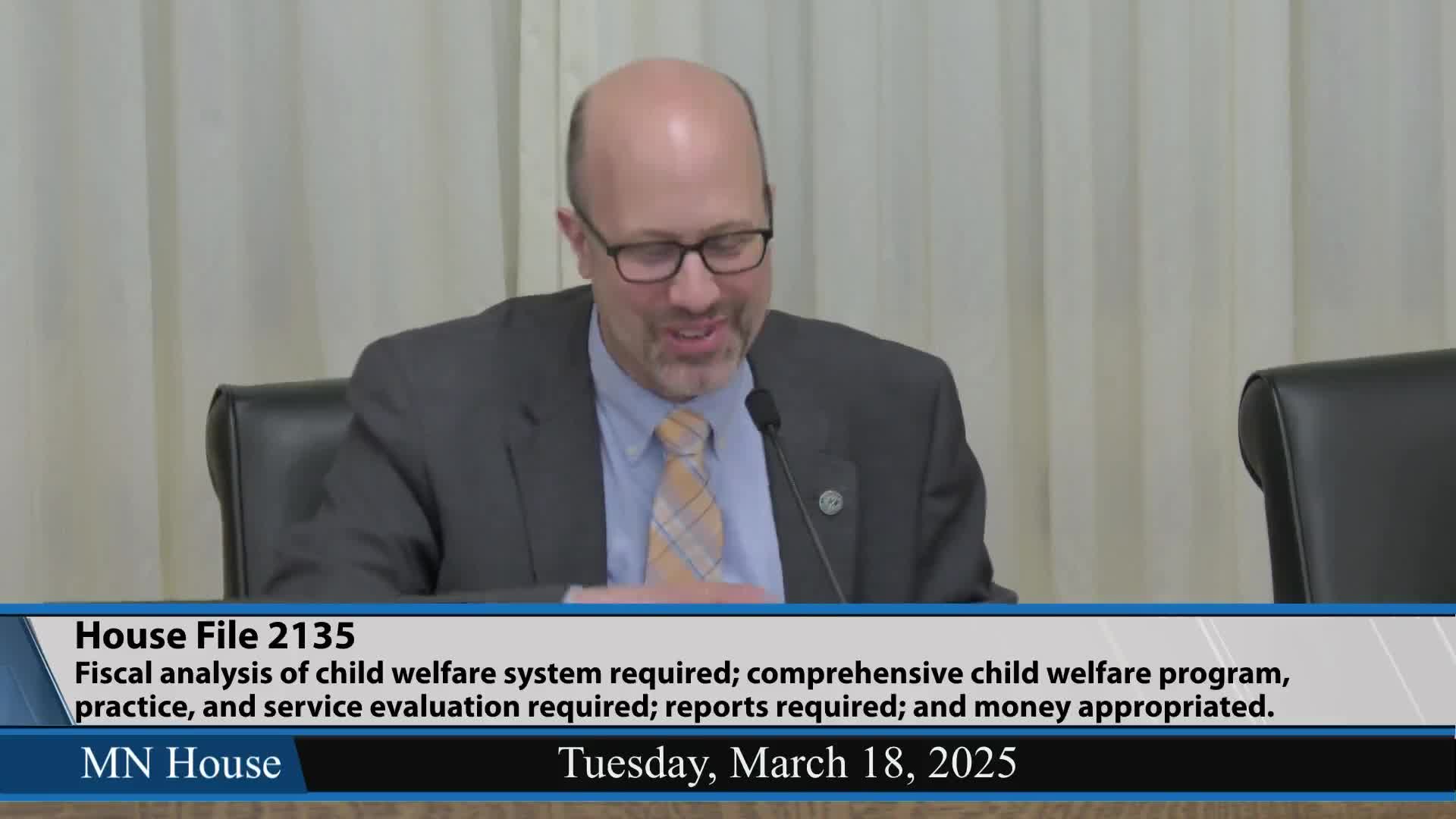
Committee lays over bill to commission fiscal analysis of Minnesota child-welfare system
Summary
The Children and Families Committee accepted an amendment and laid over House File 2,135, which directs the Department of Children, Youth and Families to contract for an independent fiscal analysis of the state’s child-welfare funding streams and federal funding opportunities.
The Children and Families Committee on Oct. 12 laid over House File 2,135 for possible inclusion in an omnibus bill after adopting an amendment that narrows the bill’s language.
The bill, as amended, directs the Department of Children, Youth and Families (DCYF) to contract for an independent fiscal analysis of Minnesota’s child-welfare financing and report findings to the legislature. Representative Pinto, sponsor of the bill, said, “So, what the bill, as amended as amended does is to, commission a fiscal analysis of our child welfare system.”
Why it matters: Witnesses and the bill sponsor told the committee that Minnesota relies disproportionately on counties and tribal governments to fund child-welfare services and that a comprehensive fiscal picture is necessary to identify untapped federal resources and other funding opportunities. Tracy Laliberte, director of a research and training center for child welfare at the University of Minnesota School of Social Work, testified that the work would “position the Department of Children, Youth and Families, county and tribal child welfare agencies, and the legislature to have critically important data available for engagement and discussions about the future of Minnesota’s child welfare system.”
What the bill would do: The adopted delete-all amendment (DE3) narrows the original bill and directs DCYF to contract with an external consultant to (as summarized by the sponsor and witnesses) identify and catalogue current funding streams, estimate funds that are not being maximized, and prepare a report with recommendations for how state, county, tribal and federal resources might be accessed more effectively. The bill text specifically directs attention to maximizing federal resources and lists report requirements that will inform legislative decision-making.
Cost and timeline: Committee discussion noted the appropriation line in the amendment was blank; committee members and staff recalled prior funding for a similar study. State staff said last year’s net cost was about $170,000 after federal match; the gross appropriation figure referenced from the prior session was $250,000. Representative Olsen pressed for assurance that the study will be actionable and not duplicative of prior work.
Discussion highlights: Witnesses described Minnesota as ‘‘one of two states with the lowest state contribution for child welfare services’’ and noted counties fund a substantial share of child-welfare costs—figures cited to the committee and county association materials put county responsibility at more than 40 percent of system funding, compared with a national average near 10 percent. Witnesses and members also discussed the Family First Prevention Services Act as a federal policy with funding streams Minnesota may not be fully maximizing.
Next steps: The committee adopted the DE3 and laid House File 2,135 over for possible inclusion in a later omnibus bill. No final appropriation was set in committee; the bill will proceed through the normal bill-drafting and fiscal-note processes.
Ending: Committee members urged prompt follow‑up on the fiscal-note process and emphasized the need to structure the vendor contract and report to produce practical, implementable findings rather than a general inventory of problems.