Get Full Government Meeting Transcripts, Videos, & Alerts Forever!
Get email alerts on the Childcare Licensing topic
No spam. Unsubscribe anytime.
DHS outlines licensing overhaul, enforcement tools after parent recounts alleged abuse at Plymouth preschool
Summary
Department of Human Services officials told the Children and Families Finance and Policy Committee they are pursuing a multi-part licensing modernization project, stepped-up enforcement tools and background-study practices as parents and lawmakers pressed for stronger oversight after a parent described an incident at Little Explorer’s Plymouth.
At a recent meeting of the Minnesota House Children and Families Finance and Policy Committee, Department of Human Services officials presented an overview of childcare licensing, enforcement tools and a multi-part modernization project while a parent described an incident at a Plymouth preschool that he said went viral online.
Joshua Truax, a parent whose son appears in a widely shared video, told the committee his 3-year-old was “picked up, slammed … aggressively pushed into a table” and had toy drumsticks taken while other toddlers watched. “We must demand stricter oversight, stronger protections, and real consequences for those who fail our children,” Truax said.
The testimony framed lawmakers’ questions as Alyssa Dodson, Deputy Inspector General for the DHS Licensing Division, described how Minnesota licenses and inspects childcare providers, the range of enforcement tools available and the department’s plan to modernize rules and inspection practices.
Dodson said DHS licenses two main program types: state-licensed childcare centers and county-delegated family childcare programs. As of February 2025, Dodson reported there were 1,791 licensed centers and 5,756 licensed family childcare providers. Centers are directly licensed and inspected by DHS staff; family childcare is licensed through county delegated licensors who recommend sanctions to DHS for more serious actions.
DHS outlined a tiered set of enforcement responses. Low-level issues can generate “documented technical assistance” (replacing the prior “fix-it ticket” approach); correction orders address more substantive but non-imminent violations; fines may be assessed for violations that impact health and safety; conditional licenses set terms and extra monitoring; temporary immediate suspensions stop operations when there is imminent risk (statutorily limited in duration); and revocation is available for severe or chronic violations. Dodson said family childcare statutory fines are capped at $1,000, while center fines can be $1,000 or $5,000 depending on severity; other licensing fines can be $100 or $200.
Dodson described DHS’s “early and often” unit—created after prior audits—to provide intensive monitoring and technical assistance to new centers, including an initial announced visit and three additional unannounced visits during the first year. DHS also said licensors follow a “nature, severity and chronicity” rubric when deciding enforcement actions and that providers may request reconsideration or appeal sanctions to a judge.
On fraud and program-integrity overlap, Dodson explained licensors refer suspicious attendance or recordkeeping issues to DHS’s program integrity/CCAP investigations unit. That unit, she said, has four investigators, 62 open cases and has recovered about $2.4 million since 2020; roughly 20% of its investigations have yielded criminal referrals, Dodson said. She added that a “credible allegation of fraud” can prompt a program-payment withhold by program-integrity staff.
Dawn Davis, Deputy Inspector General for the Background Studies Division, explained background-study procedures used by DHS. Davis said Minnesota’s statewide background-study system processed about 538,000 applications in 2024 across many program types, and that 73,556 (about 14%) of those applications were for childcare providers. Davis cited Minnesota Statutes chapter 245C.15 as the source of statutory disqualifying crimes for childcare workers and noted that many disqualifications are time-limited tiers (for example, 15, 10, 7 or 5 years) while others may be permanent.
DHS told the committee it must comply with federal Child Care Development Fund (CCDF/CCDBG) requirements, which include annual unannounced inspections and public posting of licensing history. Dodson said a 2024 federal rule requires states to post items both in compliance and out of compliance; Minnesota has a federal waiver through August 2026 while it makes system changes to meet that rule.
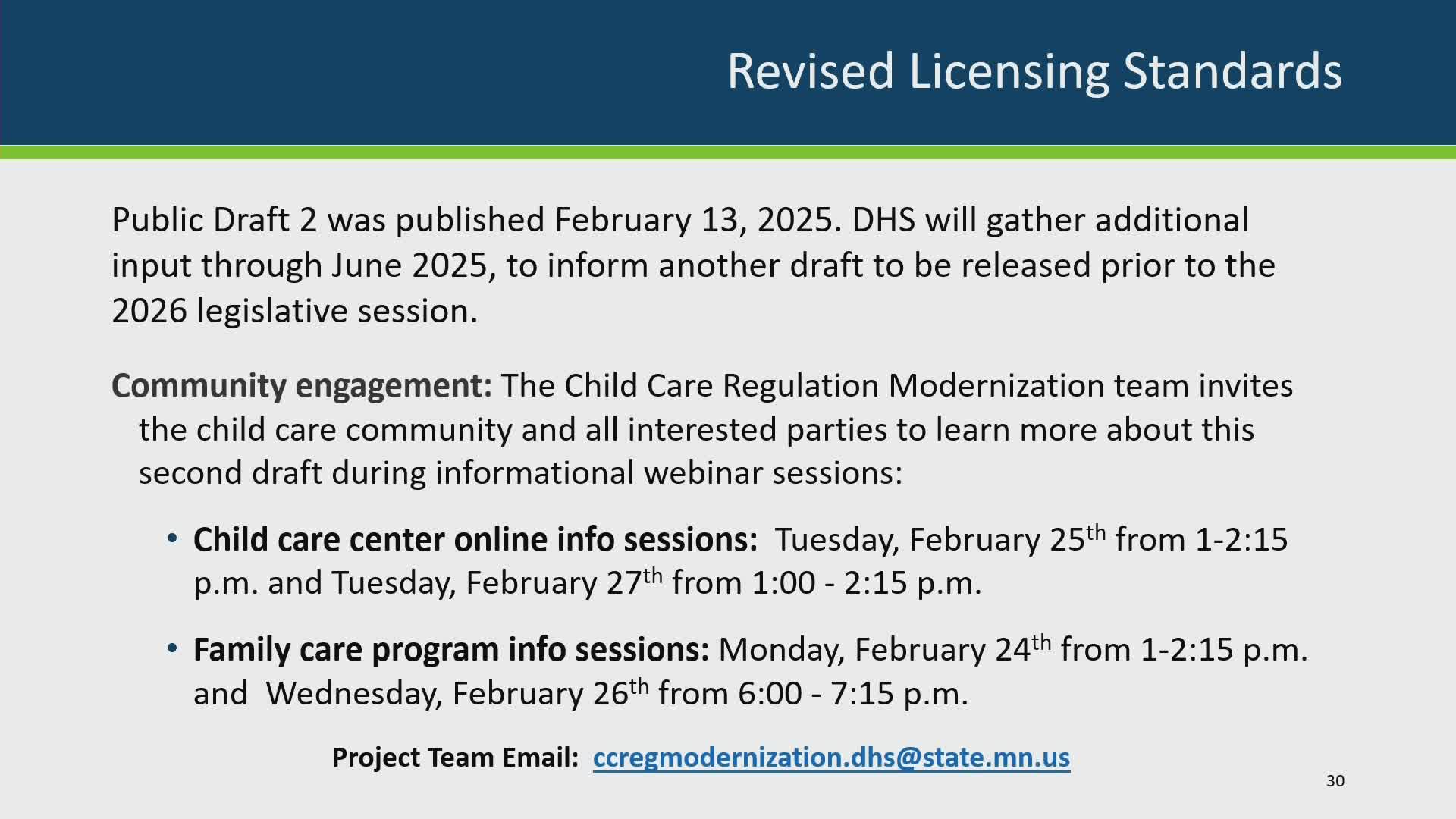
On the modernization project, Dodson described three major components: a weighted risk system (a tiered framework that scores standards by risk to children), abbreviated inspections for consistently compliant providers (shorter checklists focused on predictive indicators and high-risk rules) and revised licensing standards for family childcare that were developed with the National Association of Regulatory Administrators (NARA). Dodson said DHS released a second draft of the revised standards on Feb. 13 and plans more stakeholder engagement over the summer; a third draft will be released after affected staff transfer from DHS to the Department of Children, Youth, and Families (DCYF) in June and before the 2026 legislative session.
Committee members pressed DHS on verification of attendance when providers submit non‑electronic records, the conditions that trigger CCAP payment stoppage, how quickly program-integrity investigations can proceed and consistency in county-level enforcement in the delegated system. Dodson and Davis repeatedly told members that licensors document observations on site and refer discrepancies to program integrity, that payment withholds are used when investigations indicate fraud, and that DHS is working to improve county support, written guidance and interpretive materials to reduce inconsistent enforcement across counties.
Lawmakers also raised cost and capacity issues. Dodson said DHS has explored alternate licensing models (a Wilder Research report compared other states) and noted a “special family childcare” statutory model that allows multiple family‑childcare programs to operate in a single facility under one organizational umbrella. DHS officials said exploring small‑center or group childcare models and other resource‑sharing approaches is part of ongoing capacity work.
The committee’s meeting materials and presentations include additional operational details: family childcare programs are limited to 14 children under current rules; new centers receive four visits in their first year; fix-it tickets require correction within 48 hours; conditional licenses typically apply for one to two years and include extra monitoring; and temporary immediate suspensions have statutory timelines that may be complicated when parallel criminal or child-protection investigations continue beyond those timelines.
DHS and background-studies staff told the committee the department has paid fingerprinting and application costs for childcare background studies since October 2018. Davis said background-study checks for childcare under CCDF include multiple in-state and national checks and, when required, interstate checks and checks for minors living in provider households in specified circumstances.
The committee did not take formal legislative action during the hearing but asked DHS to provide written follow-ups. DHS officials said they will continue stakeholder engagement on the draft standards and procedural changes through the summer and will post further draft revisions prior to the 2026 session.
Votes at a glance: The committee approved the minutes from its Feb. 18 meeting by voice vote; Vice Chair Hanson moved approval and the motion carried.